Your Questions
Your Questions
Dr. Eppley, I have lower facial asymmetry that increased after advancement surgery for the lower jaw. My lower jaw was fixed in a tilted manner, which led to the displacement of the chin also. I want to fix it but I don’t now what is the best procedure. I found reviews about you, and I am hopeful you can help. Thank you.
A: Thank you for sending all of your pictures and x-rays. What they show, as you probably know, is that your lower facial asymmetry is due to the shape and position of the lower jaw. While the right side of the face is also smaller as you move up from the lower jaw, it is less so and is primarily due to the soft tissues.
Assuming that your prefer the left side of the face better (more full), the most effective approach would be a right jawline implant to build out the right side of the lower mandible that also wraps around the chin. This would create better symmetry and some increase in chin projection as well. There may also be a role for a small cheek implant combined with fat injections between the jawline and the cheeks to build out the soft tissue as well.
Dr. Barry Eppley
Indianapolis, Indiana
Q: Dr. Eppley, after a previous rhinoplasty procedure, all is well except that my nose leans to one side. If I apply pressure, my nose will be perfectly straight for a few seconds. I wonder if there’s some brace I can wear at night or internal splint or other option just for a slight straightening. Thanks.
A: Cartilage has memory so if that memory and position of the nasal structures did not get changed during the original rhinoplasty you can not manipulate it externally after surgery to do so. Nose cartilage is not like orthodontics where you can work out its memory. No internal or external device/splint will do so. Only a secondary or revisional rhinoplasty will work to actually changing the shape and position of the involved cartilages.
While there are devices out there that promote non-surgical rhinoplasties, they do not really work. They fall under the category of ‘hope lives eternal as for a few dollars many encouraged use them and see what happens. You may fall into that same category as well as there is no harm in using these nasal clip devices.
Dr. Barry Eppley
Indianapolis, Indiana
Q: Dr. Eppley, I had double jaw surgery three years ago to fix sleep apnea. But it caused some unwanted aesthetic changes. I saw a local plastic surgeon and he suggested the following after voicing my facial concerns;
1) Alar Base Reduction. I told him that my nose is wider now and he said it’s a side effect of the double jaw surgery. He said alar base reduction will fix it.
2) Chin Reduction. My chin seems too far forward and a little wide. He didn’t recommend reducing size of chin but he thought sliding it back would suffice. (reverse sliding genioplasty)
3) Lower Facelift. I told him my cheeks are quite saggy. This surgeon said lower facelift fixes saggy cheeks.
4) In addition, is it possible to add on nose tip reduction to all of the above and do together? Double jaw surgery also made my nose tip markedly bigger.
Thanks for your input. Just trying to get my face back to where it was before double jaw surgery.
A:In answer to managing the adverse soft tissue effects of double jaw surgery questions:
1) Nostril widening is very common after a LeFort 1 osteotomy due to the subperiosteal release of all midface muscle attachments to do the procedure. Nostril width reduction by Weir wedges will restore bialar width.
2) Chin reduction by a reverse sliding genioplasty is usually not a good idea. It will cause some increased submental fullness (it pushes back and down the attached submental tissues) and bony notch deformities along the interior border of the jawline. It will also keep the chin wide or make it wider. The more effective approach is a submental chin reduction by bony reshaping which can reduce both horizontal projection and width of the chin with a few far easier recovery.
3) A lower face lift addresses the jowls and neck but will not satisfactorily improve the cheeks. That requires a more direct cheek lift approach. Although I would have to see where you are seeing the cheek sagging.
4) Tip rhinoplasty can be done with any other combination of facial surgeries.
Dr. Barry Eppley
Indianapolis, Indiana
Q: Dr. Eppley, I had bone grafts done for my jaw angles about twenty years ago and they have really disappeared. I should have done jaw angle implants as they are permanent. Can you still do jaw angle implants if I had bone grafts placed there previously?
A: Having had prior bone grafts to the jaw angles does not preclude having jaw angle implants later. Onlay bone grafts always undergo irregular but near complete resorption. This has been a lesson learned in craniofacial surgery decades ago. Because the bone graft pushes out the biologic boundary of the bone and is not functionally loaded, it has no reason to persist so it largely resorbs over time.
But the prior placement of bone grafts and any asymmetry that they now cause to the jaw angle bone may indicate the need for custom made jaw angle implants to fit the irregular shape and surface of the bony angles. A 3D CT scan would be good idea to determine the shape and contours of your bony jaw angles now. That would help make the determination as to the best approach to your jaw angle augmentation needs now. By your history with the bone grafts, this would indicate that you only need a widening jaw angle implant approach.
Dr. Barry Eppley
Indianapolis, Indiana
Q: Dr. Eppley, I am interested in total jawline augmentation. I can show you the change that I am looking for when I jut my jaw down and forward as shown in the attached picture. Do you think this type of jawline change is possible?
A: In looking at your own prediction imaging by moving your jaw down and forward, it creates two artifacts that will not happen from a surgical procedure like a custom jawline implant for total jawline augmentation.
First, the depth of the labiomental fold will not be pushed forward or become more shallow. The depth of the labiomental fold can only be changed by bring the teeth forward (lower jaw advancement) not by any jawline implant augmentation. It sits above the level of the bony chin so any form of chin augmentation will not change it and may make it a bit deeper.
Second, the jaw angle area will be come more obvious or angular with implant augmentation. Jurtung the jaw forward actually blunts the jaw angles as they come down and forward. An implant will actually make the jaw angle more pronounced or stronger as your ideal pictures demonstrate.
I have attached an adjusted imaging picture which I think is more realistic of the actual result in profile view.
Dr. Barry Eppley
Indianapolis, Indiana
Q: Dr. Eppley, I have a custom midface implant procedure and canthoplasty done by you last year. The recovery went well and there hasn’t been any sign of infection. Immediately after the surgery i was very happy with the result. After my face became swollen and recovered the look was different as the lower portion of my cheek had swollen. I thought it was swelling and that it would subside but almost a year later its still prominent.
Although I had the infraorbital implant placed there is a large shelf like gap between my eye and implant which appears sunken. Last time we spoke you said the best approach would be tat grafting and retraction of the eyelids to address the drooping and hollowness.
I had fillers done to the undereyes which did help the hollowness up until the implant. The doctors said they could not place filler between the undereye implant and eyeball. Which leaves a large hollow gap.Besides from augmenting the implant is it possible to liposuction the lower cheek fat beside the philtrum? Whats the best solution the address the fullness?
A: Good hearing from you and thanks you for the long-term followup. As per the attached pictures one can see that the implant did exactly what it was designed to do. It added forward projection and fullness to the infraorbital-midface based on the areas of its design. Like all facial implants and surgery in general, it is never going to be perfect and it can not completely augment all areas of your non-skeletal deficiencies. What you are seeing now and asking about are those areas of imperfections that such an implant either creates or could not adequately treat.
In answer to your custom midface implant questions:
1) The fullness you see in the lower cheeks is the result of the implant pushing out the soft tissues. While this is an area that can be treated by microliposuction it is not very effective. It would make more sense to treat the basis of the aesthetic problem….remove the section of the implant beneath it and let the tissue fall back.
2) The gap between your eye and the implant is because the implant can only go so high particularly given that it was designed to be placed from an intraoral approach. (see attached picture with arrows) The issue is that the entire infraorbital rim needs to be elevated from the tear trough area out to the lateral orbital rim. Even if so done there will always be some sort of visible transition zone as your soft tissue anatomy is made for the underlying shape/volume of the bone. Fat injections is an option but its success would be based on how well the fat survives… which would be dubious in a young man with a high metabolism and a low percentage of body fat. Adding more implant through either ePTFE sheets or an implant ‘extension’ is another option of which lower eyelid approach would be needed. The other approach is to smooth out the implant over the lateral infraorbital rim/cheek so the transition is smoother/less obvious.
Dr. Barry Eppley
Indianapolis, Indiana
Q: Dr. Eppley, I am considering chin implant revision. I got an Implantech medium anatomical chin implant through a submental approach six months ago.
Before I list my questions/concerns, I would like to say I’m extremely happy with the way the implant looks and prefer to keep it than to remove it but the tightness on the right side of my lower lip is very bothersome. I received a few doses of Botox to see if it would relieve the tightness and it has but I’m afraid this is only masking the feeling and not really taking care of the problem. I would love to think it would solve the problem with the tightness but I know Botox is only a temporary fix. And I wouldn’t want to wait too much longer as I feel my nerve might be compressed and have some hope perhaps I could get some feeling back and relief of the tightness if I were to remove it. The reason I think I’m hopeful on my nerve having some feeling back is because when I stretch my mouth downward (as if I were yawning), I feel immediate relief. Also, when I push the right side of my lip outward with my tongue, I feel lots of tingling on my right lower lip as if there was still some nerve messaging going on there.
This is why I needed a second opinion on what I should do. I’ve heard of numbness sometimes being permanent but is this true with tightness as well? If I were to remove the chin implant, will the recovery be as when I put the implant in? Can tightness still be a problem even after removal? Does scar tissue cause problems after removal?
Thank you for your time and consideration as this has been an emotional rollercoaster for me. I don’t think I can go through a revision either as I have heard that those who have had it done usually opt to remove it anyhow due to other issues. I appreciate any guidance.
A: Thank you for supplying your additional information. The most important thing to know with your symptoms and considering a chin implant revision is what is the actual position of the implant on the bone. Is the implant placed symmetrically? Is an implant wing up against the mental nerve? Are your symptoms due to the implant position or just from the soft tissue alone? Your symptom description implies the former.
Tightness issues can be different than nerve issues but it is important to know where the implant is actually sitting on the bone which can only be obtained from a 3D CT scan. If you didn’t like the aesthetics of the chin implant then such a study would be irrelevant. But since you do, first establishing that the implant is in a good and symmetric position and its wight wing is not compressing up against the mental nerve would be a critical piece of information in how to proceed.
Dr. Barry Eppley
Indianapolis, Indiana
Q: Dr. Eppley, I am a middle-aged male and I recently noticed that I have bulging temporal arteries (can feel a pulse) on both temples, which look like squiggly worms from my ear arcing up to my (receding) hairline. These arteries are visible at rest but really ‘pop’ when I get hot, drink alcohol, or workout. I did not have these (or at least they were not noticeable enough) several months ago. I went to a Rheumatologist, who ruled out GCA/temporal arteritis. I am now exploring options to reduce the visibility of these, one of which is arterial ligation and I have a few questions:
1) In lieu of GCA/temporal arteritis, what causes the temporal artery to suddenly swell and become permanently visible (I’ve read about others who have experienced the same thing)?
2. How many of these temporal artery ligations have you performed? How many needed follow-up procedures?
3. My biggest fear by far with this procedure is damaging the facial nerve, which from pictures I’ve seen, runs extremely close to the temporal artery. I know plastic surgeons study where the nerves are but I assume the location of the facial nerve differs in everyone. Any damage to this nerve would becatastrophic and would be 100x worse than the bulging temporal arteries. How would you respond to this?
4. How do you ‘map’ these arteries to determine if there are ‘feeder branches’ that would circumvent the ligation – do you use some type of ultrasound?
5. Could ligating the temporal arteries cause the arteries that run from the eye to the hairline (or other facial arteries) to swell and turn into the ‘squiggly worms’ (I read about a guy who this happened to 3 years after he got a temporal artery ligation).
6. Which arteries would supply the scalp / forehead if the temporal arteries no longer function?
7. Does the temporal artery supply blood to anything else (besides the scalp / forehead)
8. How big are the incisions? \I’ve read that dissolving stitches leave a bigger scar than removable stitches – is this true?
9. Do you tie off the arteries or sever them? I read that you don’t drain them – how does that remove the bulging effect as the blood would be trapped within the temporal arteries (I picture a water balloon – you can tie off the end but all that does is trap the water in, making the balloon swell).
10. I assume it is local anesthesia, correct?
11. What is the recovery time? What is expected post-op as far as swelling / bruising / scarring / time until return to work / exercise / etc?
12. Do you perform this procedure on Saturdays for out-of-towners?
A: In answer to your temporal artery ligation questions:
- It is unknown.
- I have performed over 50 temporal artery ligation v]cases which has resulted in about 10% to 15% needing a touchup for additional ligations.
- The frontal branch of the facial nerve is not in the same areas as the ligation points
- Visual and digital assessment is the method used to map out the arterial patterns.
- This is not something I have seen. With multipoint ligation this risk is lowered significantly.
- There are many other arteries that supply the scalp.
- No.
- 5 to 6mms for the incisions size. Dissolveable sutures do not leave a bigger scar.
- The arteries are double tied but not cut. The blood is stripped between the ligation points to prevent postoperative bulging.
- Local anesthesia is correct.
- There is very minimal recovery time, no real recovery actually
- I only operate during the weekdays.
Dr. Barry Eppley
Indianapolis, Indiana
Q: Dr. Eppley, I had jaw surgery to correct my overbite and gummy smile which got fixed. I still however feel I have a long face and want to shorten it a bit even more. I feel as if my nose and chin are vertically too long and I would love to shorten and make them smaller. I would also like to add filler to my lips and cheeks to give me more width volume. I feel as if my chin reduction would be hard to do because I don’t need a lot and it would have to be precise to get a good result and not look odd or throw off any facial balance. My nose also is a bit droopy at base and long. I would like to shorten my nose from the bottom without it looking “piggy” and then add some upper lip filler to keep my philtrum still looking short and in balance. Do you think my picture results are realistic and do you think my genioplasty result could turn out the way I want it. You are probably the best at genioplasty as many doctors can’t seem to have nice feminine results when I see their after pics. What procedures would I need to get the “what I want” result in my pictures. What procedures would you recommend to give my face a more compact feminine look.
A: Thank you for your inquiry and sending your imaged pictures. What you are showing is a vertical reduction of the chin extending back into the jawline but not back all the way to the jaw angles. That could be done by two types of jawline reduction techniques, (intraoral vs submental) each with their own distinct advantages or disadvantages. While the submental approach is the ‘easiest’ method to do, needing just a little reduction (to quote you…although that looks at least 5mms reduction to me, maybe even 7mms) would suggest that the intraoral osteotomy method may be acceptable because it is scarless. Certainly the combination of chin reduction, rhinoplasty, and filler injection to the lips and cheeks can also be done at the same time for a comprehensive facial reshaping approach.
Dr. Barry Eppley
Indianapolis, Indiana
Q: Dr. Eppley, I am interested in facial reshaping surgery. I really don’t like my face and want to change pretty much everything like jaw/chin, browbone/forehead and nose. But the things I don’t like most is the chin/jawline, the nose and brow bone. I would like to have a bigger jaw and the chin and bottom lip to be pushed forward a bit. The small hump on my nose removed and to have a bit wider nose. And the brow bone I would like to be more prominent and cover my eyes more, something similar to what you did on a guy in one of the photos in the photo gallery on your website. And the forehead to be more square and straight. Do you think its to much, what would you change? How big are the risks of the end results looking weird? Is there a way to predict what i would look like without having to meet you personally and do a 3D facial scan?
A: Thank you for your inquiry and sending your facial reshaping pictures. Many of the changes you have indicated can be done (forehead/brow bone, nose, and jawline) but a few of those changes can not be accomplished. (lower lip coming forward which only happens with an advancement of the entire lower jaw since that is tooth-driven and the nasal widening with hump removal)
I have done some imaging looking at the following:
Forehead-Brow Bone Augmentation
Infraorbital-Cheek Augmentation (it wasn’t on your list)
Hump Reduction Rhinoplasty
Chin-Jawline Augmentation
The key about ‘not ending up looking weird or unnatural’ is based on the degree of facial changes being done. This becomes particularly relevant when multiple facial structures are being augmented.
Dr. Barry Eppley
Indianapolis, Indiana
Q: Dr. Eppley, Everything is going exactly as you described with my chin implant recovery and I love it. It’s been about 6 weeks since surgery and the numbness in my lip is almost entirely gone. The left side of the implant felt good right away. The right side of the implant took longer to settle in. Now both sides feel symmetrical and completely natural!
The only question I have is about the scar itself. How long does it take for the stitches to dissolve? I can still feel some stitches and there are some puss-filled bumps/abscesses along the scar. One spot in particular has been a little red/swollen and I’ve had to drain it a couple times. Please advise if I should do anything for this.
I haven’t shaved my beard yet since I’ve been waiting for the scar to heal. When I do, I will send you some pictures of my new chin.
Thank you again, Dr. Eppley.
A: Thank you for the followup and the good report. Such small suture abscesses are very common in the submental area of men after any chin procedure with beard hair. They are not due to the external dissolveable sutures (which go away in a few weeks but due to the internal dissolveable sutures which take much longer to go away. (months) Because of the hair follicles, these are the sutures that can create some stitch abscesses that you have developed. The one recurring stitch abscess is because the dissolveable suture is still there and infected and needs to come out for a complete resolution. The one method that can help solve it is to squeeze it like a pimple and see of you can force it out when it is at its most inflamed. That often will allow the knot of the suture to come out and then it will be a resolved issue.
Dr. Barry Eppley
Indianapolis, Indiana
Q: Dr. Eppley,I’d like your opionion on having a chin prejowl implant, or just a pre jowl sulcus implant. My concern is not the anterior projection of my chin, but the verical height. I think an implant that can add around 3 mm of vertical height below my chin, and widen or treat the prejowl area (maybe make it more square, as well) would be my best option. My goal with the implant is to disquise my double chin line underneath my chin (already treated with liposuction and Ulthera), and maybe to improve jowling if I have it. Of the off the shelf implants, what would be my best choice? Thank you very much!!
A: Thank you for your inquiry. If the vertical height is the main objective with your chin augmentation, with the addition of some squareness, no standard chin implant has those dimensions to make those changes. Certainly a chin prejowl implant can not accomplish those changes. That would require a custom chin implant design. In addition your neck should ideally be treated with a submentoplasty as your main problem now is the fat that lies below the muscle, that combined with some muscle tightening will take the results of the prior neck liposuction to another level of improvement.
Dr. Barry Eppley
Indianapolis, Indiana
Q: Dr. Eppley, I am interested in plagiocephaly surgery. I was wondering what procedure would be better to reshape the plagiocephaly of my head. I have seen that there is a procedure done in South Korea where they use bone cement to remodel the shape of the head. I was wondering what opinion you had about that procedure or the use of an implant. what are the pros and cons? I really appreciate it and thanks in advance Dr. Eppley.
A: A custom skull implant is almost always better than bone cement for almost any form of skull augmentation for the following reasons:
1) it can be put int through a smaller scalp incision,
2) it can cover a broader surface area in a smoother fashion,
3) the shape of the augmentation and all of its details is determined before surgery and is not left up to the ‘artistry’ and hands of the surgeon,
4) it has a much lower rate of revision due to inadequate augmentation, irregularities or visible implant edge transitions that are far more common with bone cements, and
5) it is very easily reversible if needed. A silicone skull implant be fairly easily removed.
Dr. Barry Eppley
Indianapolis, Indiana
Q: Dr. Eppley, I am interested in Chinese rhinoplasty surgery. I would like to schedule a consultation regarding the removal of a dorsal hump on my nose. I am Chinese and feel as though the bump does not look normal. I have attached side profile pictures for your assessment and recommendations.
A: Thank you for sending your pictures. In the Asian nose a dorsal hump often occurs because the radix (the height of the nose between the eyes) is low. Thus a pure hump reduction may make the nose look flatter and wider particularly in the frontal view. Conversely augmentation of the radix with less of a hump reduction keeps the nasal bridge higher and may create a better look. I have attached some imaging which shows the difference between these two different approaches to managing the nasal hump in the Asian or Chinese rhinoplasty patient. Consideration must be given to how the nose will look in the front view as well when taking down a nasal hump
Most Asian rhinoplasty surgeries are more about augmentation than they are about reduction of nasal heights. Bringing out the midface in general is often an overall facial goal.
Dr. Barry Eppley
Indianapolis, Indiana
Q: Dr. Eppley, I am interested in lip reduction surgery. However at rest my lips are parted and my mouth is open slightly. I’ve read this is normal but also have read that it may be minor lip incompetence. Would a lip reduction be contraindicated in this situation until I have the incompetence addressed? I’m worried about having my mouth look even more wide open and apart with a thinner upper lip and having to strain more to keep my lips together and mouth closed. I am planning to have a sliding genioplasty at some point. Is it best to wait on the lip reduction surgery until after the sliding genioplasty?
A: The answer to your lip questions is very straightforward:
1) Lip reduction, particularly upper and lower lip reduction, will exacerbate a lip incompetence issue.
2) A sliding genioplasty should absolutely precede any consideration of lip surgery.
That being said your description of your ‘lip incompetence’ seems questionable that it may really exist to any significant degree. Usually significant lip incompetence is associated with some degree of mentalis strain with underlying lack of adequate chin projection. But it would still be advised to have the chin procedure first before any lip surgery is done.
Dr. Barry Eppley
Indianapolis, Indiana
Q: Dr. Eppley, I am interested in breast implants but have some questions. I am 4′ 10″ tall and weight about 115 pounds and I’m currently a 34D. I don’t really want to go any bigger but I want implants to fill in the loose skin I have after having 3 children. (BTW you did tongue reconstruction surgery on my 19 year old son when he was 7 months old) Is there a way to get implants without making my breast much bigger? I feel like at my size if I go too big it just won’t look good at all.
A: While I would ideally have to see pictures of your breasts to provide an informed answer, adding implants to breasts that have loose skin and some sag to fill them out will, by definition, make them bigger. That postoperative outcome would be unavoidable…like filling up a deflated balloon so to speak. I suspect you are trying to fill out loose sagging breasts which is likely not a good strategy. Breast implants can not fill out a sagging breast nor can it lift them. Rather it will make the breasts look worse by pushing the sagging breast mound even lower. Sagging breasts usually need to be lifted first before any consideration of volume additions should be considered.
Dr. Barry Eppley
Indianapolis, Indiana
Q: Dr. Eppley, I do have a few questions concerning the lower third of my face which I hope you can answer.I am interested in perhaps vertically lengthening my chin since I think my chin and lower facial height is vertically deficient. If I understand correctly a sliding genioplasty is the best option for achieving vertical chin length. I am also hoping that the genioplasty can contour my chin to create a smoother transition from the chin to the jaw. My main concern regarding the sliding genioplasty is that I don’t want to add too much length since my jaw is quite narrow. I already have a narrow face and I think if I were to add a substantial amount of vertical length to my chin this would only serve to accentuate my narrow face. I would end up with a long, narrow face, which often does not look appealing.
My questions are:
1. Do you agree that my lower third + chin are indeed vertically deficient?
2. Do you think I could benefit from vertical chin lengthening?
3. Looking at my face, what facial type do I have (narrow, long and narrow, oval etc…)?
4. Looking at my pictures + x rays, do you think that my lower jaw width is indeed too narrow for my face?
4a. Follow up question… what is the ideal width of the mandible relative to the face (wider than the eyes, cheekbones, face)?
5. Will the sliding genioplasty create a longer, more narrow face?
6. Could you provide a bit of information about jaw implants and ramal augmentation (what material is used, infection risk, bone resorption, effects on soft tissue, long term risks/complications)?
Finally, a few things regarding my dental health. I have been told that I have a very thin biotype, in fact my periodontist told me I have some of the thinnest bone and gums he has ever seen. I have very little bone surrounding my lower incisors and from what I understand about the sliding genioplasty procedure, the incision is made very close to the lower incisors. I have also read about a case where the patient had significant gum recession following the sliding genioplasty procedure due to wound contraction. Is my thin biotype an issue when deciding whether I am a good candidate for the sliding genioplasty procedure?
Thank you,
A: In answer to your questions:
1) A sliding genioplasty is one method of vertical chin lengthening but not the only one. A custom made vertical lengthening chin implant can also be done and is the most assured method of a smooth transition from the chin to the jawline going back.
2) I do not have an opinion about your facial width or length. This is a matter of personal aesthetic judgment for which only you can truly answer that question. Ultimately that question is best answer by computer imaging so you can determine whether such lower facial changes are aesthetically advantageous.
3) Since I have not seen your intraoral anatomy or an x-ray of your jaw I can not comment on the state of your dental health and whether it would be adversely affected by an intraoral bony genioplasty. But the development of gingival recession from a sliding genioplasty is likely a reflection of surgical technique and is not a standard result from the procedure. It is not a postoperative finding I have ever seen.
Dr. Barry Eppley
Indianapolis, Indiana
Q: Dr. Eppley, I wanted to inquire about how you perform an upper lip reduction as I am looking to get this procedure done for my naturally full lip. There seems to be a lot of variability in the shape of excision that surgeons use – some do an ‘infinity loop’ or ‘bikini top’ shape (two ovals joined by a central band), others do a trapezoid shape, and still others simply say they remove an undefined “wedge of tissue”. I assume the shape of excision impacts the final outcome, so am confused as to why there is such variability, and what approach you take and why.
A: The shape of the excision pattern in lip reduction does not really affect the outcome significantly. Lip tissue is very stretchy, unlike skin, so any pattern of excision will end up in a straight line that largely parallels the vermilion-cutaneous border. The most common excision pattern in lip reduction surgery is a crescentic pattern that is wide in the midline and tapers to the sides.
One should not become overly focused on the excision pattern. What is more important for the outcome is where on the lip it is located. The key to a visible lip reduction result is the removal of exposed dry vermilion rather than the wet flexible mucous of the lip.
Dr. Barry Eppley
Indianapolis, Indiana
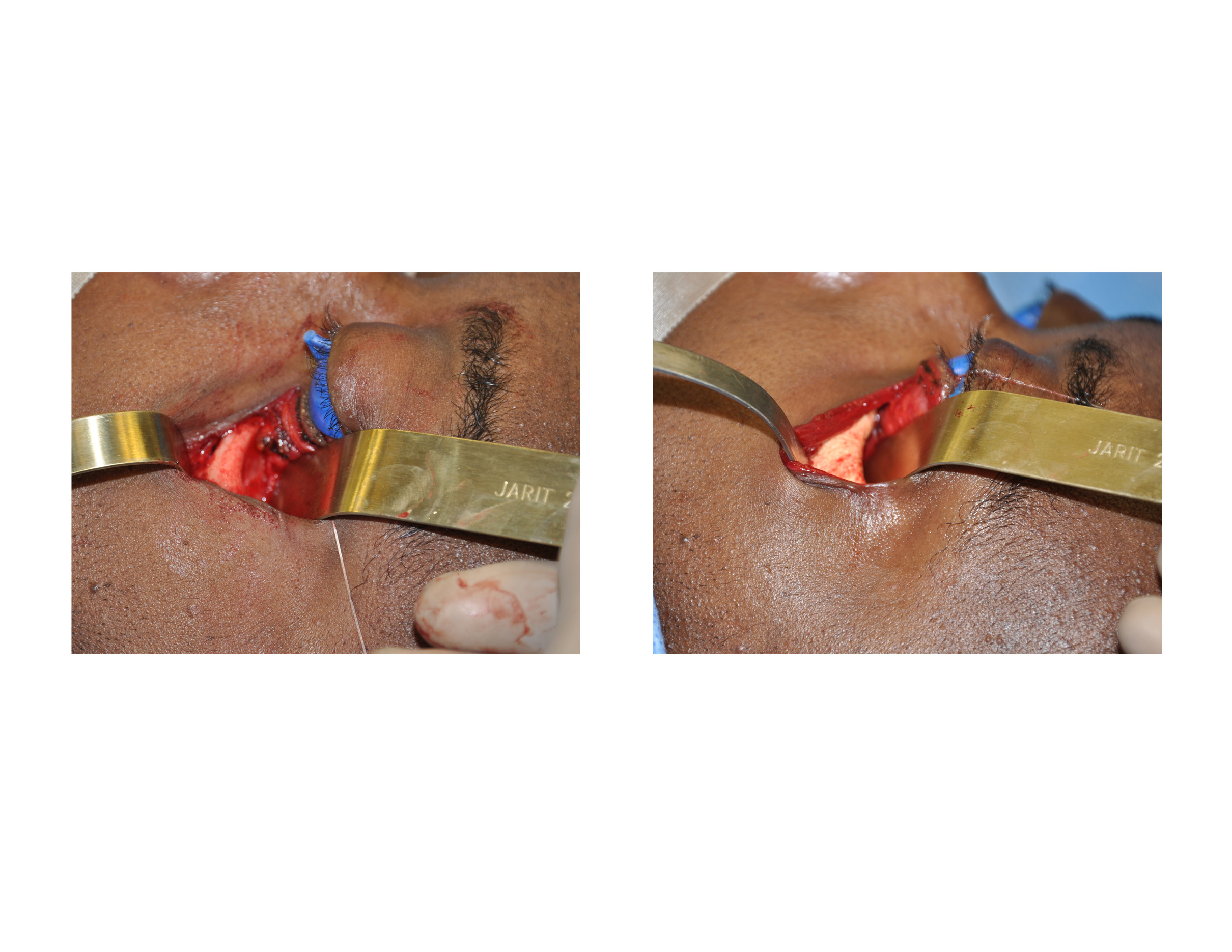
Q: Dr. Eppley, I have a few questions about an image on your website from an orbital asymmetry correction procedure which you performed years ago.
The image can still be found on your website, and is viewable from the link below:
My questions are about the blue medical “gauze” which was placed between the patient’s eyelids and globes to protect his vision during surgery.
1. What is the technical name of this blue medical protective gauze? Or is it an invention of yours?
2. What is it made of, in terms of materials?
3. How much irritation is caused by its contact with the cornea?
I am concerned because, as someone who wears contact lenses, I have experienced how easily irritated or even scratched the surface of the cornea can become simply by contact with an insufficiently lubricated contact lens, whose composition is already over 50% water and is specifically designed for contact with the cornea.
I’m sure some level of discomfort/irritation is expected, being that it is part of a surgical procedure, but in your experience do patients experience any severe levels of irritation or scratching of the cornea after contact with such a gauze? Is it lubricated or treated with an antibiotic in some way to prevent adverse effects?
Thank you for reading my questions. I suppose I am overly protective of my eyes..only have two of them after all.
A: The blue eye gauze to which you refer is not gauze at all. Those are devices known as. corneal protectors which are rigid plastic covers designed for the eye for protection during any form of periorbital surgery. Lubricating ointment is first placed in the eye and then the corneal protectors are placed which have already been lined with lubricating ointment. These corneal protectors are used injections all surgery around the eye for the express purpose of eye protection.
Dr. Barry Eppley
Indianapolis, Indiana
Q: Dr. Eppley, I am interested in a custom skull implant replacement. I am a patient of yours from 2014. You performed a successful skull implant surgery on me and I am extremely grateful. There certainly has been some improvement in my life – it usually takes a bit less time for me to get ready, etc. However, as I know that you offer 2 stages of the custom implant – one which entails using a spacer to enlarge the implant area, and I opted for the one-time only option, I was wondering if there is any ability to have a second surgery? I guess I am wondering if the first implant itself might have acted as a spacer of sorts, creating more room for a larger implant now? I truly don’t mean to sound vain or ungrateful, as the first implant surgery has absolutely helped! But I am still struggling more than I would like… I understand if this is not an option or simply a procedure you do not perform, but I thought it was worth asking before I gave up. I am not a body dysmorphic person or someone who will continue to seek the “next thing.” It’s really just that I am still relatively young, and with the efforts I am still having to make with my hair, to get ready, go swimming, etc, it makes me sad to think of spending the rest of my life this way. I was hoping to achieve (if possible) another few mm at the top and upper sides of my head. Thank you for your time, Dr. Eppley. I know you are very busy and I hope this email doesn’t find you rolling your eyes at someone who is ungrateful. Please know that is not the case.
A: Good to hear from you again. Your supposition that an indwelling scalp implant can act as a spacer or tissue expander is completely correct. A second skull implant (custom skull implant replacement) can be placed that is usually double the thickness of the first one (9 to 18mms in your case) as the scalp has had time to stretch and relax to accommodate its volume. Placing the second jmplant is usually a bit easier on the patient since much of the pocket (separating the scalp from the bone) has been done from the first surgery. As you may guessed, this is not the first time I have had this request so there is no eye rolling occurring. In reality this is just a different form of a two-stage skull augmentation approach…it just occurs over a longer period of time. And the good news is that I have not yet had anyone want to go on to a third skull implant.
Dr. Barry Eppley
Indianapolis, Indiana
Q: D. Eppley, I have some technical questions about custom jawline implants. The implant looks like solid silicone. Do you divide it in the midline for insertion? Do you use any screw fixation or just close the periosteum over these implants? Is your incision strictly transcutaneous or do you incorporate buccal incisions as well?
A: In answer to your questions:
1) All custom jawline implants require a three incision placement technique. (2 posterior vestibular and 1 anterior, submental or intraoral) It is a biggest facial implant that can be placed and requires multiple incisions to be inserted.
2) If the implant has large jaw angles, it needs to be divided in the midline and inserted in a posteroanterior approach to eliminate the risk of mental nerve injury. The key to a single for split custom jawline implant is the size of the jaw angles and how easily they can be folded during insertion.
3) If the implant has smaller jaw angles that can be easily folded it can be inserted as a single piece in an anteroposterior method.
4) The implants are placed in a completely subperiosteal pocket.
5) A three point microscrew (1.5mms) fixation is used at the chin and jaw angles.
Dr. Barry Eppley
Indianapolis, Indiana
Q: Dr. Eppley, I am interested in getting a second custom jawline implant. I should have listened to you with my first implant when I asked you to reduce in surgery the size of the implant. I regret that decision now two months after surgery as what I have now is too small. I would like to potentially proceed with the procedure, but I have some questions first
1. What are some potential risks of doing a revision?
2. Is the risk of infection higher?
3. Is the risk of the surgical wounds not healing higher?
4. Are there any extra risks with nerve damage?
5. Do you remove the screws from the previous implant or do you leave them in there?
6. How much would it cost to remove the revision implant, clean and reinsert if I was to get an infection? And when this does happen, what are usually the percent chances that an infection happens again?
7. What is the recovery like for the revision compared to the initial procedure?
8. Are there any permanent risks associated with doing a jaw implant or a jaw implant revision?
9. Would you consider a jaw implant revision easier or harder than on the surgeon compared to the initial procedure? And why?
10. Do you normally reopen the same wounds or create different wounds inside the mouth?
11. How long do you recommend waiting to let the initial wounds heal before doing a revision?
A: In answer to your custom jawline implant revision questions:
1) The surgical risks as identical to the first custom implant procedure as it is the same operation.
2) The risk of infection is the same as the first time.
3) The risk of intraoral wound dehiscence is the same as the first time.
4) No
5) The screws are removed as they have to be to remove the implant.
6) The risk of facial implant infection is around 2% to 3% every time one is inserted.
7) The recovery will be identical to the first time.
8) A custom jawline implant revision surgery incurs the identical risks as the first time, they are no higher or lower.
9) It is the same surgery so it is equally ‘hard or easy’ as the first time. This is not a surgery I would ever consider easy no matter how many times it is done.
10) The same incisions are used the second time as the first time.
11) I advise 3 to 4 months before proceeding with any secondary implant surgery.
Dr. Barry Eppley
Indianapolis, Indiana
Q: Dr. Eppley, I am interested in lip reduction surgery. In your experience, what is the revision rate for lip reductions done on natural (no foreign material) lips? One office I called gave an estimate of “1 in 4 (25%)”, which I think is shockingly high! What has your experience been, and what is the most common reason a revision is requested by patients?
Also does the lip’s overall shape change much with the surgery? I would like mine to be more M-shaped and curvy, as it’s currently lacking any definition. Or does that require a different procedure entirely?
Thanks.
A: The revisions rate for lip reduction at 25% to 33%, which I consider to be a very realistic and honest number, may seem shockingly high to you but that is the reality of doing aesthetic procedures on the lips. The most common reason for as revision is the desire for more reduction that can be achieved in a single procedure or some minor issues with the scar. In male lip reduction patients, which make up the majority of lip reduction procedures, I would put that revisions rate of 50% or higher. Young male face patients, of which my practice has an enormous experience, are the most challenging and particular of all aesthetic surgery patients.
A lip reduction is a debulking/volume changing procedure not a lip reshaping one. It can not or should one expect any shape change in their lips.
Dr. Barry Eppley
Indianapolis, Indiana
Q: Dr. Eppley, I had jaw surgery and genioplasty almost a year ago to correct my recessed upper and lower jaw, which was fairly successful. However I still have a few remaining issues. One being that I have pretty significant notching along my jaw line where the cuts were made (14mm advancement). I also need to add length and width to my ramus. I figure I would have to go the custom route due to the asymmetry I have and large notching from my sagittal split jaw osteotomy.
A: Deformities of the mandibular ramus are not uncommon after sagittal splits osteotomies particularly large advancements. By your description a custom jaw angle implant would have the best success rate insect cases of jaw asymmetry. The first place to start is to send me some pictures of your face for my assessment and I will have my assistant contact you to schedule a virtual consultation time. Ultimately a 3D CT scan will be needed to not only show the anatomy but it designing the custom jaw angle implants for insertion. The 3D Ct scan can be done where you live and I can place the order for it.
Dr. Barry Eppley
Indianapolis Indiana
Q: Dr. Eppley, , I am interested in doing a scrotal lift procedure. I am 32 years old and I have family genetics with large scrotums unfortunately. I want to know the risks for having this procedure.
A: The scrotal lift is am aesthetic genital procedure that tightens and lifts the scrotal sac through a midline excision of tissue along the raphe. Such a reduction lifts the lower edge of the scrotum by a wide removal of scrotal skin and deeper tissues that raises the level of the bottom hang of the scrotum. It leaves a fine line scar that often looks just like the raphe itself. The scar is really the only ‘risk’ of a scrotal lift other than standard ones like infection or hematoma which are very rare in this type of surgery. Because the tissue excision is in the midline it has no impact on the function or position of the testicles which are to the side of the midline
.The aesthetic ‘risk’ is the outcome of the procedure which is obviously important. There is always the question of whether the degree of improvement (reduction and lift) meets the aesthetic expectation of the patient. In my experience it is a highly satisfying procedure and the revision rate is very low.
Dr. Barry Eppley
Indianapolis, Indiana
Q: Dr. Eppley, Thank you for all the info you generously gave me on midface implants. I came across this image on your website. I wonder if it’s a combination of premaxillary implant and cheek implant. In addition, I feel a bit nervous about having this surgery. It seems like you are the only doctor who talks about it. When I look up premaxillary implant, there is a poor amount of info found on Google and all that info are written by you. I found absolutely nothing else other than the posts you wrote, not the info nor any before-and-after photos. I tried to search in a different language too but nothing. Other doctors seem to work on only cheek implants. Did you ‘invent’ this surgery? Or does this surgery go by another name? Or is it just that this surgery isn’t popular?
I honestly feel weird about this and feel more anxious when no info can be found on the internet. On one hand I really want to improve my appearance, on the other hand, I can’t just have a surgery if i don’t feel well-informed. Is there anything about this you can tell me?
A: The custom implant image to which you refer is a total midface implant that covers the paranasal, premaxillary, anterior cheek and infraorbital rim areas. Implant augmentation of the base of the nose (premaxillary-paranasal region) has been around for decades. It is not ‘popular’ because it is not commonly requested and almost all surgeons have no experience with it. In my experience midface implants have moved beyond trying to use various implant materials not specifically designed for it to try and make it work. The use of custom implants designed and fabricated from the patient’s 3D CT scan allows for midface augmentation results around the nose that have previously been unattainable in any other reliable way.
Dr. Barry Eppley
Indianapolis, Indiana
Q: Dr. Eppley, regarding jaw angle reduction or removal (traditional jaw angle amputation) where the surgeon cuts off the jaw angle at the mandibular ramus. Will the masseter muscle also be cut? (looks like the masseter muscle covers this area of the bone) If the masseter muscle gets cut, then what will happen and what will be the potential consequence?
A: In jaw angle reduction surgery the masseter muscle is first lifted off the bone through subperiosteal dissection. Then the bone is cut and the muscle falls back into place during closure. Thus no muscle is cut unlike that of the bone.
While no muscle is cut during jaw angle reduction surgery, the muscle will retract upwards to the new lower border of the jaw angle when it is amputated or removed in an oblique full thickness bone cut fashion. This does not affect its function or mouth opening/closing. But between the bone removal and muscle retraction the shape and support of the soft tissues will change over the angle area. Facial width will definitely be less and hopefully there will be no soft tissue sag as a result.
Dr. Barry Eppley
Indianapolis, Indiana
Q: Dr. Eppley, I wrote to you before about my chin implant removal problem but I wanted to wait a little bit more to have a surgery. I am 22 years old and had a bad chin implant surgery six months ago. The chin implant was the extended anatomical type, Implantech brand, small size 5.5mm. The incision was submental and implant stayed in only 2 days and was removed due to not liking it at all. It was a big mistake for my face. Its been is months and even though it improved with time, its not exactly how it was before both the shape and size of my chin. My chin is wider, longer, and bigger than before and it feels squashy inside and not tight as before. But now I see that,my jaw is also larger. My jaw was never touched in the surgery but somehow it effected it too. My jaw is obviously larger than before and its square. My jaw used to be V shaped and my face is now more square. My lower face looks heavier and not lifted. What can be the reason for my jaw to be larger? Is there a solution for that? Since you are one of the most qualified chin surgeons in the world, i thought maybe you know why and maybe you have seen something like that before. I am sending my pictures. Thank you so much.
A: I do remember your chin implant removal case and patients have come forth before with similar findings. While not common it results from the tissues being lifted off the bone for implant placement and they never reattach like they were before the implant. It should not have affected your jawline per se since those tissues were not lifted off of the bone as the wings of the implant does not go back that far. But that is the effect of the tissues along the chin and backward having an inferior descent creating the change the shape your jawline from the front.
Options for improvement are either a submental chin tuck, a jowl tuck up or a combination of both.
Dr. Barry Eppley
Indianapolis, Indiana
Q: Dr. Eppley, I am a 30 year old male and have been debating about a skull reshaping procedure for the past five years. Attached are some profile pictures of my head shape and two pictures of my expectations. I was hoping to round out the back of my skull and shape it in a way that makes my jaw line more prominent/visually appealing. I’m sitting here wondering about the following factors:
1) Are my expectations reasonable/attainable?
2) Am I even a good candidate for this?
3) Is the scarring blatantly noticeable?
4) Will altering the back to improve the profile affect the frontal view (eg…head on)?
A: Thank you for your inquiry and sending your pictures. In answer to your skull reshaping questions:
1) The morphed images of the back of your head are fairly realistic, being able to achieve 80% to 90% of that change as a one stage skull augmentation procedure.
2) One is a good candidate for this surgery if their expectations are in line with what can realistically be achieved.
3) The implant is placed through a small horizontal incision low in the occipital region. This is a scar that is barely detectable without hair and undetectable with hair.
4) Changing the back of the head will have no effect on the front of the head/face.
Dr. Barry Eppley
Indianapolis, Indiana
Q: Dr. Eppley, I thank you for your pre surgery notes in relation to the psychological effects of living with a new jawline implant have become apparent this weekend. I think the initial panic set in and I’ve had to take a step back and think about your comments again. I think the initial feeling is that the implant is way to big – but again I’ve taken onboard your comments around swelling and the amount of time that should be allocated to allow this to subside. Aside from this I’d like to ask a few questions:
1) Can you advise how long I should wait to shave the area under the chin – where the stitches are placed (these dissolve naturally right?)
2) Will I have a noticeable scar from the skin were the stitches are?
3) If after a number of weeks the implant still looks out of proportion and I decide to have it removed what are the implications? Would the current implant cause a permanent change to my facial features?
4) How quickly could we move from making the decision to remove the implant to actually removing it ? (i’m not suggesting this at this point, I’d just like to understand the process)
A: in answer to your custom jawline implant recovery questions:
1) It is important to realize that you are just less than 4 days after your surgery…when things look their worse. A lot will change in the next 2 to 3 weeks when you will feel much more comfortable with the way your face will look.
2) Having done hundreds of custom jawline implants there is no way this design would ever be considered too big. Conversely, in a month or so you will likely feel the other way….thinking maybe I should have gone a bit bigger.
3) You may shave under the chin at 7 to 10 days after surgery.
4) Implant removal will likely have no adverse effects on your preoperative facial shape, particularly when it is this small size.
5) Any removal of the implant before 8 weeks after surgery, when you have had time to fully see the actual facial changes and adjust to them, would be capricious.
6) Implant removal could happen within a week if one decides to do so.
Dr. Barry Eppley
Indianapolis, Indiana