Body Contouring After Weight Loss
Body Contouring after Weight Loss Procedures
The Journey Isn’t Over Yet
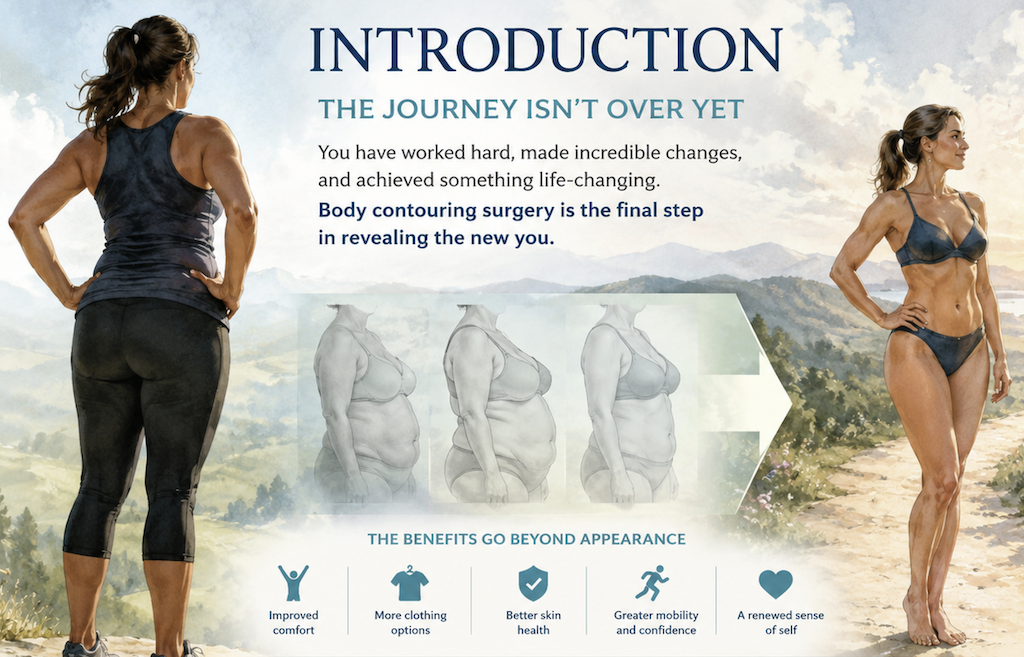
You have made remarkable changes in your body—and in your life. Losing a significant amount of weight requires determination, sacrifice, discipline, and faith in yourself. You have worked hard to reach this point, and you should take pride in what you have accomplished. Whether you have lost 75 pounds or more than 150 pounds, you have already achieved something that few people ever do.
The health benefits of major weight loss are undeniable. Many people experience dramatic improvements in conditions such as diabetes, high blood pressure, sleep apnea, and joint pain. Increased energy, improved mobility, and a renewed sense of confidence often accompany these physical changes.
Yet for many people, weight loss creates a new challenge.
After the fat is gone, the skin often remains. Large folds of loose skin can develop from the neck to the knees, creating physical discomfort, skin irritation, hygiene problems, limitations in clothing choices, and persistent self-consciousness. Despite achieving a healthier body weight, many patients find that the body they worked so hard to create is still hidden beneath excess skin.
Unfortunately, no amount of additional dieting, exercise, or determination can restore skin that has permanently lost its elasticity. Once significant skin stretching has occurred, surgery is the only effective treatment.
This is where body contouring surgery becomes the final step in the weight-loss journey.
Body contouring surgery is designed to remove excess skin, restore body shape, and improve body proportions after massive weight loss. It is not about losing more weight—it is about allowing your new body to finally reflect the success you have already achieved.
As a plastic surgeon who has treated hundreds of patients following massive weight loss, I have seen firsthand how transformative these procedures can be. Body contouring surgery not only changes appearance, but often restores confidence, expands clothing options, improves comfort during everyday activities, and provides a sense of completion after years of hard work.
A wide range of procedures may be used to reshape the body, including:
- Abdominoplasty (tummy tuck)
- Circumferential body lift
- Brachioplasty (arm lift)
- Breast lift, augmentation, or reduction
- Thigh lift
- Buttock lift
- Liposuction
- Face and neck lift
Over the past two decades, body contouring surgery has evolved tremendously. Surgical techniques have become safer, more refined, and better suited to the unique needs of patients who have experienced massive weight loss. Today, these procedures can produce dramatic improvements while maintaining realistic expectations about recovery, scars, and long-term results.
If you are considering body contouring surgery, you probably have many questions.
Am I a good candidate?
When is the right time after weight loss to have surgery?
Which procedures should I choose?
Can multiple procedures be performed together?
What should I expect during recovery?
This book was written to answer those questions. My goal is to help you understand your options, make informed decisions, and prepare for the final stage of your transformation. The journey to a healthier life did not end when you reached your goal weight. For many patients, body contouring surgery is the final step in creating a body that reflects the extraordinary accomplishment they have already achieved.
Why Does My Skin Sag?
One of the most common—and often most unexpected—consequences of massive weight loss is loose, sagging skin. Whether the weight loss occurs through diet and exercise, bariatric surgery, or weight-loss medications, losing 75 to 100 pounds or more almost always leaves behind excess skin. While this may come as a surprise to some patients, it is actually a predictable consequence of significant weight loss.
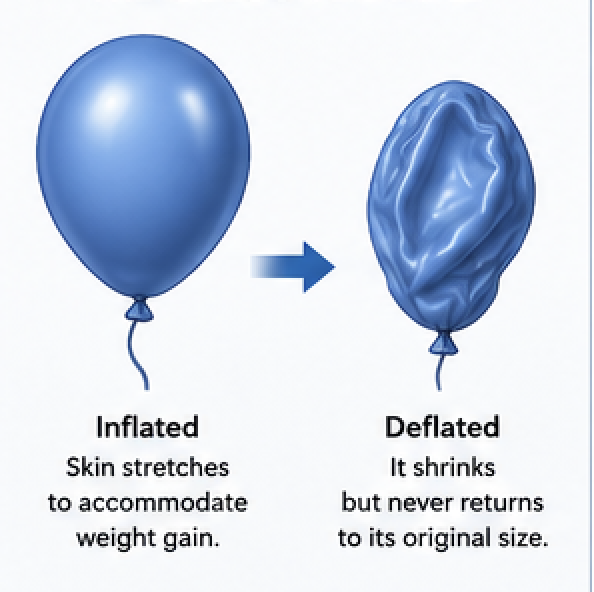 Think of your skin as a balloon. When a balloon is inflated for a long period of time, it stretches. Once the air is released, it shrinks somewhat but never completely returns to its original size. The same principle applies to skin after prolonged obesity.
There are two primary reasons why this happens.
The first is that skin actually grows as the body enlarges. As weight gradually increases, the skin must expand to accommodate the growing volume beneath it. Plastic surgeons routinely take advantage of this biological property through a technique called tissue expansion, in which healthy skin is slowly stretched to create additional skin for reconstructive procedures. The skin responds to chronic stretching by producing more surface area—it does not simply become thinner.
The second reason is the loss of skin elasticity. Healthy skin contains collagen and elastic fibers that allow it to stretch and recoil. When these fibers are stretched beyond their natural limits over many years, they become permanently damaged. Like an overstretched rubber band that has lost its snap, the skin can no longer contract effectively after the underlying fat disappears.
The combination of extra skin and permanently reduced elasticity is what creates the loose folds of skin that remain after major weight loss.
Several factors influence how much loose skin develops, including:
- The total amount of weight lost
- How long the excess weight was present
- How quickly the weight was lost
- Age
- Skin quality and genetics
- Smoking history
- Previous pregnancies
In general, patients who lose larger amounts of weight over a shorter period, are older, have thinner or sun-damaged skin, or have a history of smoking tend to develop more significant skin laxity.
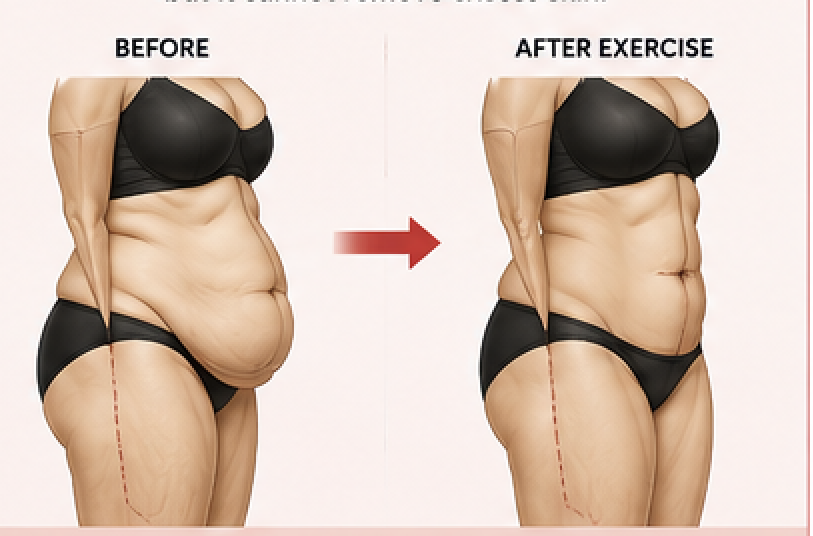 Unfortunately, there is no cream, exercise program, laser treatment, or nutritional supplement that can restore skin that has permanently lost its elasticity. Building muscle may improve body contours slightly, but it cannot eliminate excess skin.
For patients with mild skin laxity, the appearance may improve modestly over six to twelve months after weight loss stabilizes. However, once the skin has been permanently stretched, there is a limit to how much natural tightening can occur.
The only reliable treatment for significant excess skin is surgical removal.
Body contouring surgery removes the excess skin and reshapes the remaining tissues to better fit your new body. Although these procedures leave scars, they replace loose, hanging skin with a smoother, more proportionate body contour. For most patients, this trade-off is well worth it.
It is also important to understand that surgery cannot restore the skin to the way it looked before weight gain. Stretch marks that remain outside the areas of skin removal will still be present, and all skin naturally relaxes somewhat over time. Nevertheless, the improvement achieved through body contouring surgery is usually dramatic and long-lasting, allowing the outside of your body to more accurately reflect the remarkable transformation that has already occurred on the inside.
Key Takeaways
“Loose skin is not a failure – It is a normal result of a transformed life. Surgery is the final step in completing your journey.”
- Loose skin is a normal consequence of major weight loss.
- Skin sags because it has expanded and permanently lost elasticity.
- Age, genetics, smoking, and the amount of weight lost all influence how much excess skin develops.
- No non-surgical treatment can remove significant excess skin.
- Body contouring surgery remains the only predictable and effective treatment for moderate to severe skin laxity.
What Is Body Contouring Surgery?
After significant weight loss, many patients discover that reaching their goal weight is only part of the journey. While the fat is gone, excess skin often remains, creating a body shape that no longer reflects the tremendous accomplishment of losing the weight.
Body contouring surgery is designed to address this problem.
Rather than helping you lose additional weight, body contouring surgery removes excess skin and reshapes the underlying tissues to restore more natural body contours. The goal is to create a body that better matches your healthier weight while improving comfort, function, clothing fit, and self-confidence.
For many patients, excess skin is more than a cosmetic concern. Large folds of skin can interfere with exercise, trap moisture that leads to skin irritation and rashes, make finding properly fitting clothes difficult, and create a constant reminder of the body they worked so hard to change. Body contouring surgery addresses these physical and emotional challenges by removing the excess tissue that cannot be improved through diet or exercise.
Every body contouring procedure is based on the same fundamental principle: removing excess skin and tightening what remains.
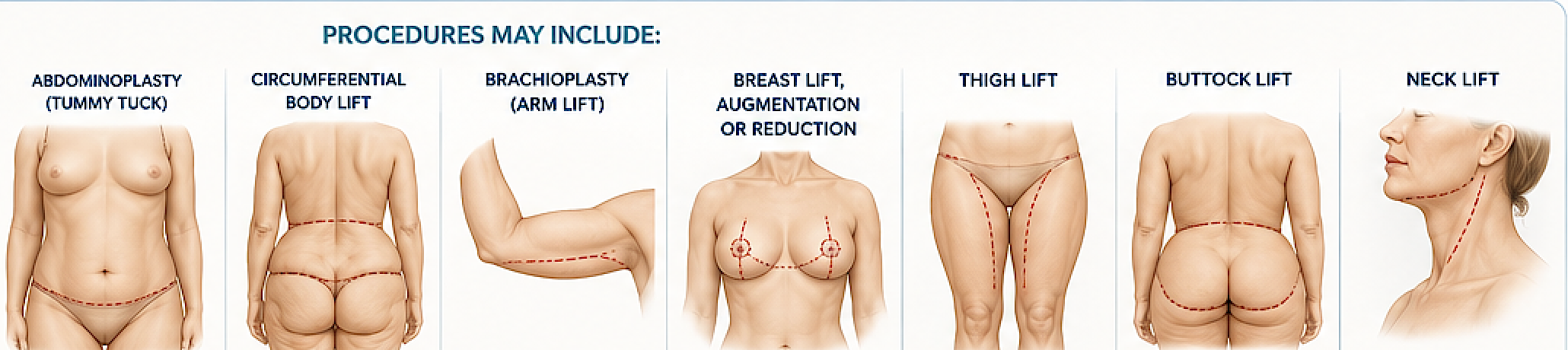
Depending on the areas involved, body contouring surgery may include procedures such as:
- Abdominoplasty (tummy tuck)
- Circumferential body lift
- Brachioplasty (arm lift)
- Breast lift, augmentation, or reduction
- Thigh lift
- Buttock lift
- Back lift
- Neck lift
Liposuction is often associated with body contouring, but it plays a much smaller role than many patients expect. Liposuction removes fat—it does not remove loose skin. While it may occasionally be used to improve contour or reduce localized fat deposits, the defining feature of body contouring surgery is skin removal, not fat removal.
One of the most important concepts to understand is that body contouring surgery is not weight-loss surgery. The amount of tissue removed may appear dramatic, but surprisingly little of it is actual weight. Loose skin occupies a large volume while weighing much less than most patients expect. The true benefit of body contouring surgery is not the number of pounds removed, but the improvement in body shape and proportion.
Every surgical procedure involves a trade-off.
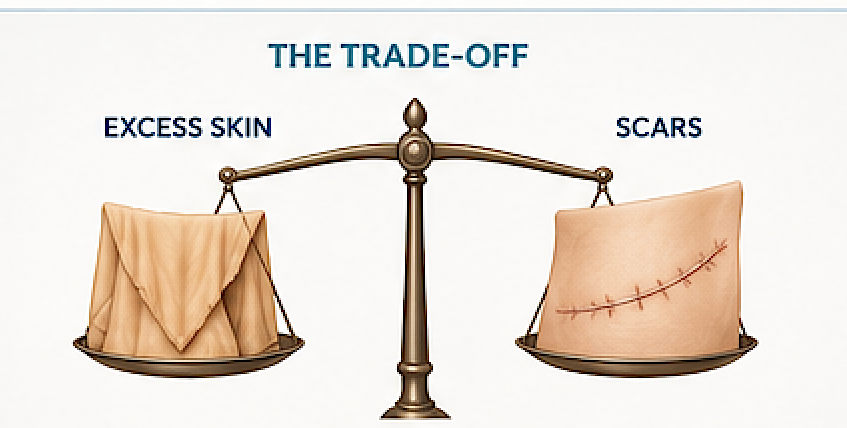 With body contouring surgery, that trade-off is replacing loose, hanging skin with permanent scars. These scars can be extensive, depending on the procedures performed, and they are an unavoidable part of achieving meaningful improvement. Fortunately, most patients view their scars as a worthwhile exchange for the comfort, confidence, and freedom that come with eliminating excess skin.
Unlike traditional cosmetic body contouring performed in patients with minimal skin laxity, post-weight-loss body contouring is fundamentally reconstructive in nature. The objective is not to create perfection but to restore proportion, improve function, and help your appearance reflect the healthier person you have become.
While no operation can restore the body exactly to the way it looked before weight gain, body contouring surgery can produce dramatic, life-changing improvements. For many patients, it represents the final chapter in a remarkable transformation.
Key Takeaways
“Body contouring surgery is fundamentally reconstructive for the post-weight-loss patient.”
- Body contouring surgery reshapes the body after major weight loss.
- The primary goal is removing excess skin—not additional weight.
- Liposuction is only a supplemental procedure in most body contouring operations.
- Permanent scars are the necessary trade-off for meaningful improvement.
- Body contouring surgery restores body shape, comfort, function, and confidence after weight loss.
Am I a Good Candidate for Body Contouring Surgery?
One of the first questions patients ask is whether they are a good candidate for body contouring surgery. While almost anyone with excess skin after major weight loss can technically undergo these procedures, the more important question is whether the surgery can be performed safely and produce the best possible result.
Successful body contouring surgery depends on much more than the amount of loose skin you have. It also depends on your overall health, nutritional status, weight stability, and readiness for recovery.
In my experience, the best candidates share several important characteristics.
Good Overall Health
Body contouring procedures are among the largest operations performed in plastic surgery. Unlike smaller cosmetic procedures, they place significant demands on the body’s ability to heal. Good general health is therefore the most important requirement.
Before surgery, you should:
- Feel healthy and physically active.
- Have any chronic medical conditions well controlled.
- Be free of significant nutritional deficiencies.
- Be medically cleared by your primary physician or bariatric surgeon when appropriate.
Patients who have undergone bariatric surgery should also be evaluated for vitamin, mineral, and protein deficiencies before considering major body contouring procedures. Proper nutrition is essential for wound healing.
A Stable Weight
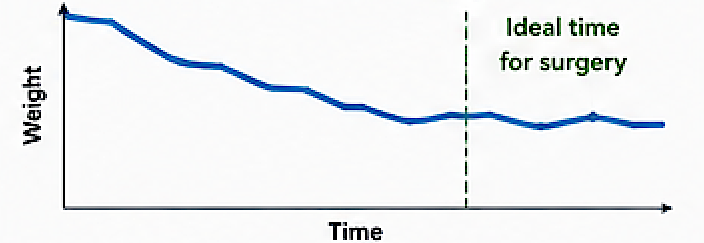
One of the biggest mistakes patients can make is pursuing body contouring surgery before their weight has stabilized.
Ideally, your weight should remain relatively unchanged for at least six months before surgery. Stable weight indicates that your body has adapted to its new metabolic state and that you are more likely to maintain your long-term results.
If significant weight loss continues after surgery, additional skin laxity may develop and reduce the quality of your outcome.
An Appropriate Body Mass Index (BMI)
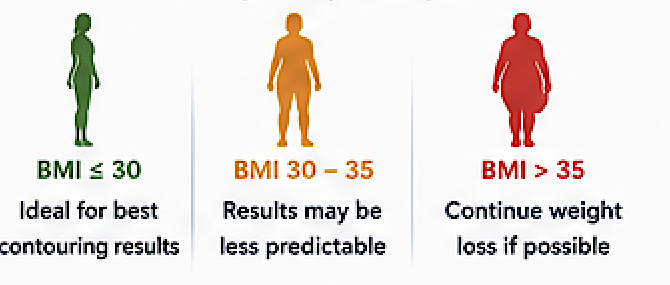
Body contouring surgery is most effective after you have reached, or come very close to, your long-term weight goal.
Although there is no absolute BMI cutoff, patients with a BMI of 30 or less generally achieve the best contouring results. Patients with higher BMIs often still have a substantial layer of fat beneath the skin, making it more difficult to achieve meaningful reshaping.
For patients with BMIs above 35, I generally recommend continuing weight loss before undertaking extensive procedures such as body lifts or thigh lifts. An exception may be a panniculectomy performed primarily to relieve symptoms caused by a large abdominal overhang.
Nutritional Readiness
Weight loss—particularly following bariatric surgery—can result in protein, vitamin, and mineral deficiencies that may not produce obvious symptoms but can significantly affect healing.
Laboratory testing before surgery commonly evaluates:
- Blood counts
- Protein levels
- Electrolytes
- Iron
- Vitamin levels when indicated
Correcting nutritional deficiencies before surgery greatly improves healing and reduces the risk of complications.
Emotional Readiness
Body contouring surgery can be life-changing, but it is not a cure for every concern related to body image.
The best candidates understand that surgery will improve body shape, not create perfection. They appreciate that scars are part of the process and recognize that recovery requires patience and commitment.
Realistic expectations are just as important as good health.
Financial Preparedness
Most body contouring procedures are considered elective and are not covered by health insurance. Although certain procedures, such as panniculectomy, may occasionally qualify for insurance coverage because of documented medical problems, the majority of patients should expect to pay for surgery themselves.
Understanding the financial commitment before beginning the process helps avoid unnecessary stress and disappointment.
The Ideal Candidate
The ideal body contouring patient is someone who:
- Has reached a stable weight.
- Is in good overall health.
- Has good nutritional status.
- Does not smoke or is willing to stop smoking.
- Has realistic expectations.
- Understands the recovery process.
- Is emotionally and financially prepared for surgery.
When these factors come together, body contouring surgery can safely produce dramatic improvements in comfort, body shape, function, and confidence.
Key Takeaways
“Health—not loose skin—is the primary determinant of candidacy”
“The three major determinants of candidacy: health, weight stability, and realistic expectations”
- Good health is more important than the amount of excess skin.
- Stable weight for at least six months improves long-term results.
- A BMI of approximately 30 or lower generally produces the best contouring outcomes.
- Good nutrition is essential for proper healing.
- Successful patients have realistic expectations and are prepared for recovery, scars, and the financial commitment of surgery.
How Long After Weight Loss Can I Have Surgery?
One of the most common questions patients ask is, “When is the right time to have body contouring surgery?”
The answer is surprisingly simple.
The best time is when your body is ready—not when the calendar says it should be.
While there is no single waiting period that applies to everyone, several important milestones should be reached before considering surgery. Meeting these milestones helps minimize complications, improves healing, and produces more predictable long-term results.
Your Weight Should Be Stable
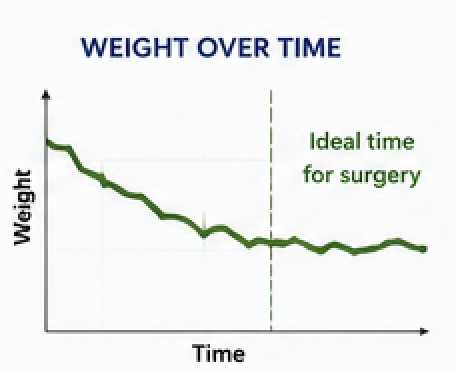
The single most important factor is weight stability.
In general, your weight should remain relatively unchanged for at least six months before surgery. Stable weight indicates that your body has adapted to its new metabolic state and that you are more likely to maintain your weight loss results.
Continuing to lose a significant amount of weight after body contouring surgery may create new areas of loose skin and diminish the improvements achieved through surgery.
You Should Have Reached Your Goal Weight
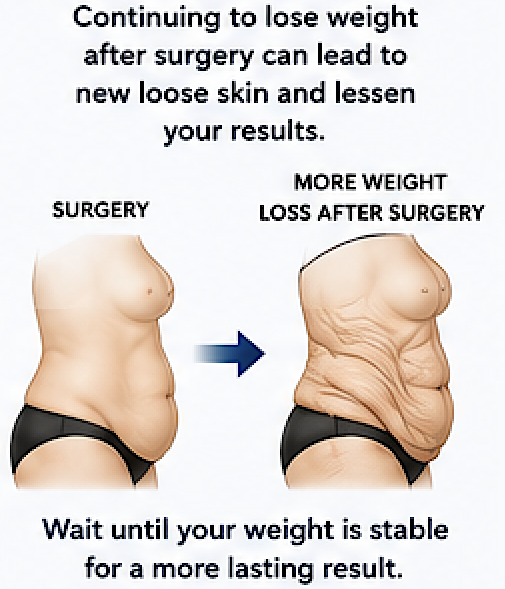
Ideally, body contouring surgery should be performed after you have reached, or come very close to, your long-term weight goal.
Patients sometimes become anxious to remove excess skin before finishing their weight-loss journey because the loose tissue can interfere with exercise, clothing, and self-confidence. While these frustrations are understandable, waiting until your weight has stabilized almost always leads to a better and more lasting result.
Recovery from Bariatric Surgery
For patients who have undergone bariatric surgery, most body contouring procedures are performed 12 to 18 months after the operation.
This waiting period allows:
- Weight loss to slow or stabilize.
- Nutritional deficiencies to be identified and corrected.
- The body to adapt to its new metabolic state.
- Overall health to improve before major reconstructive surgery.
Some patients may be ready sooner, while others may require additional time. The decision should be based on your overall health rather than the number of months since surgery.
Nutrition Comes First
After significant weight loss—especially following bariatric surgery—protein, vitamin, and mineral deficiencies are common.
Before body contouring surgery, your nutritional status should be carefully evaluated. Adequate protein intake and correction of any vitamin or mineral deficiencies are essential for proper wound healing and recovery.
Healthy tissue heals better than malnourished tissue.
Medical Conditions Should Be Optimized
Conditions such as diabetes, hypertension, heart disease, or sleep apnea should be well controlled before surgery.
Smoking or nicotine use should also be discontinued well in advance of surgery, as nicotine significantly increases the risk of wound-healing problems and skin loss.
Don’t Rush the Process
It is understandable to want excess skin removed as soon as possible. After all, it serves as a constant reminder of your previous weight.
However, body contouring surgery is the final stage of your transformation—not the next stage of your weight loss.
Allowing your body sufficient time to recover, stabilize, and optimize its nutritional health gives you the greatest opportunity for a safe operation and a lasting result.
In my experience, patients who wait until they are truly ready are almost always happier with both their recovery and their final outcome.
Key Takeaways
“The body—not the calendar—determines when surgery should be done.”
- The best time for body contouring surgery is when your body—not the calendar—is ready.
- Weight should be stable for approximately six months before surgery.
- Most bariatric patients undergo body contouring 12 to 18 months after weight-loss surgery.
- Good nutrition and stable health are essential for proper healing.
- Waiting until your weight loss is complete produces safer surgery and better long-term results.
Creating Your List of Body Changes
One of the biggest mistakes patients make when considering body contouring surgery is focusing on only one area of concern.
While your abdomen may be what bothers you most today, significant weight loss affects nearly every region of the body. Excess skin often develops from the neck to the knees, and the changes in one area frequently influence the appearance of another.
For that reason, the first step in planning body contouring surgery is not choosing a procedure—it is creating a complete list of the changes you would like to improve.
Think of this as creating a roadmap for your transformation.
Start with the Areas That Bother You Most
Begin by asking yourself a simple question:
“What do I notice first when I look in the mirror?”
For some patients, the answer is the hanging abdominal skin. For others, it is loose upper arms, deflated breasts, sagging thighs, or excess skin around the neck.
Write down every area that concerns you, even if you are unsure whether surgery is possible.
Then Evaluate Your Entire Body
Next, perform a head-to-toe assessment.
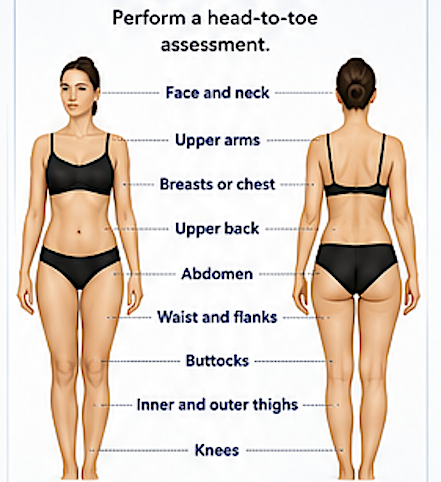
Looking in a full-length mirror, examine each region individually.
Consider:
- Face and neck
- Upper arms
- Breasts or chest
- Upper back
- Abdomen
- Waist and flanks
- Buttocks
- Inner and outer thighs
- Knees
Many patients discover concerns they had gradually accepted and no longer consciously noticed until they systematically evaluated their entire body.
Think Beyond Appearance
Body contouring surgery is not only about how you look.
Ask yourself whether excess skin causes:
- Difficulty exercising
- Skin irritation or recurrent rashes
- Problems with hygiene
- Difficulty finding clothing that fits properly
- Discomfort while walking or sitting
- Loss of self-confidence
These functional concerns are often just as important as cosmetic ones and may influence the order in which procedures are performed.
Prioritize Your Goals
After creating your list, rank each area according to its importance.
Ask yourself:
- Which area bothers me the most?
- Which area affects my daily life the most?
- Which improvement would make the biggest difference in how I feel?
- Which area can reasonably wait until a later stage?
This prioritization becomes extremely helpful if surgery needs to be performed in stages.
Understand That You May Need More Than One Procedure
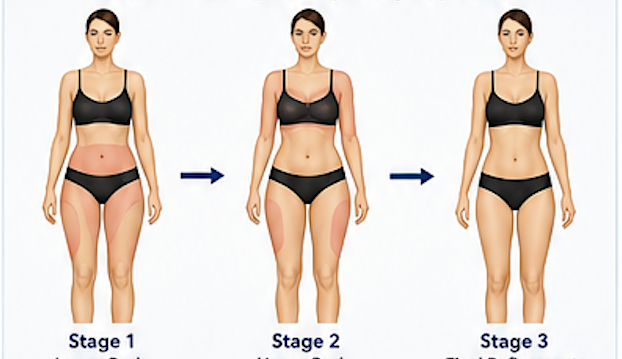
Few patients require only a single operation.
Because massive weight loss affects multiple regions of the body, treatment is often planned as a series of procedures performed over time. Your priorities, recovery schedule, overall health, and financial considerations all play a role in determining the sequence.
Planning the entire journey from the beginning usually produces better long-term results than making decisions one operation at a time.
Your Consultation
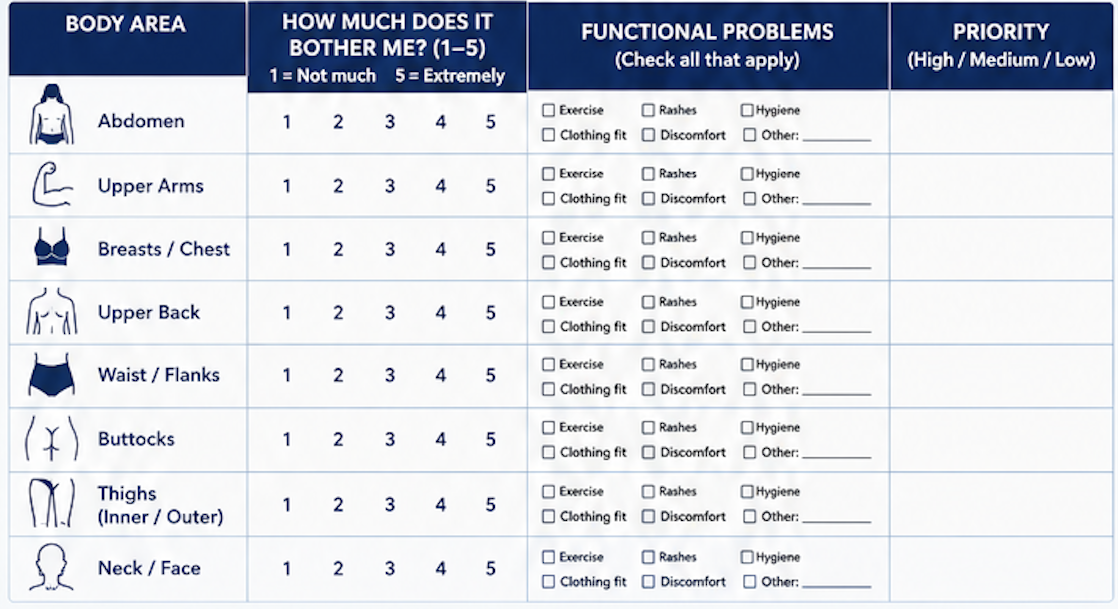
Bring your written list to your consultation.
It helps ensure that every concern is discussed and allows your surgeon to develop a comprehensive surgical plan tailored to your goals.
Many patients are surprised to learn that some areas can be improved together, while others are better addressed separately. An organized discussion leads to better planning and fewer surprises.
Key Takeaways
“Patients should evaluate their entire body before deciding on surgery.”
- Evaluate your entire body—not just your most obvious concern.
- Include both cosmetic and functional problems on your list.
- Rank the areas that are most important to you.
- Understand that body contouring often requires multiple procedures.
- A written list helps your surgeon develop the safest and most effective treatment plan.
Expectations About Body Contouring Surgery
Body contouring surgery can produce remarkable improvements in body shape after massive weight loss. For many patients, it is the final step in completing a life-changing transformation.
However, successful surgery depends on more than technical expertise—it also depends on having realistic expectations.
The goal of body contouring surgery is improvement, not perfection.
Understanding what surgery can and cannot accomplish is one of the most important parts of preparing for your procedure.
Expect Better Shape—Not a Perfect Body
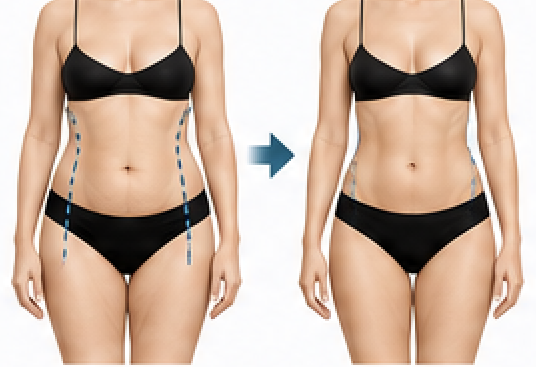
Body contouring surgery removes excess skin and reshapes the remaining tissues to create a smoother, more proportionate appearance.
Most patients experience dramatic improvement in their body contours, but no operation can completely erase the effects of years of obesity or restore the body to the way it looked before weight gain.
The objective is to help your appearance reflect the healthier person you have become.
Expect Permanent Scars
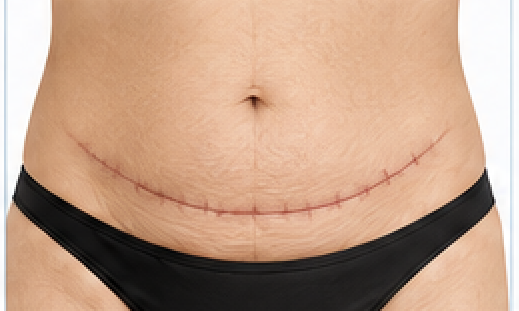
Every body contouring procedure leaves scars.
Because large amounts of excess skin must be removed, the incisions are often extensive. Although scars usually fade and soften over 12 to 18 months, they never disappear completely.
Most patients ultimately view their scars as an acceptable trade-off for eliminating loose, hanging skin.
In many ways, scars become a reminder of the journey you completed rather than the weight you once carried.
Expect a Recovery Period
Body contouring surgery is major surgery.
Recovery requires time, patience, and commitment. Swelling, temporary discomfort, fatigue, and activity restrictions are all normal parts of the healing process.
While many patients begin feeling much better within several weeks, complete healing and final contour refinement continue for many months.
Healing is a process—not an event.
Expect Improvement—Not Perfection
No two sides of the human body are perfectly identical before surgery, and they will not be perfectly symmetrical afterward.
Minor differences in contour, scar appearance, or healing are normal.
The goal is meaningful improvement, not flawless symmetry.
Expect Your Results to Last
One of the most rewarding aspects of body contouring surgery is that the results are generally long-lasting.
Provided your weight remains stable and your overall health is maintained, the improvements achieved through surgery can be enjoyed for many years.
Normal aging will continue, and some gradual skin relaxation is inevitable, but it is unlikely that your body will ever return to its preoperative appearance.
Maintaining your healthy lifestyle is the best way to protect your investment in surgery.
Success Is More Than Appearance
Patients often expect to look better after surgery.
What many do not anticipate is how much better they feel.
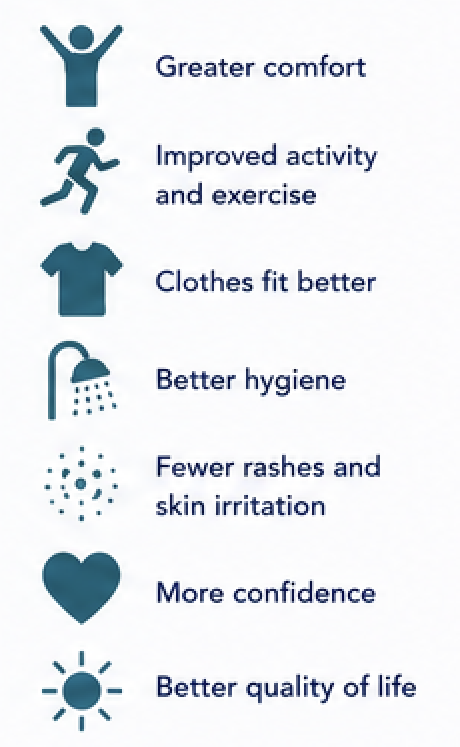
Removing excess skin can improve:
- Comfort during daily activities
- Exercise and physical activity
- Clothing fit
- Personal hygiene
- Skin irritation and rashes
- Self-confidence
- Overall quality of life
These functional improvements are often just as meaningful as the cosmetic changes.
The Right Expectations Lead to the Best Results
Patients who understand the limitations as well as the benefits of body contouring surgery are almost always the happiest with their results.
The most satisfied patients are not those who expect perfection—they are those who appreciate the remarkable improvements that surgery can realistically provide.
Key Takeaways
“Patient satisfaction after body contouring surgery is determined as much by expectations as it is by surgical technique.”
- Body contouring surgery produces dramatic improvement—not perfection.
- Permanent scars are an unavoidable part of removing excess skin.
- Recovery takes weeks, while complete healing continues for many months.
- Stable weight helps preserve long-term results.
- Success should be measured not only by appearance, but also by improved comfort, function, and confidence.
Changing the Body in Stages
One of the most common questions patients ask is, “Can everything be done at once?”
The answer depends on many factors, including your overall health, the number of body areas requiring treatment, the anticipated length of surgery, and your ability to recover safely.
Although it is tempting to complete the entire transformation in a single operation, body contouring after massive weight loss is often best accomplished in stages.
The goal is not to perform the most surgery in one day—it is to achieve the safest operation with the best long-term result.
Why Stage Body Contouring Surgery?
Massive weight loss typically affects multiple areas of the body.
Excess skin may involve the abdomen, waist, back, breasts or chest, upper arms, buttocks, thighs, and neck. Correcting every area in a single operation would require an extremely long procedure with a prolonged recovery and a significantly higher risk of complications.
By dividing surgery into planned stages, each operation becomes safer, more focused, and easier to recover from.
The Benefits of Staging
Staged surgery offers several important advantages:
- Shorter operative times
- Lower risk of complications
- Less blood loss
- Faster recovery after each procedure
- More comfortable postoperative care
- Better opportunity to evaluate healing before proceeding with additional surgery
Rather than delaying your transformation, staging often makes the entire process more predictable and successful.
How Are Procedures Grouped?
Procedures are commonly combined based on the areas of the body being treated and the total amount of surgery that can be performed safely.
A typical sequence might include:
Stage One
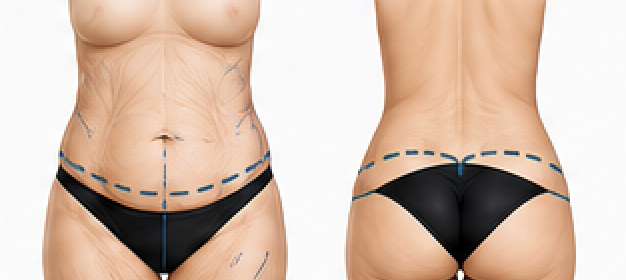
- Circumferential body lift or tummy tuck
- Liposuction when appropriate
Stage Two
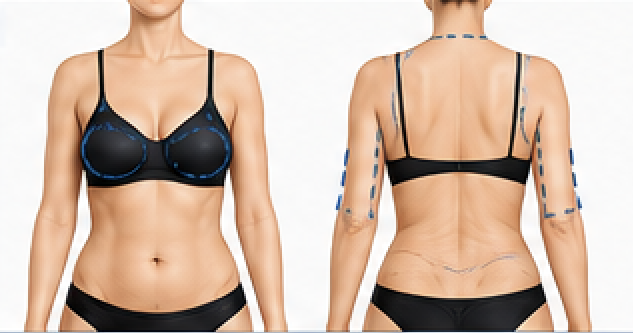
- Breast lift, breast reshaping, or chest contouring
- Brachioplasty (arm lift)
- Upper back lift
Stage Three
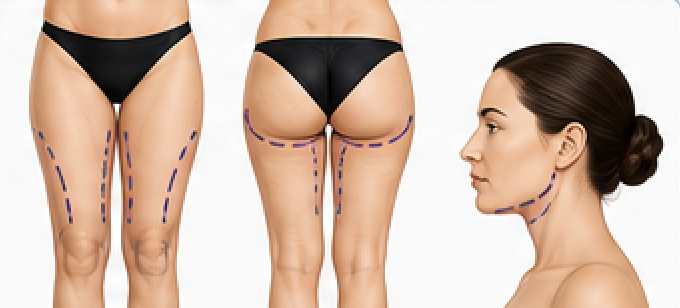
- Thigh lift
- Buttock contour refinement
- Neck or facial procedures, when indicated
Not every patient follows this sequence. The surgical plan is individualized according to your anatomy, priorities, recovery, and overall health.
Safety Always Comes First
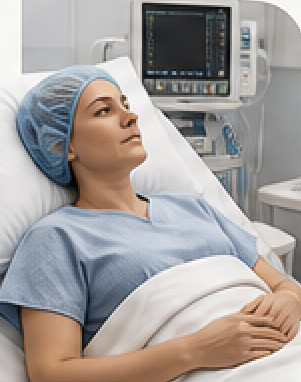
The duration of surgery is an important consideration.
Longer operations generally increase the risk of complications such as blood clots, excessive swelling, wound-healing problems, and fatigue during recovery.
For that reason, I believe it is usually better to perform two well-planned operations than one excessively long procedure.
Patients often underestimate how physically demanding body contouring surgery can be. Recovery from one major procedure is challenging enough without combining every operation into a single surgical event.
Think of It as a Journey
Body contouring is rarely one operation.
It is a carefully planned series of procedures designed to gradually reshape your body while maintaining the highest level of safety.
Each stage builds upon the previous one, bringing you closer to your final result.
Although completing your transformation requires patience, a staged approach almost always provides the safest experience and the most satisfying long-term outcome.
Key Takeaways
“Successful body contouring isn’t about doing the most surgery—it’s about doing the right surgery at the right time.”
- Most patients benefit from body contouring performed in stages.
- Staging reduces surgical risk and simplifies recovery.
- Procedures are grouped according to safety, anatomy, and your individual goals.
- The exact sequence is customized for every patient.
- The goal is not to finish quickly—it is to achieve the safest and best possible result.
Choosing a Plastic Surgeon
Selecting your plastic surgeon is one of the most important decisions you will make during your body contouring journey.
While body contouring surgery can dramatically improve your appearance and quality of life, the success of these procedures depends not only on the operation itself but also on the judgment, experience, and skill of the surgeon performing it.
Finding the right surgeon is about much more than credentials alone.
Choose a Surgeon with Extensive Body Contouring Experience
Not all plastic surgeons perform the same operations on a regular basis.
Body contouring after massive weight loss is among the most challenging areas of plastic surgery. These procedures involve long incisions, extensive tissue removal, careful wound closure, and thoughtful surgical planning.
Experience matters.
A surgeon who performs body contouring procedures routinely will generally have a better understanding of:
- Surgical planning
- Procedure staging
- Scar placement
- Wound management
- Complication prevention
- Recovery after extensive surgery
There is no substitute for experience.
Board Certification Is Important—but It Is Only the Beginning
Board certification by the American Board of Plastic Surgery (ABPS) demonstrates that a surgeon has completed accredited training and met rigorous professional standards.
However, board certification should be viewed as the starting point—not the final qualification.
Ask how often the surgeon performs body contouring after massive weight loss.
Experience with your specific procedure is often more valuable than simply offering it.
Review Before-and-After Photographs Carefully
One of the best ways to evaluate a surgeon’s work is by reviewing photographs of previous patients.
Look for patients who resemble you in:
- Body type
- Amount of weight loss
- Degree of excess skin
- Areas treated
Pay attention to:
- Overall body proportions
- Scar placement
- Symmetry
- Natural appearance
- Consistency of results
One outstanding result proves very little.
Consistently good results across many patients are much more meaningful.
Communication Matters
The best surgeon is also an excellent teacher.
During your consultation, you should feel comfortable asking questions and discussing your goals.
A good consultation should leave you with a clear understanding of:
- What surgery can accomplish
- What it cannot accomplish
- The expected recovery
- Potential risks and complications
- The overall treatment plan
If you leave your consultation feeling confused or pressured, seek another opinion.
Beware of Unrealistic Promises
No surgeon can honestly guarantee a perfect result.
Be cautious of anyone who:
- Promises perfection
- Minimizes scars
- Downplays recovery
- Suggests there are no meaningful risks
- Recommends performing every procedure at once without discussing safety
Honest discussions build trust.
Realistic expectations produce satisfied patients.
Safety Should Always Come First
Body contouring procedures are major operations.
Ask where your surgery will be performed.
Ideally, surgery should take place in an accredited outpatient surgery center or hospital with experienced anesthesia providers and staff familiar with complex body contouring procedures.
Your safety is every bit as important as your result.
Trust Your Instincts
After considering credentials, experience, photographs, and recommendations, trust your instincts.
Choose a surgeon who:
- Listens carefully.
- Answers your questions honestly.
- Makes you feel comfortable.
- Explains the advantages and limitations of surgery.
- Develops a treatment plan based on your goals—not simply on what can be operated on.
The best surgeon is one who combines technical skill with sound judgment, honesty, experience, and genuine concern for your long-term well-being.
Key Takeaways
- Choose a surgeon with substantial experience in body contouring after massive weight loss.
- Board certification is essential, but procedure-specific experience is equally important.
- Review many before-and-after photographs—not just a few exceptional results.
- Good communication and realistic expectations are signs of an experienced surgeon.
- Your safety should always be the highest priority.
Financial Considerations
Body contouring surgery is an investment in yourself.
After dedicating months—or even years—to losing weight, many patients view body contouring as the final step in completing their transformation. Like any major investment, however, it requires thoughtful financial planning.
Understanding the costs involved before beginning your surgical journey helps prevent unnecessary stress and allows you to focus on your recovery rather than your finances.
What Determines the Cost?
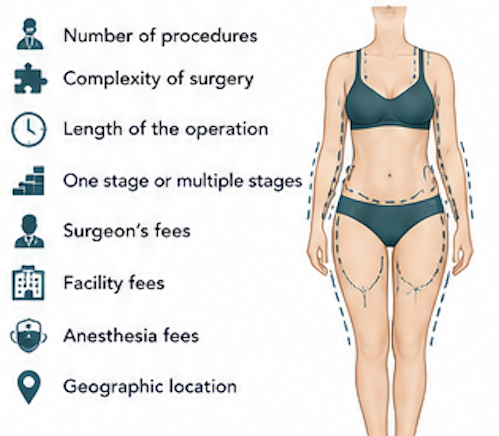
The cost of body contouring surgery varies considerably from one patient to another because every surgical plan is unique.
Factors that influence the total cost include:
- The number of procedures performed
- The complexity of the surgery
- The length of the operation
- Whether surgery is performed in one stage or multiple stages
- Surgeon’s fees
- Facility fees
- Anesthesia fees
- Geographic location
No two treatment plans are exactly alike, so there is no single price that applies to every patient.
Insurance Coverage
Most body contouring procedures are considered elective and are therefore not covered by health insurance.
An important exception may be a panniculectomy, in which the hanging abdominal apron is removed because it causes chronic skin irritation, recurrent infections, hygiene problems, or functional limitations. Even then, insurance approval is never guaranteed and usually requires careful documentation of medical necessity.
Procedures performed to improve body contour, body proportion, or appearance are generally considered cosmetic and are the patient’s financial responsibility.
Think About the Entire Journey
One of the most common mistakes patients make is budgeting only for the operation itself.
Your financial plan should also consider:
- Time away from work
- Travel expenses, if applicable
- Prescription medications
- Compression garments
- Assistance at home during recovery
- Childcare or family support
- Follow-up visits when travel is required
Planning for these additional expenses often makes recovery much less stressful.
Staged Surgery Can Help Financially
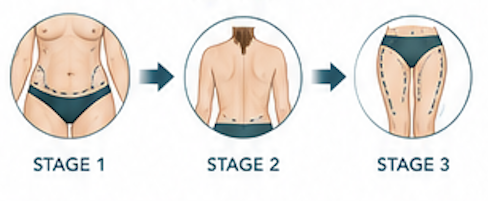
Many patients undergo body contouring in planned stages.
In addition to improving safety, staging procedures allows the financial investment to be spread over time. Rather than paying for every procedure at once, patients can complete their transformation over months or even years as their schedule, recovery, and finances allow.
For many patients, this approach is both medically and financially advantageous.
Choose Value—Not the Lowest Price

It is natural to compare fees when considering surgery.
However, body contouring after massive weight loss is among the most technically demanding procedures in plastic surgery.
Choosing a surgeon based primarily on price may not provide the best value.
Experience, judgment, safety, communication, and consistent results are often far more important than the lowest surgical quote.
Remember that you are choosing a surgeon—not shopping for a commodity.
Financial Planning Reduces Stress
Once you understand your treatment plan and its associated costs, develop a realistic financial strategy before scheduling surgery.
Many practices offer financing options that allow patients to spread payments over time. Others prefer to complete procedures gradually as funds become available.
There is no single right approach.
The best financial plan is one that allows you to proceed comfortably without creating unnecessary financial pressure.
Key Takeaways
“Approach surgery with a well-thought-out financial plan rather than being surprised by ancillary expenses.”
- Body contouring surgery is an investment in your health, comfort, and confidence.
- Costs vary because every treatment plan is individualized.
- Insurance coverage is uncommon except for selected medically necessary procedures, such as some panniculectomies.
- Plan for recovery-related expenses in addition to the surgical fee.
- Choose your surgeon based on experience, safety, and results—not simply on price.
Your Healing Risks
Every surgical procedure carries some degree of risk.
Body contouring surgery after massive weight loss is no exception. These are major operations involving extensive incisions, large areas of tissue dissection, and significant wound closure. Fortunately, most patients heal without major problems, especially when they are healthy, well prepared, and carefully follow their postoperative instructions.
The goal is not to eliminate every risk—that is impossible.
The goal is to minimize risk through careful planning, meticulous surgical technique, and active patient participation.
Why Healing Can Be More Challenging
Patients who have lost a significant amount of weight often present unique healing challenges.
Compared with traditional cosmetic surgery patients, they may have:
- Reduced skin quality and elasticity
- Protein or vitamin deficiencies
- Previous bariatric surgery
- Medical conditions related to obesity
- Large areas requiring skin removal
- Longer operative times
Each of these factors can influence how the body heals.
The Most Common Healing Problems
Fortunately, most complications are minor and can be successfully treated.
The most common healing issues include:
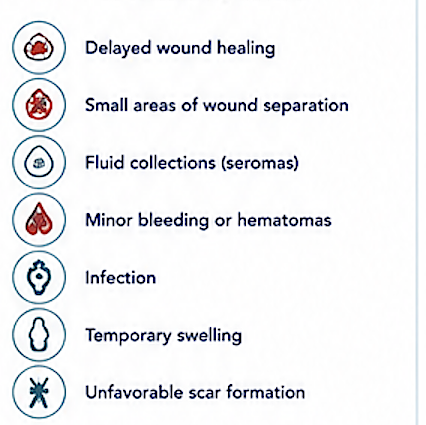
While these problems can be frustrating, they are usually manageable and rarely affect the final outcome when recognized and treated early.
The Serious Complications
Although uncommon, more serious complications deserve discussion.
These include:
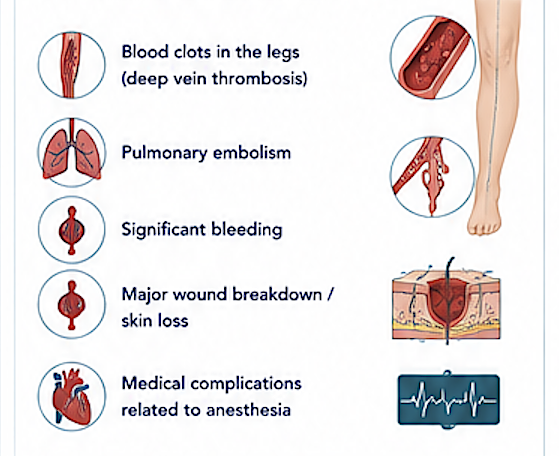
Fortunately, these events are uncommon, and modern preventive measures have substantially reduced their incidence.
What You Can Do to Reduce Your Risk
Patients play an important role in their own recovery.
You can significantly improve your healing by:
- Reaching and maintaining a stable weight
- Eating a protein-rich, nutritionally balanced diet
- Correcting vitamin and mineral deficiencies
- Stopping all nicotine products well before surgery
- Following activity restrictions
- Walking regularly after surgery
- Wearing compression garments as instructed
- Attending all follow-up appointments
Successful healing is truly a partnership between surgeon and patient.
Smoking and Nicotine
Few factors impair healing more than nicotine.
Smoking, vaping, nicotine gum, nicotine patches, and other nicotine-containing products reduce blood flow to healing tissues and dramatically increase the risk of wound-healing problems, skin loss, infection, and poor scarring.
For this reason, complete nicotine cessation before and after surgery is one of the most important requirements for safe body contouring surgery.
Most Complications Are Temporary
Patients often fear that any complication means their surgery has failed.
Fortunately, this is rarely true.
Minor wound-healing problems generally improve with time, appropriate wound care, and patience. Even when healing takes longer than expected, the final result is usually very good.
Healing is rarely a perfectly straight path.
Small setbacks can occur without affecting the long-term success of your surgery.
Preparation Is the Best Prevention
The safest patients are those who arrive for surgery healthy, nutritionally prepared, physically active, and fully committed to the recovery process.
Although no surgeon can guarantee a complication-free recovery, careful preparation greatly reduces risk and provides the best opportunity for an excellent outcome.
Key Takeaways
“Successful healing is truly a partnership between surgeon and patient.”
“Most complications are preventable, and many of the factors that influence healing are under your control.”
- Every body contouring procedure carries some risk.
- Most healing problems are minor and can be successfully managed.
- Serious complications are uncommon but deserve careful discussion.
- Good nutrition, weight stability, nicotine avoidance, and following postoperative instructions significantly reduce risk.
- Successful healing is a partnership between you and your surgeon.
Are Different Weight-Loss Methods More Risky for Surgery?
One of the questions patients frequently ask is whether the way they lost weight affects the safety of body contouring surgery.
The answer is yes—but perhaps not in the way most people expect.
In most cases, it is not the method of weight loss that determines surgical risk. Rather, it is your overall health, nutritional status, weight stability, and medical condition at the time of surgery.
Whether you lost weight through diet and exercise, bariatric surgery, or weight-loss medications, the goal is the same: to arrive at surgery healthy, nutritionally prepared, and at a stable weight.
Weight Loss Through Diet and Exercise
Patients who lose weight through lifestyle changes alone are often among the healthiest candidates for body contouring surgery.
Because they have not undergone an operation that alters nutrient absorption, they are generally less likely to develop significant protein, vitamin, or mineral deficiencies. Nevertheless, substantial weight loss through diet and exercise can still produce the same excess skin and body contour changes seen after bariatric surgery.
Weight Loss After Bariatric Surgery
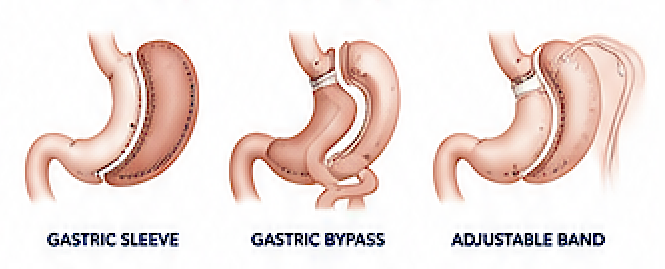
Bariatric surgery has helped millions of people achieve dramatic and sustained weight loss.
However, these procedures can create unique considerations for body contouring surgery.
Depending on the type of bariatric operation performed, patients may develop deficiencies in:
- Protein
- Iron
- Vitamin B12
- Folate
- Vitamin D
- Calcium
- Other essential vitamins and minerals
These nutritional deficiencies can impair wound healing if they are not identified and corrected before surgery.
Fortunately, careful laboratory evaluation and nutritional optimization allow most bariatric patients to undergo body contouring safely.
Weight Loss with GLP-1 Medications
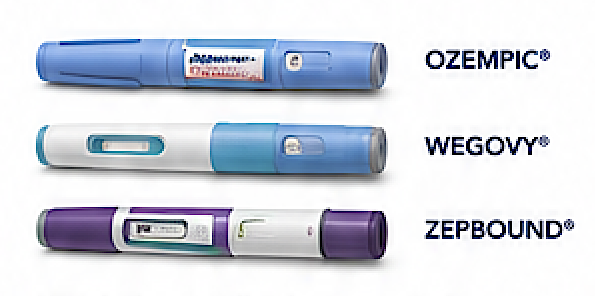
Weight-loss medications such as semaglutide and tirzepatide have become increasingly common.
Patients who achieve substantial weight loss with these medications often develop the same loose skin and body contour changes seen after other forms of weight loss.
Before body contouring surgery, these patients should also demonstrate:
- A stable weight
- Good nutritional status
- Appropriate medical management of their medications
- Overall good health
As with all patients, timing surgery after weight stabilization produces the most predictable long-term results.
Does One Method Produce Better Surgical Results?
From a body contouring standpoint, there is very little difference.
The amount of loose skin depends far more on:
- The amount of weight lost
- How long the excess weight was present
- Age
- Genetics
- Skin quality
- Smoking history
The body does not “remember” how the weight was lost.
It simply responds to the loss of volume beneath the skin.
Preparation Matters More Than the Method
When planning body contouring surgery, your surgeon is far more interested in questions such as:
- Has your weight stabilized?
- Are you nutritionally healthy?
- Are your medical conditions well controlled?
- Have you stopped using nicotine?
- Are you physically and emotionally prepared for surgery?
The answers to these questions are much more important than the specific method you used to lose weight.
The Bottom Line
The best candidates for body contouring surgery are healthy patients who have reached a stable weight and are nutritionally prepared for surgery.
How you achieved your weight loss is only one part of the story.
Your health today is what matters most.
Key Takeaways
“Preparation, nutrition, and weight stability are the factors that have the greatest impact on safe surgery and successful healing.”
- The method of weight loss is generally less important than your current health.
- Bariatric surgery patients require careful nutritional evaluation before body contouring.
- Patients who lose weight with GLP-1 medications should also reach a stable weight before surgery.
- Loose skin develops regardless of how weight is lost.
- Your nutritional status, weight stability, and overall health have the greatest influence on healing and surgical outcomes.
How Long Will My Operation Be?
One of the most common questions patients ask before body contouring surgery is, “How long will my operation take?”
The answer depends on the procedures being performed.
Some operations require only a few hours, while more extensive body contouring procedures may take considerably longer. The length of surgery is determined by the complexity of the operation—not by how quickly the surgeon works.
More importantly, the safest operation is not always the shortest one, but neither is it the longest.
The goal is to perform every procedure carefully, efficiently, and safely.
What Determines Operative Time?
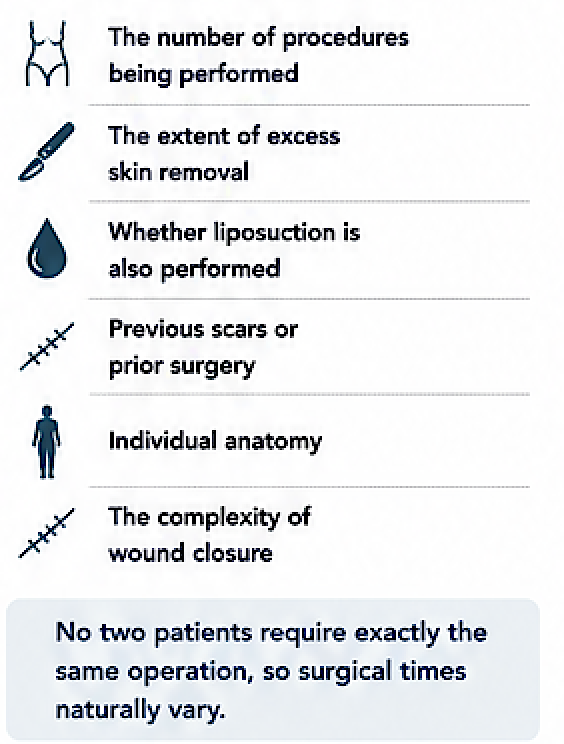
Several factors influence how long body contouring surgery takes, including:
- The number of procedures being performed
- The extent of excess skin removal
- Whether liposuction is also performed
- Previous scars or prior surgery
- Individual anatomy
- The complexity of wound closure
No two patients require exactly the same operation, so surgical times naturally vary.
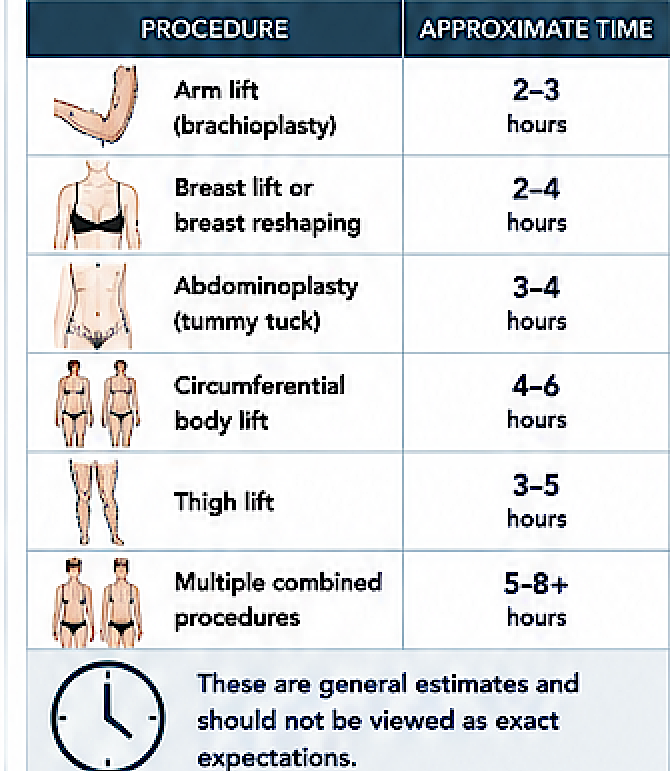
Typical Operative Times
Although every patient is different, the following are approximate surgical times:
Why Longer Surgery Matters
As operative time increases, so does the physical stress placed on the body.
Longer procedures may increase the risk of:
- Blood clots
- Blood loss
- Swelling
- Hypothermia
- Wound-healing problems
- Fatigue during recovery
For this reason, surgeons carefully balance the benefits of combining procedures with the additional risks associated with prolonged operative time.
Why Surgery Is Sometimes Staged
Many patients ask whether every procedure can be completed during one operation.
Although combining procedures is often appropriate, there comes a point where adding more surgery no longer improves the overall result—it simply increases the risk.
That is why body contouring surgery is frequently performed in stages.
Two well-planned operations are often safer than one excessively long procedure.
Quality Takes Time
Patients sometimes worry when they hear that surgery may take several hours.
In reality, much of that time is spent performing meticulous wound closure.
Large body contouring procedures involve long incisions that must be carefully closed in multiple tissue layers. This detailed closure helps reduce tension on the skin, promotes better healing, and often leads to more favorable scars.
The time invested in careful closure is time well spent.
The Goal Is Safe, Efficient Surgery
Every operation should be performed as efficiently as possible—but never rushed.
Your surgeon’s objective is to complete the planned procedures while maintaining the highest standards of safety and surgical quality.
For most patients, the exact number of hours matters far less than knowing the operation has been carefully planned and safely executed.
Key Takeaways
“Success comes from thoughtful planning, meticulous technique, and patient safety—not from trying to accomplish the most surgery in a single day.”
- The length of surgery depends on the complexity of your procedures.
- Longer operations are not necessarily better and may increase surgical risk.
- Body contouring procedures are often staged to improve safety.
- Careful wound closure is one of the most time-consuming—and important—parts of surgery.
- The goal is safe, efficient surgery rather than the shortest possible operative time.
Do I Need Surgical Drains?
One of the most common questions patients ask before body contouring surgery is whether they will need surgical drains.
The answer depends on the procedure being performed and the surgical technique used.
Although drains are commonly used after body contouring surgery, they are not required for every operation. Their purpose is simple: to remove fluid that naturally collects beneath the skin during the early stages of healing.
Why Are Drains Used?
Whenever excess skin is removed, a temporary space is created between the skin and the underlying tissues.
As the body heals, this space can fill with blood-tinged fluid called serous fluid.
If too much fluid accumulates, it may delay healing or require additional treatment.
Surgical drains help remove this fluid while the tissues seal together during the first several days after surgery.
What Is a Surgical Drain?
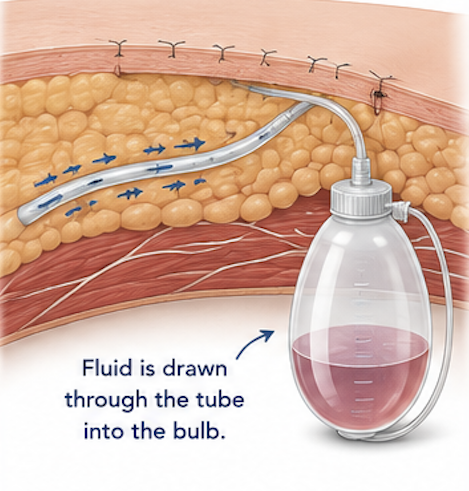
A surgical drain is a small, flexible tube placed beneath the skin before the incision is closed.
The tube exits through a separate small opening in the skin and connects to a soft collection bulb that creates gentle suction.
This constant suction helps remove fluid and encourages the tissues to adhere to one another during healing.
Although the appearance of drains may seem intimidating, most patients quickly become comfortable caring for them.
How Long Do Drains Stay In?
There is no fixed timetable.
Most drains remain in place for one to three weeks, depending on:
- The procedure performed
- The amount of fluid produced
- Individual healing
Drains are removed when the daily drainage decreases to an appropriate level.
Removing them too early may increase the likelihood of a fluid collection (seroma).
Are Drains Painful?
Most patients are pleasantly surprised.
The drains themselves usually cause more inconvenience than discomfort.
Many patients describe them as awkward rather than painful.
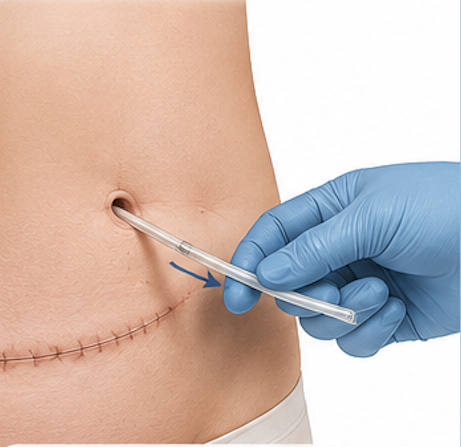
Removing a drain is typically completed in just a few seconds during an office visit and is generally associated with only mild, temporary discomfort.
Can Surgery Be Performed Without Drains?
In selected procedures, yes.
Advances in surgical technique—particularly the use of progressive tension sutures and other methods that eliminate dead space—have reduced the need for drains in some operations, especially abdominoplasty.
However, many body contouring procedures after massive weight loss still involve large areas of tissue dissection where drains remain the safest and most reliable method of preventing fluid accumulation.
Your surgeon will determine whether drains are appropriate based on the specific procedure being performed.
Living with Drains
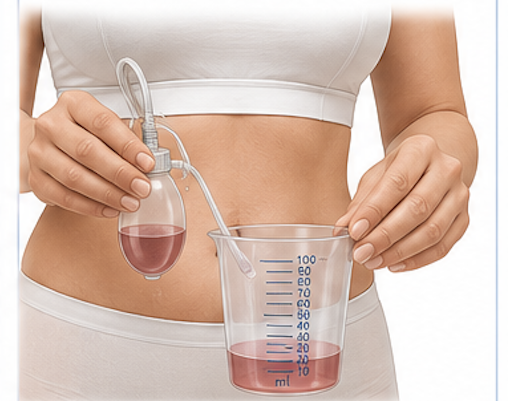
Although drains require a little extra attention, most patients adjust quickly.
During the first few days after surgery you will be instructed how to:
- Empty the drainage bulb
- Measure and record the drainage
- Keep the drain site clean
- Secure the drains to your clothing
- Recognize signs of a potential problem
These simple steps help ensure safe healing until the drains are removed.
A Temporary Inconvenience
Patients often worry about having drains before surgery.
In reality, they are only a temporary part of the recovery process.
For many body contouring procedures, drains help reduce complications and promote smoother healing.
Although few patients enjoy having them, almost everyone agrees that they are a small inconvenience compared with the long-term benefits of a successful surgical result.
Key Takeaways
“Patients are often more anxious about drains than they are about the operation itself.”
- Surgical drains remove fluid that naturally collects during healing.
- Not every body contouring procedure requires drains.
- Most drains remain in place for one to three weeks.
- Drains usually cause more inconvenience than pain.
- Proper drain care helps reduce complications and promotes healing.
Real Recovery
One of the biggest concerns patients have before body contouring surgery is, “What will recovery really be like?”
The answer is different for every patient.
Recovery depends on the procedures performed, your overall health, your physical condition before surgery, and how closely you follow your postoperative instructions.
Most patients recover more quickly than they expect—but not as quickly as they hope.
Healing is a gradual process that continues for weeks and months after surgery.
The First Few Days

The first several days are devoted primarily to rest and recovery.
You should expect:
- Swelling
- Bruising
- Mild to moderate discomfort
- Fatigue
- Limited mobility
Although walking is encouraged beginning on the day of surgery, your activity will be intentionally limited to allow your body to heal.
Most patients are pleasantly surprised that discomfort is generally well controlled with modern pain-management techniques.
The First Two Weeks

By the second week, most patients begin noticing meaningful improvement.
You will gradually become more mobile and independent while swelling and soreness continue to decrease.
Many patients are able to perform light daily activities, although lifting, strenuous exercise, and prolonged standing are still restricted.
This is often the point when patients begin to feel much better—even though complete healing is still far from finished.
Weeks Three Through Six

During this phase, recovery accelerates.
Most patients return to work, resume many normal daily activities, and steadily regain their strength and endurance.
Swelling continues to improve, body contours become more defined, and scars begin their long process of maturation.
Although you may feel considerably better, your tissues are still healing beneath the surface.
The Long-Term Recovery

Complete healing takes much longer than most people realize.
Scar maturation, soft tissue remodeling, and the gradual resolution of swelling continue for six months to one year, and sometimes even longer.
The improvements you see during the first few weeks represent only the beginning of your final result.
Patience is an important part of recovery.
Recovery Is More Than Physical
Many patients experience an emotional recovery as well.
It is common to feel excited one day and discouraged the next.
Temporary swelling, bruising, fatigue, and the adjustment to a changing body image are all normal parts of the recovery process.
As healing progresses and swelling subsides, confidence usually grows along with the physical improvements.
What Helps You Recover Faster?
Successful recovery depends on following your surgeon’s instructions.
Patients who recover most smoothly generally:
- Walk regularly
- Eat a protein-rich diet
- Stay well hydrated
- Wear compression garments as directed
- Avoid nicotine
- Get adequate rest
- Attend all follow-up appointments
Small daily efforts often have the greatest impact on healing.
Recovery Is a Journey
Recovery should not be measured by individual days.
Instead, look for gradual improvement from week to week.
Most patients are surprised by how much progress they make over the first month and delighted by how much additional improvement occurs during the months that follow.
Body contouring surgery is a major operation, but with patience, preparation, and realistic expectations, recovery is usually much easier than patients imagine before surgery.
Key Takeaways
“Recovery follows chronological stages with gradual improvements that require patience.”
- Recovery occurs in stages—not all at once.
- Walking, nutrition, hydration, and rest all contribute to healing.
- Most patients begin feeling significantly better within two weeks.
- Final contour refinement and scar maturation continue for many months.
- Patience is one of the most important parts of a successful recovery.
The Signs of Successful Healing
After body contouring surgery, every patient watches the healing process closely.
It is natural to wonder whether what you are seeing—and feeling—is normal.
The good news is that most changes during recovery are expected and are simply signs that your body is healing.
Understanding the difference between normal healing and warning signs can provide reassurance and help you recognize when you should contact your surgeon.
Normal Signs of Healing
Most patients experience many of the following changes during the first several weeks after surgery:
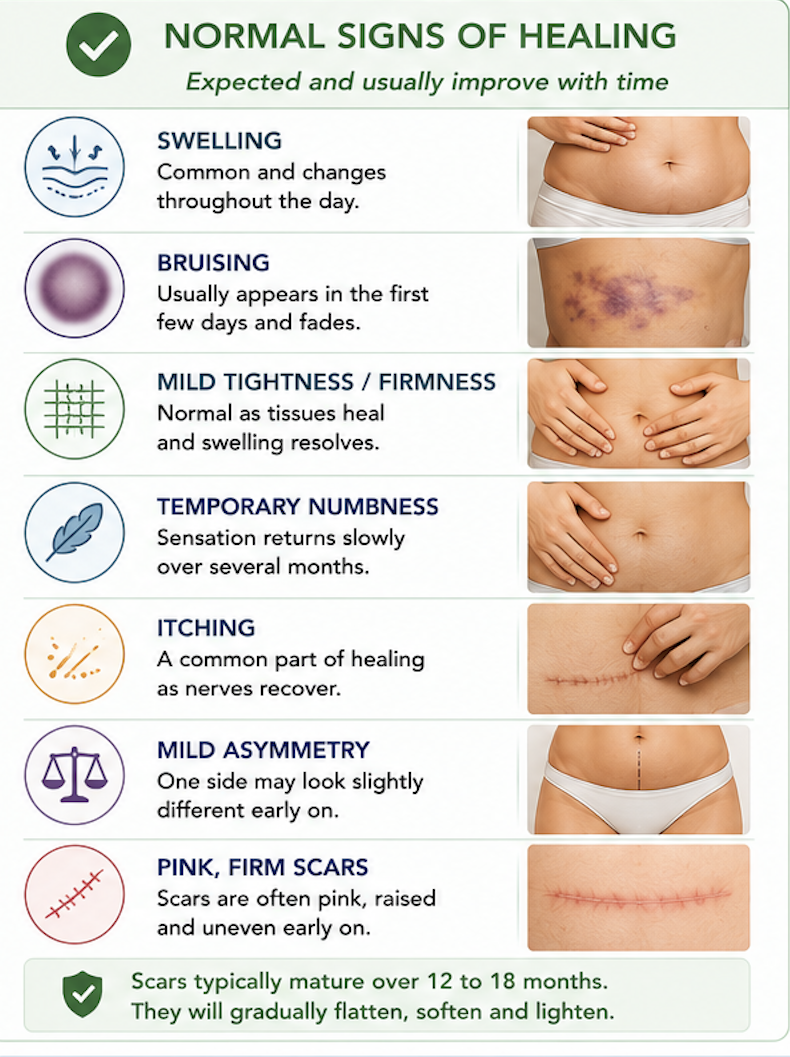
Although these changes may seem concerning, they are usually a normal part of the healing process.
As swelling gradually subsides, your new body contours become more apparent.
Your Incisions
Incisions rarely look perfect immediately after surgery.
During the first several weeks they commonly appear:
- Pink or red
- Slightly raised
- Firm
- Uneven in places
This is normal.
Scars typically mature over 12 to 18 months, gradually becoming flatter, softer, and lighter in color.
Healing requires patience.
Swelling Changes Daily
Many patients are surprised that swelling is not consistent.
You may notice:
- More swelling in the evening than in the morning.
- Increased swelling after prolonged standing or activity.
- One side appearing slightly more swollen than the other.
These day-to-day variations are common and generally improve as healing progresses.
Sensation Returns Slowly
Temporary numbness is expected after body contouring surgery.
Small sensory nerves are divided during skin removal and require time to regenerate.
Most sensation gradually returns over several months, although small areas of permanent numbness may remain near some incisions.
Fortunately, these areas rarely interfere with normal daily activities.
When Should You Call Your Surgeon?
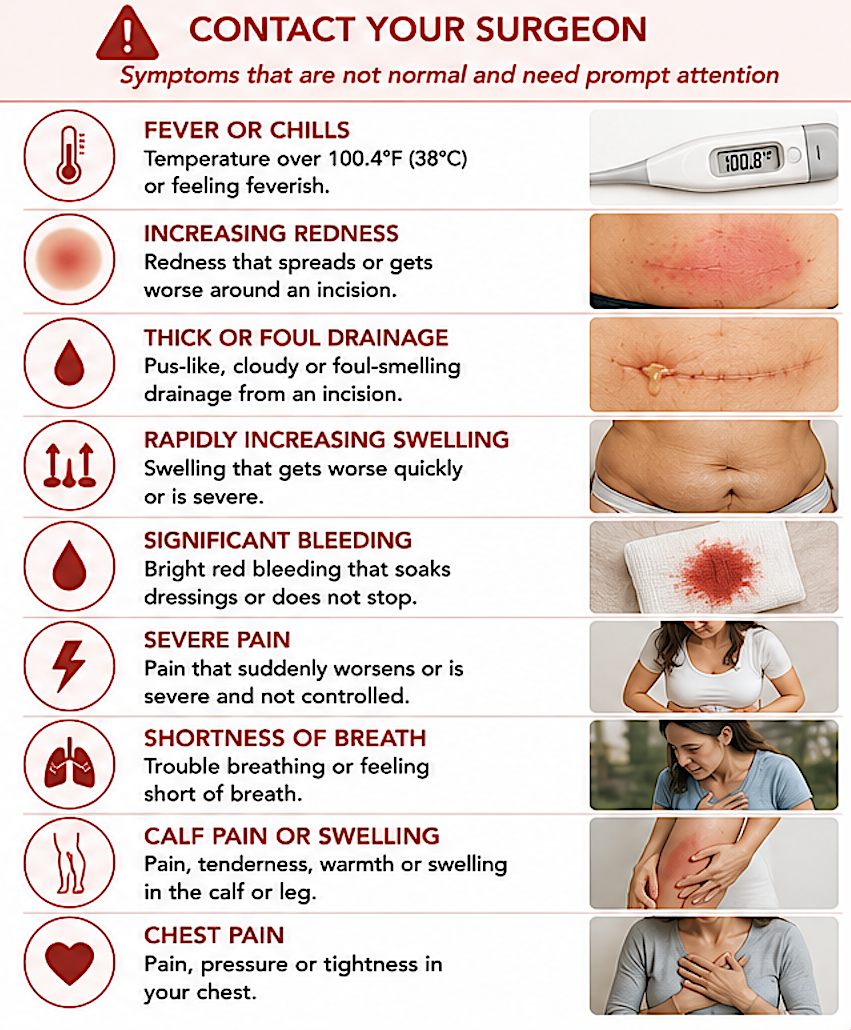
Although most recovery progresses normally, certain symptoms deserve prompt medical attention.
Early communication allows potential problems to be evaluated and treated before they become more serious.
Trust the Healing Process
Healing is rarely a perfectly straight line.
Some days you will feel better than others.
Small fluctuations in swelling, comfort, and appearance are completely normal during recovery.
Rather than evaluating your progress from one day to the next, compare how you feel from one week to the next.
The overall trend should always be gradual improvement.
Your Surgeon Is Your Best Resource
No book can replace communication with your surgeon.
If something concerns you—even if it ultimately proves to be normal—it is always appropriate to contact your surgical team.
Most patients are reassured to learn that what they are experiencing is simply part of the normal healing process.
Key Takeaways
“Healing should be judged over weeks rather than day by day.”
- Swelling, bruising, tightness, numbness, and itching are usually normal signs of healing.
- Scars often take 12 to 18 months to fully mature.
- Daily fluctuations in swelling are expected during recovery.
- Contact your surgeon promptly if you develop fever, spreading redness, increasing pain, shortness of breath, chest pain, or other concerning symptoms.
- Recovery should be judged by gradual weekly improvement rather than day-to-day changes.
More Than Weight Is Lost
When people think about weight loss, they usually think about pounds.
But weight is only one part of the transformation.
Significant weight loss changes far more than the number on a scale. It improves health, restores mobility, increases confidence, and often changes the way people view themselves and interact with the world around them.
Body contouring surgery is not about losing more weight.
It is about helping your outward appearance reflect the remarkable changes that have already occurred on the inside.
A Healthier Body
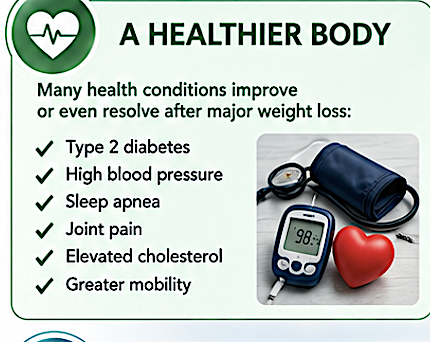
The medical benefits of major weight loss are often dramatic.
Many patients experience improvement—or complete resolution—of conditions such as:
- Type 2 diabetes
- High blood pressure
- Sleep apnea
- Joint pain
- Elevated cholesterol
- Limited mobility
For many people, weight loss represents a new beginning rather than simply a reduction in body size.
A New Level of Confidence
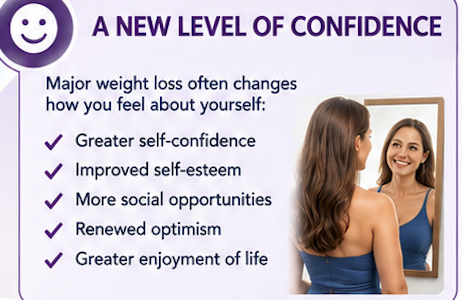
Major weight loss often changes how people feel about themselves.
Patients frequently report:
- Greater self-confidence
- Increased willingness to participate in social activities
- Improved self-esteem
- Renewed optimism
- Greater enjoyment of physical activity
Yet many also discover that excess skin continues to hide the body they worked so hard to achieve.
Body contouring surgery helps complete that transformation.
Freedom of Movement
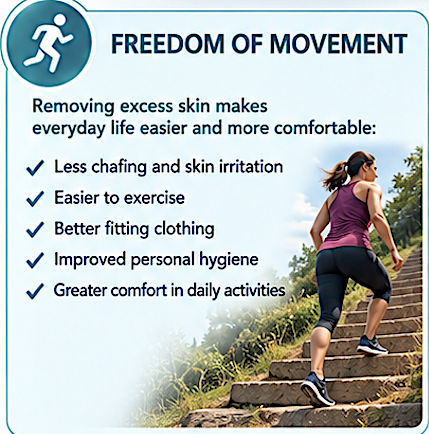
Loose skin is not merely a cosmetic issue.
Many patients experience:
- Chafing
- Skin irritation
- Difficulty exercising
- Problems finding properly fitting clothing
- Challenges with personal hygiene
Removing excess skin often makes everyday activities easier and more comfortable.
Patients frequently tell me they can finally move without constantly being reminded of the body they once had.
Completing the Journey
Weight loss changes your health.

Body contouring changes how you live with your new body.
The goal is not perfection.
The goal is to allow your appearance to reflect your accomplishment while improving comfort, function, and confidence.
For many patients, body contouring surgery represents the final chapter of a journey that began months—or even years—earlier.
More Than a Physical Transformation
One of the most rewarding aspects of body contouring surgery is watching patients rediscover themselves.
Many describe:
- Wearing clothes they never imagined they could wear.
- Exercising with greater comfort.
- Participating in activities they once avoided.
- Feeling more comfortable in photographs.
- Looking in the mirror and finally seeing the healthy person they have become.
These changes cannot be measured on a scale.
Yet they are often the most meaningful outcomes of all.
The True Success of Weight Loss
Successful weight loss is not simply measured by pounds lost.
It is measured by improved health, increased independence, renewed confidence, and a better quality of life.
Body contouring surgery cannot create those achievements.
It simply allows them to become visible.
Key Takeaways
“Body contouring is not about losing more weight, but about completing a life-changing journey.”
- Weight loss changes far more than your body weight.
- Major health improvements often accompany successful weight loss.
- Removing excess skin improves comfort, mobility, and confidence.
- Body contouring surgery completes—but does not replace—the weight-loss journey.
- The greatest transformation often cannot be measured on a scale.
Nutrition for Better Healing
Good nutrition is one of the most important factors in successful body contouring surgery.
While your surgeon performs the operation, your body is responsible for healing the incisions, repairing tissues, and rebuilding strength. Those processes require the right nutrients before and after surgery.
Simply put, healthy tissue heals better.
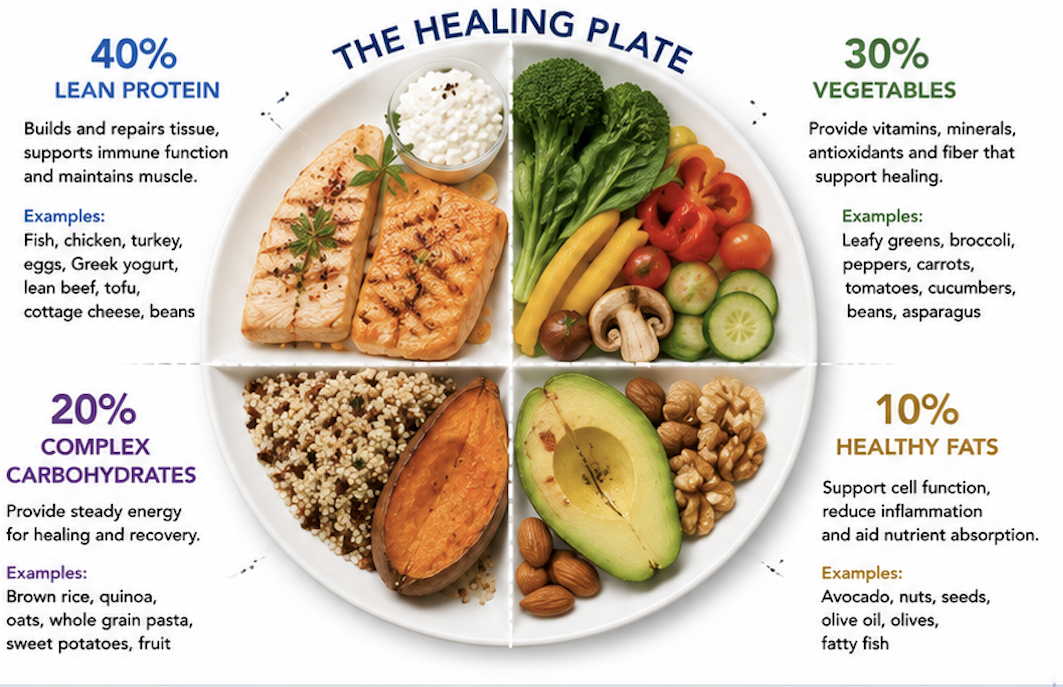
Preparing your body nutritionally before surgery—and continuing healthy eating afterward—can reduce complications, improve wound healing, and speed your recovery.
Protein: The Building Block of Healing
Protein is the single most important nutrient during recovery.
Your body uses protein to:
- Repair surgical wounds
- Build new collagen
- Strengthen healing tissues
- Maintain muscle mass
- Support the immune system
Patients who consume too little protein often experience slower healing and a greater risk of wound complications.
For many patients, increasing protein intake several weeks before surgery and maintaining it throughout recovery is one of the most beneficial nutritional changes they can make.
Vitamins and Minerals Matter
Healing also depends on adequate levels of essential vitamins and minerals.
Particularly important are:
- Iron
- Vitamin C
- Vitamin D
- Vitamin B12
- Folate
- Zinc
- Calcium
Patients who have undergone bariatric surgery may require laboratory testing and supplementation before body contouring procedures to correct deficiencies that are not obvious from symptoms alone.
Hydration Is Essential
Water is often overlooked as part of recovery.
Proper hydration supports:
- Blood circulation
- Oxygen delivery
- Nutrient transport
- Temperature regulation
- Tissue healing
Even mild dehydration can contribute to fatigue and slow the recovery process.
Nutrition After Surgery
Recovery increases your body’s metabolic demands.
Even if your appetite is temporarily reduced, try to maintain:
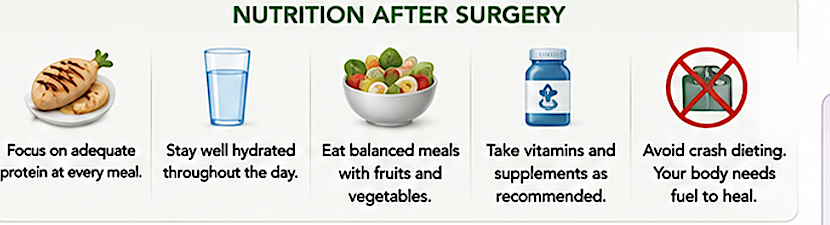
Your body needs energy and nutrients to heal.
Patients After Bariatric Surgery
Patients who have undergone bariatric surgery require special nutritional attention.
Depending on the type of bariatric procedure, deficiencies in protein, iron, calcium, vitamin D, vitamin B12, and other nutrients are relatively common.
These deficiencies should be identified and corrected before body contouring surgery whenever possible.
Careful nutritional preparation significantly improves healing and reduces complications.
Nutrition Is an Investment in Your Results
Patients often focus on choosing the right surgeon and procedure.
Equally important is preparing your body for surgery.
Good nutrition is not simply about recovering faster.
It is about giving your body every possible advantage for successful healing and the best long-term result.
Key Takeaways
“How does nutrition help me heal?”
- Good nutrition is one of the most important factors in successful healing.
- Protein is the body’s primary building block for tissue repair.
- Vitamins, minerals, and hydration all support wound healing.
- Bariatric surgery patients should be evaluated for nutritional deficiencies before surgery.
- Healthy eating before and after surgery helps reduce complications and improve recovery.
RESHAPING THE WEIGHT LOSS BODY
Options in Abdominal Contouring
The abdomen is the area that concerns most patients after major weight loss.
While losing a significant amount of weight improves your health, it often leaves behind loose skin, stretched abdominal muscles, and stubborn fat deposits that cannot be corrected through diet or exercise alone.
Fortunately, several surgical procedures can improve the appearance of the abdomen.
The best option depends on the amount and location of excess skin, the condition of the abdominal muscles, and your overall treatment goals.
There Is No Single “Best” Procedure
Many patients ask for a “tummy tuck.”
In reality, body contouring after massive weight loss is much more complex than a traditional cosmetic abdominoplasty.
Some patients require only removal of the lower abdominal apron, while others need correction of excess skin extending around the waist, flanks, and lower back.
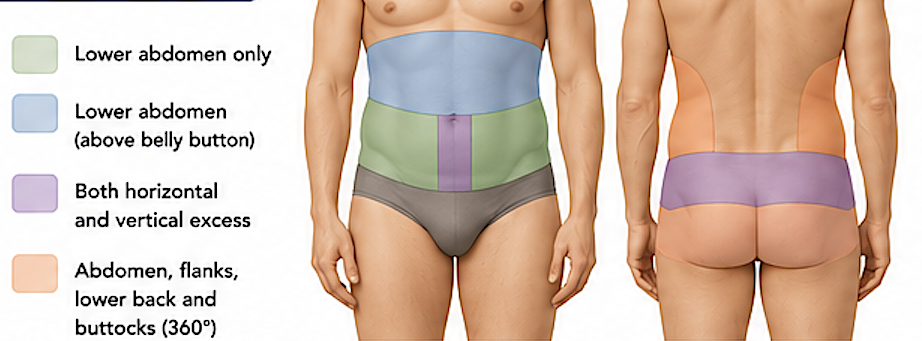
Choosing the right procedure begins with understanding the pattern of excess skin.
Panniculectomy
A panniculectomy removes the hanging lower abdominal apron (pannus).
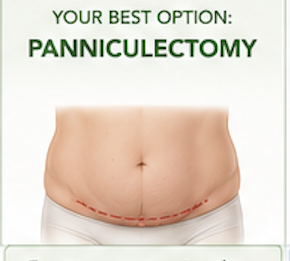
Its primary goal is to improve:
- Hygiene
- Skin irritation
- Chronic rashes
- Mobility
- Comfort
Unlike a tummy tuck, a panniculectomy generally does not tighten the abdominal muscles or reshape the waist.
For patients whose primary concern is the heavy overhanging abdominal skin, it can provide significant functional improvement.
Abdominoplasty (Tummy Tuck)
An abdominoplasty combines excess skin removal with tightening of the abdominal wall.
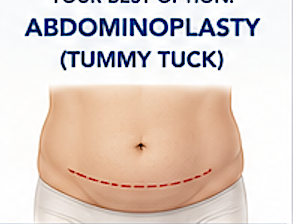
In addition to removing loose skin, it often includes:
- Muscle repair
- Waist contouring
- Repositioning of the belly button
- Liposuction when appropriate
This procedure provides greater cosmetic improvement than a panniculectomy while also restoring a flatter, firmer abdominal contour.
Fleur-de-Lis Abdominoplasty
Patients who have lost a very large amount of weight often have excess skin in both the horizontal and vertical directions.
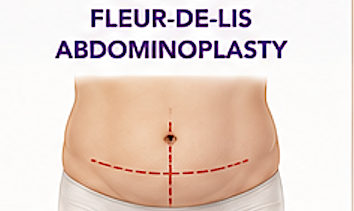
A fleur-de-lis tummy tuck removes skin in both dimensions by adding a vertical incision in the middle of the abdomen.
Although this creates an additional scar, it often produces dramatically better contouring in patients with extensive skin laxity.
Circumferential Body Lift
When loose skin extends beyond the abdomen to involve the flanks, lower back, and buttocks, a circumferential body lift may be the best option.
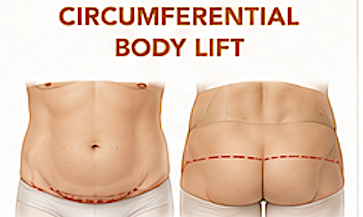
This operation treats the entire lower trunk rather than the abdomen alone.
In addition to improving the front of the abdomen, it can elevate the outer thighs, reshape the waist, and improve buttock position.
For many massive weight loss patients, it provides the most comprehensive lower body contouring procedure.
Which Procedure Is Right for You?
The answer depends on several factors, including:
- The location of excess skin
- The amount of skin laxity
- Muscle separation
- Body mass index
- Previous abdominal surgery
- Your overall health
- Your aesthetic goals
No single operation is ideal for every patient.
A careful examination allows your surgeon to recommend the procedure—or combination of procedures—that will provide the safest and most effective result.
The Beginning of Your Surgical Journey
The abdomen is often the first area addressed during body contouring because it usually represents the patient’s greatest functional and cosmetic concern.
For many patients, abdominal contouring also serves as the foundation for additional procedures involving the breasts, arms, thighs, or lower body.
Choosing the appropriate abdominal procedure is therefore one of the most important decisions in your entire body contouring plan.
Key Takeaways
“Which Abdominal Contouring Procedure Is Right for You?”
- Several abdominal contouring procedures are available after major weight loss.
- The best procedure depends on your anatomy and goals.
- A panniculectomy primarily improves function, while an abdominoplasty adds cosmetic reshaping.
- A fleur-de-lis abdominoplasty is designed for extensive excess skin in both directions.
- A circumferential body lift treats the entire lower trunk, not just the abdomen
Panniculectomy: Removing the Hanging Abdominal Apron
For some patients, the most troublesome consequence of massive weight loss is the large fold of skin and fat that hangs over the lower abdomen.
This overhanging tissue, known as a pannus, can interfere with daily activities, make exercise difficult, cause chronic skin irritation and infections, and create significant hygiene challenges.
A panniculectomy is designed to remove this excess tissue and improve comfort and function.
Unlike a tummy tuck, however, its primary purpose is not cosmetic body contouring.
What Is a Pannus?
A pannus is the excess skin and fatty tissue that hangs below the lower abdomen after significant weight loss.
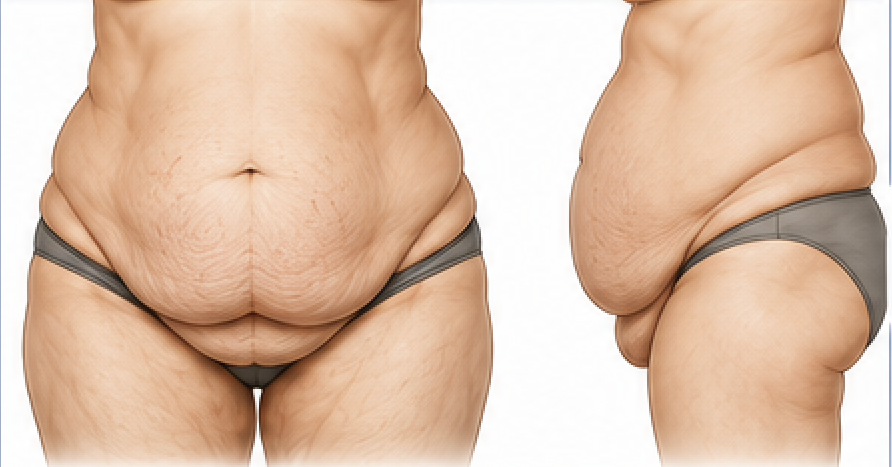
Depending on its size, it may:
- Cover the pubic region
- Extend over the upper thighs
- Trap moisture beneath the skin
- Cause chronic rashes or skin infections
- Make walking and exercise uncomfortable
- Interfere with clothing and personal hygiene
For many patients, the pannus becomes one of the greatest obstacles to fully enjoying the benefits of weight loss.
What Is a Panniculectomy?
A panniculectomy removes the hanging abdominal apron while preserving the remaining abdominal tissues.
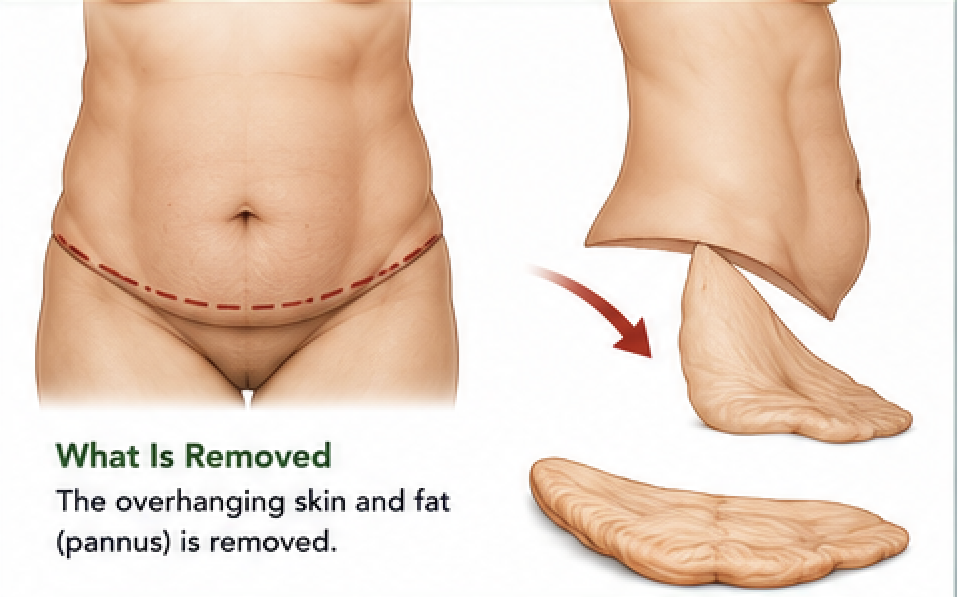
The operation is designed to improve:
- Comfort
- Mobility
- Hygiene
- Skin health
- Quality of life
Because the focus is functional improvement, a panniculectomy usually does not include:
- Tightening of the abdominal muscles
- Significant waist contouring
- Repositioning of the belly button
- Extensive liposuction
These additional procedures are typically associated with a cosmetic abdominoplasty.
Who Is a Good Candidate?
Patients who benefit most from a panniculectomy typically:
- Have a large overhanging abdominal apron.
- Experience recurrent rashes or skin infections.
- Have difficulty with hygiene.
- Experience discomfort during walking or exercise.
- Have reached a stable weight.
- Are medically optimized for surgery.
For patients with significant medical problems, a panniculectomy may also represent a safer and less extensive operation than a full abdominoplasty.
Will Insurance Cover It?
Unlike most body contouring procedures, a panniculectomy may sometimes qualify for insurance coverage.
Coverage generally depends on documentation demonstrating that the pannus causes persistent medical problems, such as:
- 0Chronic skin irritation
- Recurrent infections
- Functional impairment
- Failure of prolonged nonsurgical treatment
Approval policies vary among insurance companies, and coverage is never guaranteed.
What Results Can I Expect?
Most patients notice immediate improvement in comfort.
Walking becomes easier.
Personal hygiene improves.
Skin irritation is often eliminated.
Clothing fits more comfortably.
Although the abdomen is flatter after surgery, patients should understand that a panniculectomy is not intended to create the same cosmetic result as a tummy tuck.
Its greatest benefit is improved function rather than improved body contour.
Recovery
Recovery after a panniculectomy is generally similar to that of other major abdominal contouring procedures.
Patients should expect:
- Temporary swelling
- Drains when appropriate
- Activity restrictions for several weeks
- Gradual return to normal activities
Complete healing continues over many months as swelling resolves and scars mature.
Key Takeaways
“The distinction between panniculectomy and abdominoplasty is a common area of patient confusion.”
- A panniculectomy removes the hanging abdominal apron after major weight loss.
- The operation primarily improves comfort, hygiene, mobility, and skin health.
- It does not usually include muscle repair, belly button repositioning, or waist contouring.
- Some panniculectomies may qualify for insurance coverage when medically necessary.
- The primary goal is functional improvement rather than cosmetic enhancement.
Circumferential Body Lift – 360 Degree Contouring
After major weight loss, excess skin rarely affects only the front of the abdomen.
For many patients, loose skin extends around the entire waist, involving the flanks, lower back, buttocks, and outer thighs. Treating only the front of the abdomen may improve one area while leaving the rest of the lower body unchanged.
That is why some patients benefit from 360° waistline recontouring, also known as a circumferential body lift or lower body lift.
Rather than focusing on one area, this operation reshapes the entire lower trunk.
Why a 360° Approach?
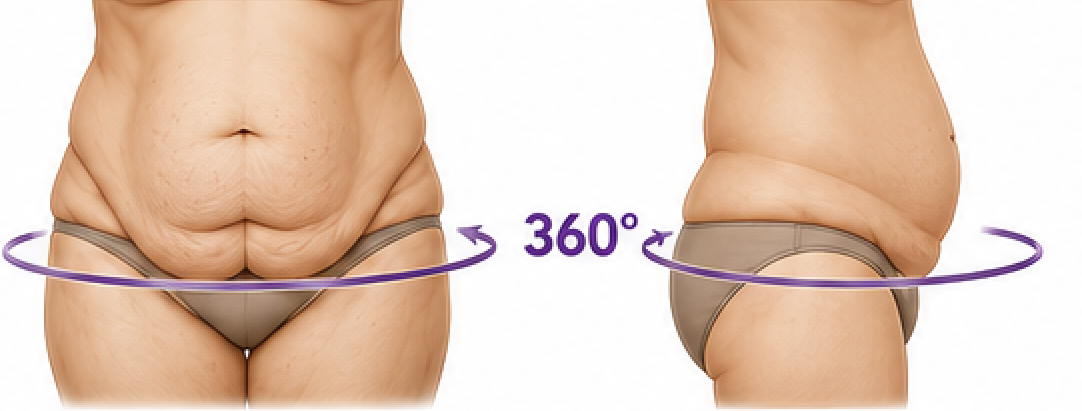
Think of the waist as a continuous ring rather than separate front and back sections.
When excess skin develops after massive weight loss, it usually affects the entire circumference of the body. Tightening only the abdomen is like pulling on one side of a loose belt—the remaining skin on the sides and back stays lax.
A 360° body lift addresses all of these areas together, creating a more balanced and harmonious result.
What Areas Are Improved?
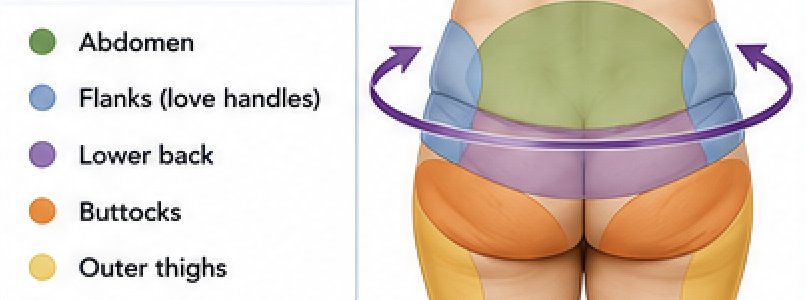
A circumferential body lift can improve:
- The abdomen
- The waist and flanks
- The lower back
- The buttocks
- The outer thighs
By removing excess skin around the entire waistline, the procedure restores smoother body contours from every angle—not just the front.
More Than an Abdominal Operation
Many patients assume this procedure is simply a larger tummy tuck.
It is much more than that.
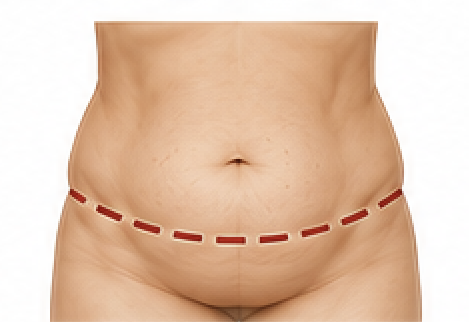
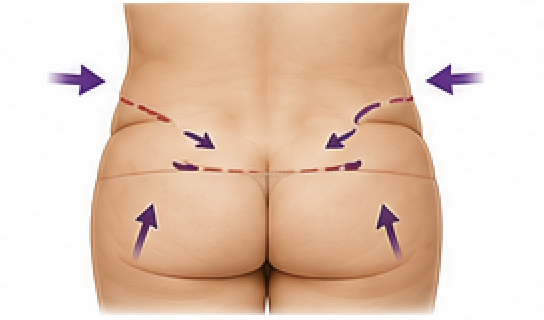
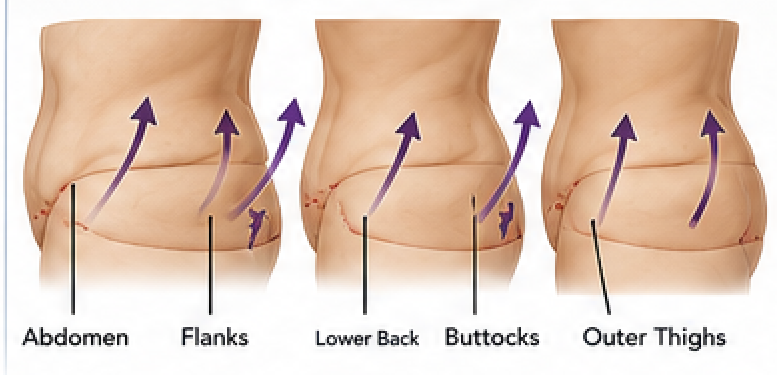
A 360° body lift not only removes excess abdominal skin but also lifts tissues along the sides and back of the body. This often improves buttock position, reduces lower back skin folds, and creates a more defined waistline.
The operation treats the lower trunk as a single anatomical unit.
Who Is a Good Candidate?
The best candidates typically:
- Have significant excess skin around the entire waist.
- Have reached a stable weight.
- Are in good overall health.
- Have realistic expectations.
- Understand the recovery process.
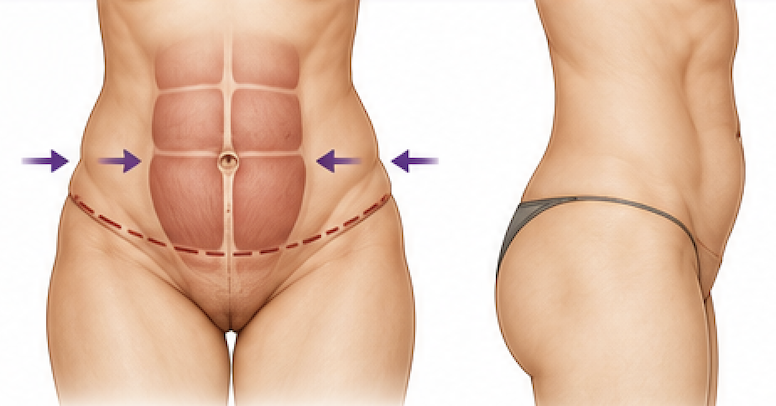
Patients with excess skin confined primarily to the front of the abdomen may achieve excellent results with a standard abdominoplasty instead.
Recovery
Because a circumferential body lift treats multiple areas at the same time, recovery is generally more extensive than after a tummy tuck alone.
Patients should expect:
- Temporary swelling
- Surgical drains when appropriate
- Compression garments
- Activity restrictions for several weeks
- A gradual return to normal activities
Most patients agree that the more comprehensive recovery is worthwhile because of the dramatic improvement in overall body shape.
The Trade-Off
The principal trade-off is a longer scar.
The incision extends around much of the waistline and is intentionally positioned to remain as low as possible so it can usually be concealed beneath underwear or a swimsuit.
For most patients, exchanging excess skin for a well-placed scar is a worthwhile decision.
A Complete Lower Body Transformation
One of the greatest advantages of a 360° body lift is that it improves the body from every viewpoint.
Patients often notice that clothing fits better, the waist appears more defined, the buttocks are elevated, and loose skin around the lower trunk is dramatically reduced.
Rather than treating isolated areas, the procedure restores continuity to the entire lower body.
Key Takeaways
“The 360° Treatment Zone” of the circumferential body lift treats the entire lower trunk as one continuous anatomical unit rather than a collection of separate body regions.”
- A 360° waistline recontouring procedure treats the entire lower trunk—not just the abdomen.
- It improves the abdomen, flanks, lower back, buttocks, and outer thighs.
- It is more comprehensive than a traditional tummy tuck.
- Recovery is longer, but the overall contour improvement is significantly greater.
- The procedure creates a more balanced body shape from every angle.
Pubic Lift (Monsplasty): Correcting a Sagging Pubic Area
After major weight loss, excess skin does not affect only the abdomen.
Many patients also develop significant sagging of the mons pubis, the soft tissue located directly above the genital area. As the abdominal skin stretches downward, it often pulls the pubic tissues with it, creating fullness, drooping, and loss of normal contour.
Although this is not a topic patients often discuss openly, it is a very common concern after massive weight loss.
Fortunately, it can usually be corrected at the same time as abdominal contouring surgery.
Why Does the Pubic Area Sag?
The mons pubis contains skin and fatty tissue that respond to weight gain and weight loss much like the rest of the body.
After significant weight loss, the tissues may:
- Lose elasticity.
- Stretch downward.
- Retain excess fatty tissue.
- Become enlarged or droop below their normal position.
In many patients, the sagging pubic area is simply an extension of the loose lower abdominal skin.
Problems Caused by a Sagging Mons
A low-hanging mons pubis can create both cosmetic and functional concerns.
Patients commonly report:
- Difficulty fitting into clothing
- A visible bulge beneath fitted garments
- Skin irritation or chafing
- Discomfort during exercise
- Difficulty with personal hygiene
- Self-consciousness during intimacy
For some patients, these concerns are every bit as significant as the excess abdominal skin itself.
What Is a Monsplasty?
A monsplasty, also called a pubic lift, restores the mons pubis to a more youthful position.
Depending on the patient’s anatomy, the procedure may include:
- Lifting the pubic tissues
- Removing excess skin
- Reducing excess fatty tissue
- Tightening the remaining tissues
The goal is to create a smoother transition between the lower abdomen and the pubic area while improving both appearance and function.
Is It Performed with a Tummy Tuck?
In most cases, yes.
A pubic lift is commonly performed during:
- Abdominoplasty
- Fleur-de-lis abdominoplasty
- Circumferential body lift
Because the same lower abdominal incision provides access to the mons pubis, no separate visible scar is usually required.
Correcting the abdomen without addressing a significantly sagging mons may leave the lower body contour incomplete.
Recovery
Recovery from a pubic lift is usually no different from recovery after the accompanying abdominal procedure.
Patients should expect:
- Temporary swelling
- Mild bruising
- Temporary tenderness
- Gradual improvement over several weeks
Final contour refinement continues as swelling resolves during the months following surgery.
A Small Procedure with a Big Impact
Although it represents only a small portion of an abdominal contouring operation, correcting a sagging mons pubis often has a surprisingly positive effect on patient satisfaction.
Many patients find that clothing fits better, exercise is more comfortable, and they feel more confident in their appearance.
It is one of those improvements that patients often do not realize they need until they see the final result.
Key Takeaways
“A monsplasty creates an improved transition from the abdomen to the pubic region with a low, concealed incision line.”
- A sagging mons pubis is a common consequence of major weight loss.
- A pubic lift (monsplasty) restores the mons to a more natural position.
- The procedure can improve both function and appearance.
- Monsplasty is commonly performed during tummy tuck or body lift surgery without requiring additional visible scars.
- Correcting the mons often completes the lower abdominal contour and significantly improves patient satisfaction.
Brachioplasty (Arm Lift): Lift Up Your Arms
After significant weight loss, the upper arms are one of the first areas where patients notice loose, hanging skin.
While exercise can strengthen the underlying muscles, it cannot tighten skin that has lost its elasticity. As a result, many patients develop what is commonly called “bat wings”—excess skin that hangs from the upper arm and becomes more noticeable when the arms are raised.
An arm lift, or brachioplasty, removes this excess skin to restore a smoother, firmer, and more proportional arm contour.
Why Do the Arms Sag?
The upper arms naturally store fat.
As weight is gained and lost, the skin stretches to accommodate changes in volume. After massive weight loss, the skin often cannot contract enough to match the smaller arm.
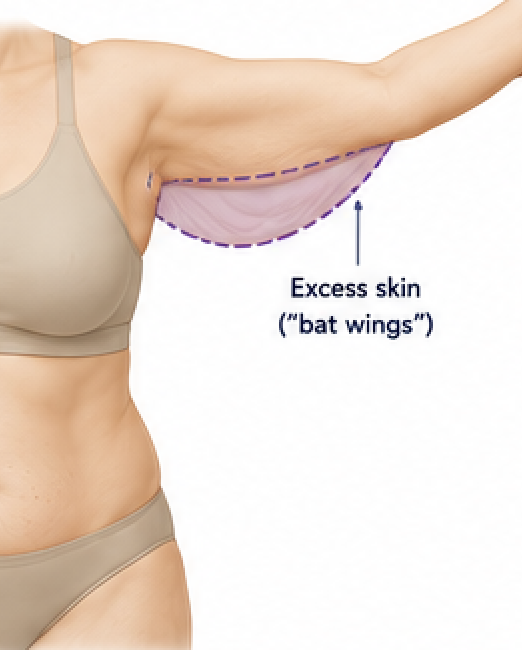
The result is loose skin that may:
- Hang from the upper arm.
- Rub against the chest or torso.
- Interfere with exercise.
- Make fitted clothing uncomfortable.
- Cause embarrassment when wearing short sleeves.
The amount of sagging varies from patient to patient, but once the skin has lost its elasticity, surgery is usually the only effective treatment.
What Is Brachioplasty?
Brachioplasty removes excess skin and, when necessary, a small amount of fat from the upper arm.
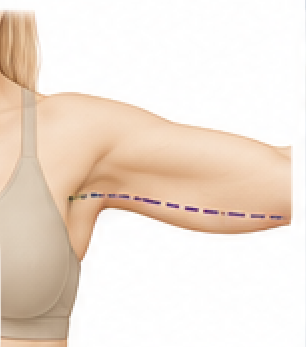
The remaining tissues are tightened to create a smoother contour extending from the armpit toward the elbow.
Depending on the amount of excess skin, the incision may be:
- Limited to the armpit.
- Extended along the inner upper arm.
- Continued to the elbow in patients with severe skin excess.
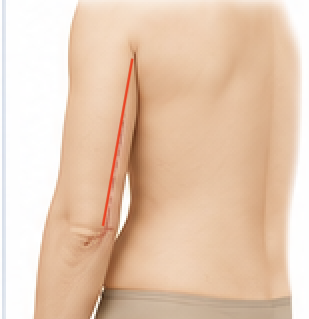
The incision is carefully positioned along the inner or back portion of the arm where it is less visible during normal activities.
Is Liposuction Enough?
Many patients ask whether liposuction alone can correct loose upper arms.
The answer depends on skin quality.
Liposuction removes fat, but it does not tighten loose skin.
For patients with significant skin laxity after major weight loss, liposuction alone often makes the problem more noticeable by removing additional volume without addressing the excess skin.
Brachioplasty is usually required when substantial skin redundancy is present.
Recovery
Recovery after an arm lift is generally straightforward.
Patients should expect:
- Temporary swelling
- Mild bruising
- Compression garments
- Temporary limitations in lifting and overhead activities
- Gradual return to normal arm movement over several weeks
Walking and light daily activities begin almost immediately, while strenuous upper-body exercise is delayed until healing is more complete.
The Trade-Off
The primary trade-off is a scar along the upper arm.
Although the scar is permanent, it usually fades considerably over time.
Most patients readily accept the scar in exchange for arms that no longer have loose, hanging skin.
When wearing the arms naturally at the sides, the scar is typically much less noticeable than patients anticipate before surgery.
A New Confidence
Patients frequently report that an arm lift changes more than just the appearance of their arms.
Many become comfortable wearing:
- Short-sleeved shirts
- Sleeveless tops
- Swimsuits
- Athletic clothing
For the first time in years, they no longer feel the need to hide their arms.
Key Takeaways
“Brachioplasty—not exercise or liposuction—is the definitive treatment for loose upper arm skin after major weight loss.”
- Brachioplasty removes excess skin from the upper arms after major weight loss.
- Exercise strengthens muscle but cannot tighten loose skin.
- Liposuction alone is usually insufficient when significant skin laxity is present.
- The main trade-off is a permanent but generally well-concealed scar.
- Arm lift surgery restores smoother arm contours and improves confidence in wearing short sleeves and sleeveless clothing.
Brachioplasty Incisions: Which Scar Is Right for You?
Once patients decide to undergo an arm lift, the next question is almost always the same:
“Where will the scar be?”
The answer depends on how much excess skin is present and where it is located. No single incision works for every patient, so the surgical approach is tailored to the amount and distribution of loose skin.
The goal is always the same—to achieve the best contour while placing the scar where it is least noticeable during everyday activities.
Why Does Incision Location Matter?
Removing excess skin requires an incision.
The greater the amount of loose skin, the longer the incision generally needs to be. Although everyone prefers the shortest possible scar, limiting the incision too much can leave behind loose skin and compromise the final result.
The best scar is not necessarily the smallest one—it is the one that produces the best overall arm contour.
The Three Basic Incision Options
Axillary Brachioplasty
Patients with only a small amount of loose skin near the armpit may be candidates for an axillary brachioplasty.
The incision is hidden within the natural crease of the armpit.
Advantages
- Smallest scar
- Well concealed
- Short recovery
Limitations
- Removes only a limited amount of skin
- Not appropriate after major weight loss
Standard Brachioplasty
For most patients following significant weight loss, the standard brachioplasty is the preferred approach.
The incision extends from the armpit toward the elbow along the inner or posterior aspect of the upper arm.
This location keeps the scar relatively hidden when the arms rest naturally at the sides while allowing removal of a substantial amount of excess skin.
Advantages
- Excellent contour improvement
- Reliable skin removal
- Appropriate for most weight-loss patients
Trade-Off
- A longer permanent scar
Extended Brachioplasty
Some patients have loose skin that extends beyond the upper arm onto the side of the chest.
In these cases, the incision may continue across the armpit and onto the lateral chest wall.
This is known as an extended brachioplasty.
Although the scar is longer, it removes excess skin that would otherwise remain untreated.
Can the Scar Be Hidden?
A common misconception is that the scar can be completely invisible.
Unfortunately, that is not possible.
Instead, surgeons position the scar where it is least noticeable during normal activities.
When the arms rest comfortably at the sides, the incision usually lies along the inner or back portion of the arm, making it far less visible from the front.
Over time, scars generally soften and fade, although they never disappear completely.
Choosing the Right Incision
The appropriate incision is determined by your anatomy—not by patient preference alone.
Factors that influence the decision include:
- The amount of excess skin
- Skin elasticity
- Distribution of skin laxity
- Extension of loose skin onto the chest
- Desired contour improvement
Trying to avoid a longer incision when it is truly needed often leads to a less satisfying result.
Balancing Contour and Scar
Every brachioplasty represents a balance between contour improvement and scar length.
Most patients who have lived with loose, hanging arm skin find that the improved arm shape is well worth the trade-off of a carefully placed scar.
As the scar matures over the following year, it typically becomes much less noticeable than patients anticipated before surgery.
Key Takeaways
“The scar placement in arm lifts is designed to maximize contour improvement while minimizing everyday visibility.”
- The amount of loose skin determines the appropriate brachioplasty incision.
- Three basic options include axillary, standard, and extended brachioplasty.
- Longer incisions allow more complete skin removal and better contour improvement.
- Scars are placed along the inner or posterior arm to reduce their visibility.
- The best incision is the one that achieves the best overall contour—not necessarily the shortest scar.
Elbow Lift Surgery: Refining the Lower Arm Contour
Most patients think of an arm lift as a procedure that improves the upper arm.
However, after major weight loss, loose skin may also extend around the elbow, creating wrinkles, folds, and excess tissue that can remain noticeable even after a well-performed brachioplasty.
In carefully selected patients, an elbow lift can improve this area and complete the contour of the entire arm.
Why Does the Elbow Develop Loose Skin?
The skin around the elbow is naturally thin and highly mobile, allowing the arm to bend freely.
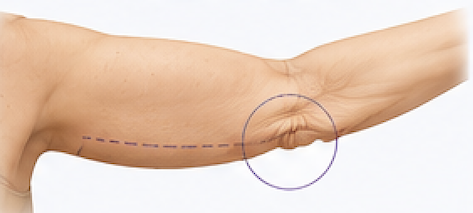
After significant weight loss, this skin may lose its elasticity and fail to retract completely, leaving:
- Wrinkled skin around the elbow
- Redundant skin folds
- Residual laxity below a brachioplasty incision
- A visible transition between the upper arm and forearm
Although these changes are usually mild, they can be bothersome to patients seeking the smoothest possible arm contour.
What Is an Elbow Lift?
An elbow lift removes a limited amount of excess skin from around the elbow.
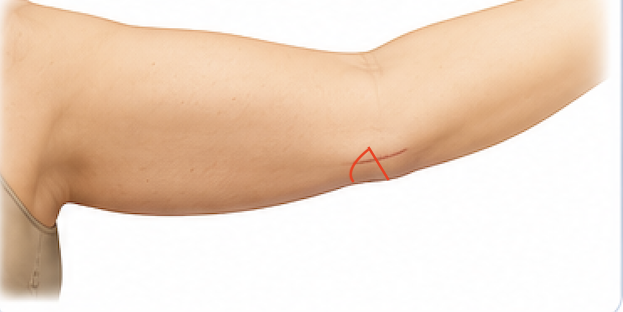
The goal is not to change the shape of the elbow itself, but rather to tighten the loose skin surrounding it so that the contour of the arm appears smoother and more continuous.
The procedure is relatively small compared with a brachioplasty and is often performed at the same time as an arm lift or an isolated procedure later.
Who Is a Good Candidate?
An elbow lift is appropriate only for selected patients.
Good candidates include those who:
- Have persistent loose skin around the elbow after weight loss.
- Have skin laxity extending beyond the lower end of the planned brachioplasty.
- Desire the smoothest possible contour from the shoulder to the forearm.
Patients whose loose skin is confined to the upper arm generally do not require a separate elbow lift.
Is It Commonly Performed?
No.
Most brachioplasty procedures provide excellent improvement without extending surgery around the elbow.
An elbow lift is considered only when excess skin remains that would otherwise interrupt the overall contour of the arm.
For this reason, it is a relatively uncommon procedure and is reserved for carefully selected patients.
Recovery
Recovery is usually similar to that of a brachioplasty.
Patients should expect:
- Mild swelling
- Temporary bruising
- A short period of activity modification
- Progressive scar maturation over several months
Because the elbow is constantly moving during daily activities, careful attention to wound care helps promote optimal healing.
The Trade-Off
As with any skin-tightening procedure, the benefit of improved contour comes with an additional scar.
Fortunately, the incision is relatively short and is positioned within the natural contour of the elbow whenever possible.
For patients with significant skin redundancy in this area, the improvement in contour often outweighs the presence of the scar.
Completing the Arm
Although rarely performed as a stand-alone procedure, an elbow lift can provide the finishing touch for selected patients undergoing post-weight-loss arm contouring.
By smoothing the transition from the upper arm to the forearm, it creates a more continuous, balanced appearance that complements the results of brachioplasty.
Key Takeaways
“An elbow lift is a refinement procedure designed to complete the overall arm contour or as a stand-alone operation.”
- An elbow lift treats localized loose skin around the elbow after major weight loss.
- It is usually performed as an adjunct to brachioplasty rather than as a stand-alone procedure.
- The operation removes a limited amount of excess skin to improve lower arm contour.
- Only selected patients require an elbow lift.
- The procedure can complete the aesthetic result of an arm lift by creating a smoother transition to the forearm.
Upper Body Lift: Reshaping the Upper Torso After Weight Loss
Massive weight loss changes the entire body—not just the abdomen and waist.
Many patients also develop loose skin around the upper torso, including the upper back, sides of the chest, and beneath the arms. Even after procedures such as an arm lift or breast surgery, excess skin in these areas may remain and become visible when wearing fitted clothing or swimsuits.
An upper body lift addresses these concerns by removing excess skin from the upper trunk, creating smoother body contours and restoring better overall proportions.
Why Does the Upper Torso Sag?
During weight gain, the skin of the chest, back, and sides stretches to accommodate increased fat deposits.
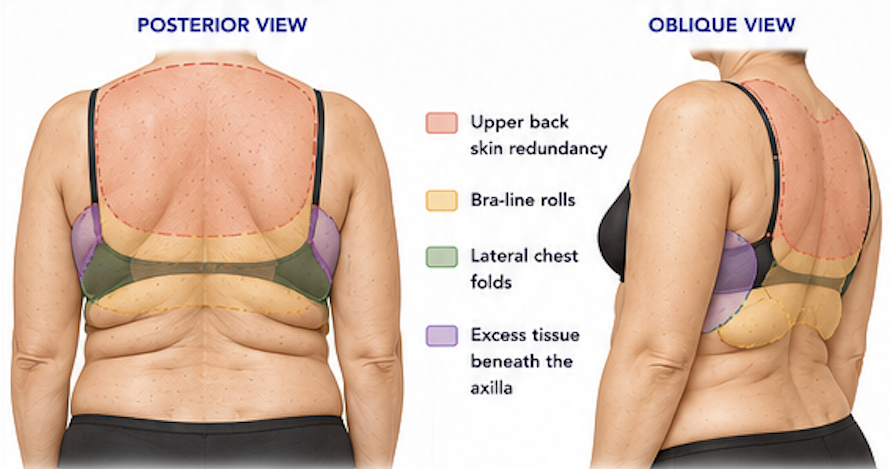
After substantial weight loss, the skin often cannot retract completely. As a result, patients may notice:
- Rolls of loose skin along the upper back
- Redundant skin beneath the armpits
- Excess skin along the sides of the chest
- Bra-line folds in women
- Skin that extends from the upper arm onto the lateral chest
These changes often become more noticeable after the abdomen has been improved, making the upper torso the next area patients wish to address.
What Is an Upper Body Lift?
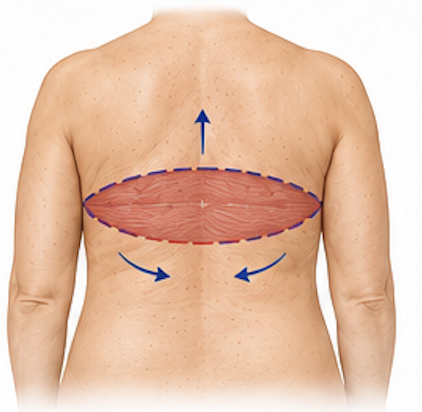
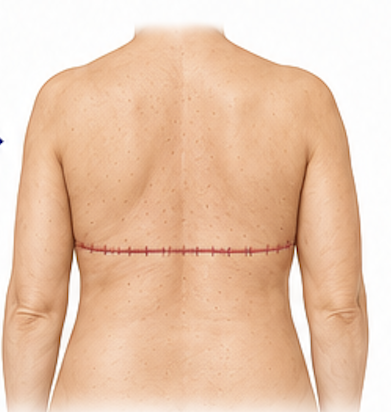
An upper body lift removes excess skin from the upper trunk through carefully planned incisions that extend across the upper back and lateral chest.
Depending on the patient’s needs, the procedure may be combined with:
- Brachioplasty (arm lift)
- Breast lift (mastopexy)
- Breast reduction
- Breast augmentation
- Gynecomastia surgery in men
By treating multiple adjacent areas together, the surgeon can create smoother transitions and a more balanced upper body contour.
Who Is a Good Candidate?
The best candidates typically:
- Have reached a stable weight.
- Have significant upper back and lateral chest skin laxity.
- Are in good overall health.
- Have realistic expectations regarding scars and recovery.
Patients with excess skin limited to the upper arms or breasts usually do not require a complete upper body lift.
Recovery
Recovery depends on the number of procedures performed simultaneously.
Most patients experience:
- Temporary swelling
- Mild bruising
- Compression garments when appropriate
- Activity restrictions for several weeks
- Gradual return to full upper-body activity
Because several areas are often treated at the same operation, recovery may be somewhat longer than for a single contouring procedure.
The Trade-Off
The major trade-off is a scar that extends across portions of the upper back and lateral chest.
These scars are intentionally placed along natural clothing lines whenever possible, such as beneath the bra line in women or within the natural transition between the back and chest.
Although permanent, the scars generally fade over time and are usually well accepted by patients because of the significant improvement in body contour.
Completing the Upper Torso
An upper body lift is often the final step in comprehensive upper-body contouring after major weight loss.
By treating the back, sides of the chest, and adjacent tissues as one continuous unit, the procedure creates a smoother silhouette from every angle.
For many patients, it provides the finishing touch that restores balance to the upper body and allows clothing to fit more comfortably and confidently.
Key Takeaways
“An upper body lift restores continuity to the entire upper torso—creating smoother contours from every angle rather than treating isolated areas.”
- An upper body lift removes excess skin from the upper back, lateral chest, and adjacent upper torso.
- It is often combined with arm lift or breast procedures for comprehensive contouring.
- The operation is intended for patients with circumferential upper trunk skin laxity after major weight loss.
- Recovery depends on the number of procedures performed.
- Although longer scars are required, the improvement in upper body shape and clothing fit is often dramatic.
The Deflated Female Breast: Restoring Shape After Weight Loss
Many women expect to lose fat from their abdomen, waist, and thighs after major weight loss.
What often surprises them is how dramatically their breasts change.
Because much of the breast consists of fatty tissue, significant weight loss frequently leaves the breasts smaller, flatter, and less supported. Combined with stretched skin, the result is what many women describe as a “deflated” breast.
Although disappointing, this is one of the most common—and most treatable—changes following massive weight loss.
Why Do the Breasts Deflate?
The female breast is composed of:
- Breast gland tissue
- Fat
- Skin
- Supporting ligaments
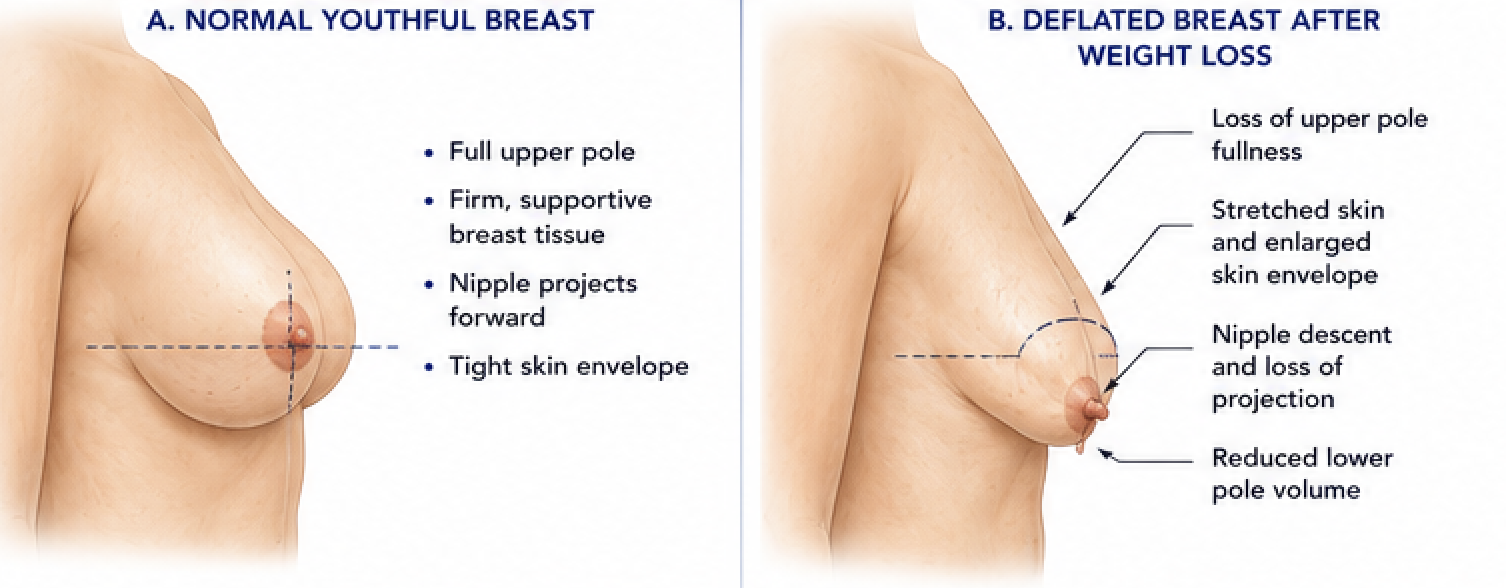
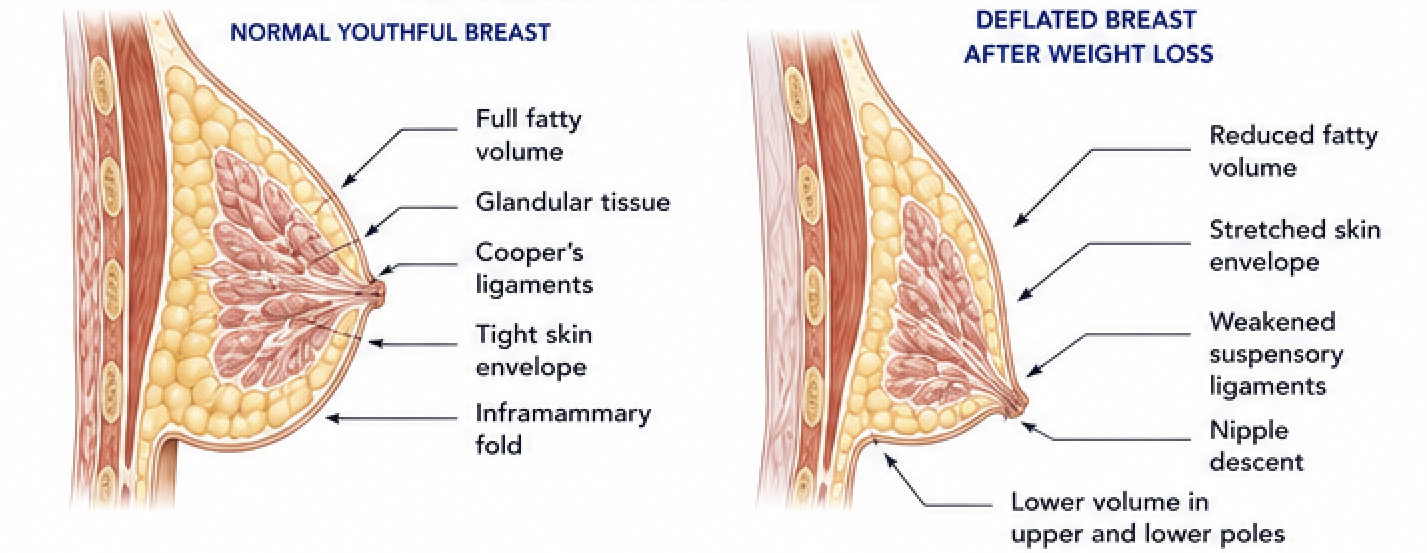
Weight loss primarily reduces the fat within the breast. As volume decreases, the stretched skin and supporting tissues often cannot shrink enough to match the smaller breast.
The result is:
- Loss of upper breast fullness
- Flattening of the breast
- Sagging (ptosis)
- Downward-pointing nipples
- Loose breast skin
Every woman experiences these changes differently, depending on age, genetics, skin quality, pregnancy history, and the amount of weight lost.
More Than Just Smaller Breasts
Many women assume they simply need larger breasts again.
In reality, restoring breast shape is usually more important than restoring breast size.
A breast that has lost volume but still has significant loose skin often requires lifting as well as volume restoration. Simply increasing breast size without correcting sagging may not produce the most natural or attractive result.
The goal is to recreate a youthful breast shape—not just a larger breast.
What Are the Treatment Options?
Treatment depends on the degree of volume loss and skin laxity.
Options include:
Breast Lift (Mastopexy)
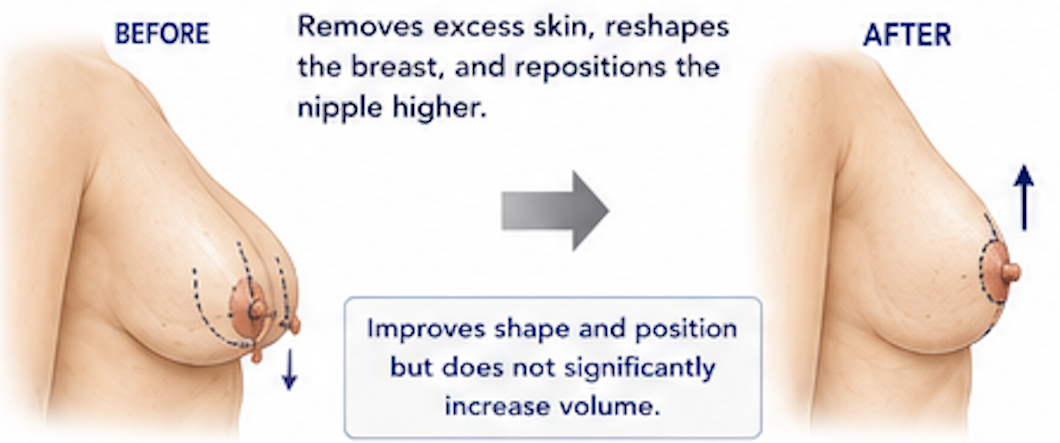
A breast lift removes excess skin and repositions the nipple and breast tissue to a more youthful location.
This restores breast shape but does not significantly increase breast volume.
Breast Augmentation
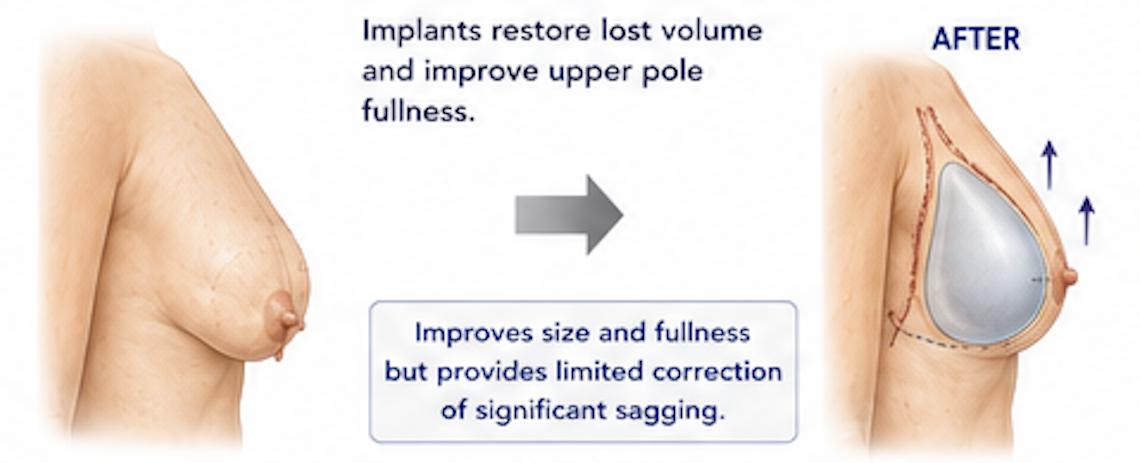
Breast implants restore lost fullness and improve upper-pole projection.
Implants are particularly helpful for women who desire increased breast size or wish to replace volume lost during weight loss.
Breast Lift with Implants
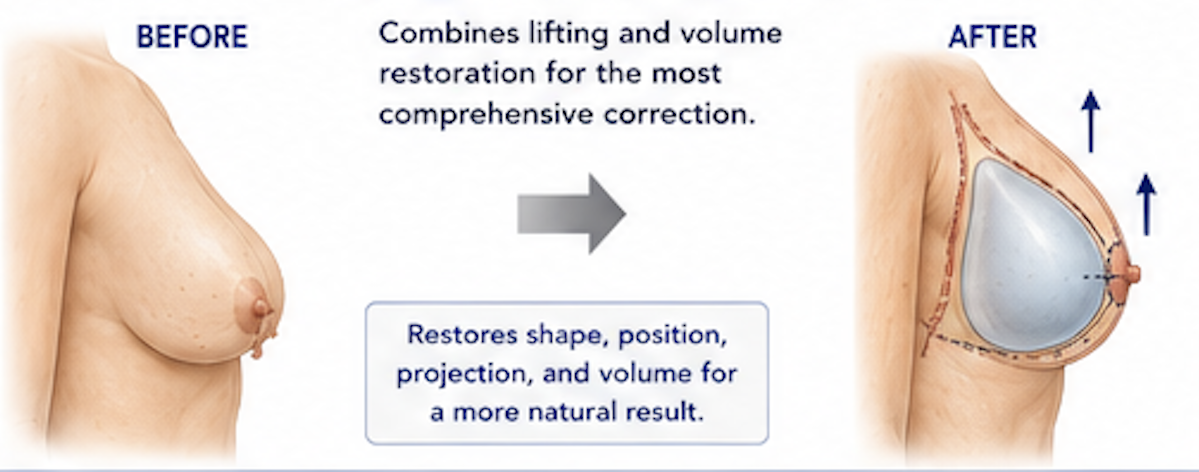
Many post-weight-loss patients benefit from combining both procedures.
The lift reshapes the breast while the implant restores fullness, producing a more balanced and youthful contour than either procedure alone.
Choosing the Right Operation
The best procedure depends on your goals.
Some women simply want to restore the breast volume they once had.
Others prefer a smaller but firmer breast.
Still others desire both lifting and increased fullness.
A careful examination and discussion with your plastic surgeon will determine the operation—or combination of procedures—that best matches your anatomy and expectations.
Recovery
Recovery depends on the procedure performed.
Most women experience:
- Mild to moderate discomfort
- Temporary swelling
- Bruising
- Supportive surgical bra use
- Gradual return to normal activities over several weeks
Breast shape continues to evolve during the months following surgery as swelling resolves and the tissues settle into their final position.
Restoring Confidence
Breast restoration after major weight loss is about much more than appearance.
Many women report feeling that their new breasts better reflect the healthier body they worked so hard to achieve.
Whether the treatment involves a lift, implants, or both, restoring breast shape often becomes one of the most satisfying steps in completing the weight-loss journey.
Key Takeaways
“Successful breast rejuvenation after weight loss restores both shape and proportion—not simply breast size.”
- Weight loss commonly causes loss of breast volume and skin support, creating a “deflated” appearance.
- Restoring breast shape is usually more important than simply increasing breast size.
- Treatment options include breast lift, breast augmentation, or a combination of both.
- The best procedure depends on breast volume, skin laxity, and personal goals.
- Breast rejuvenation helps restore body proportions and confidence after major weight loss.
Breast Lift Surgery (Mastopexy): Restoring Position and Shape
After major weight loss, many women are bothered less by the size of their breasts than by how low they sit on the chest.
As breast volume decreases and the supporting tissues stretch, the breasts descend, the nipples point downward, and the skin envelope becomes loose. The result is a breast that appears elongated, flattened, and less youthful.
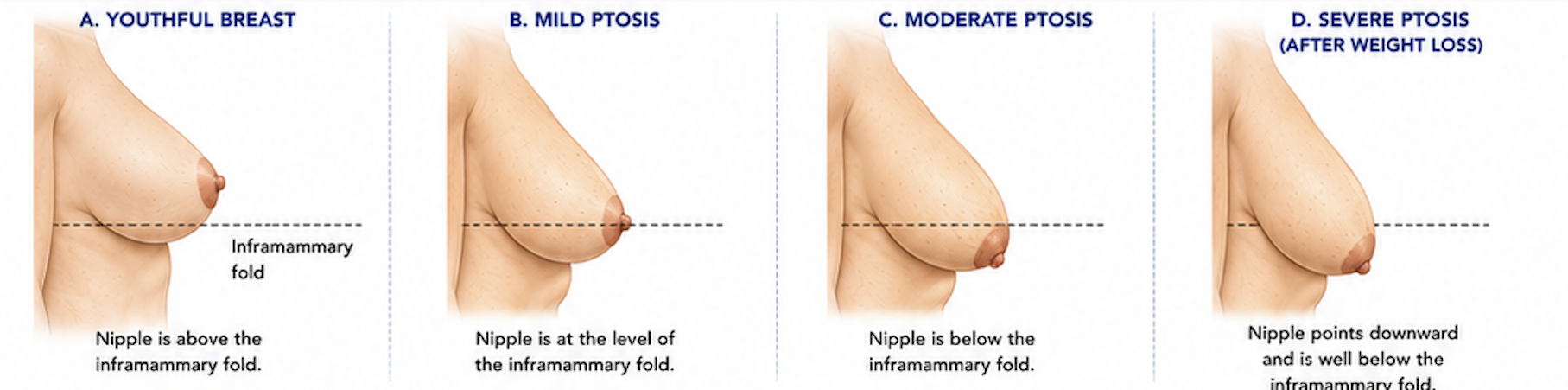
This is known as ptosis which is known to occur in varying degrees. This prosis scale is very important as it affects how breast lift surgery is performed.
A breast lift, or mastopexy, is designed to restore the breast to a higher, more natural position while improving its overall shape.
What Does a Breast Lift Correct?
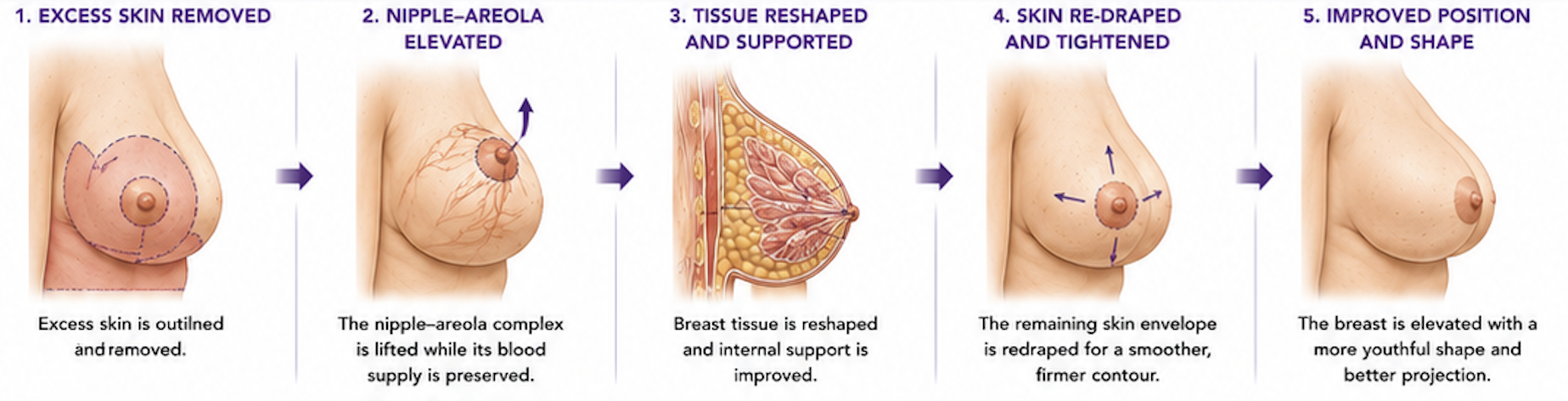
A mastopexy reshapes the breast by:
- Removing excess skin
- Tightening the remaining skin envelope
- Repositioning the nipple and areola
- Reshaping the existing breast tissue
- Restoring a more youthful breast contour
A breast lift improves shape and position, but it does not significantly increase breast size.
When Is a Breast Lift Enough?
Some women have adequate breast volume but significant sagging.
For these patients, a breast lift alone may provide excellent improvement.
The breast becomes firmer, the nipple returns to a more youthful position, and the overall contour is restored without increasing breast size.
Women who are satisfied with their breast volume but unhappy with drooping are often ideal candidates for mastopexy alone.
When Are Implants Needed?
If significant breast volume has been lost after weight reduction, a lift by itself may not restore the desired fullness—particularly in the upper portion of the breast.
In these patients, combining a breast lift with implants often provides the most complete correction.
The lift restores position and shape, while the implant replaces lost volume and improves upper-pole fullness.
The choice depends on your anatomy and your personal goals.
Where Are the Scars?
Every breast lift requires incisions to remove excess skin.
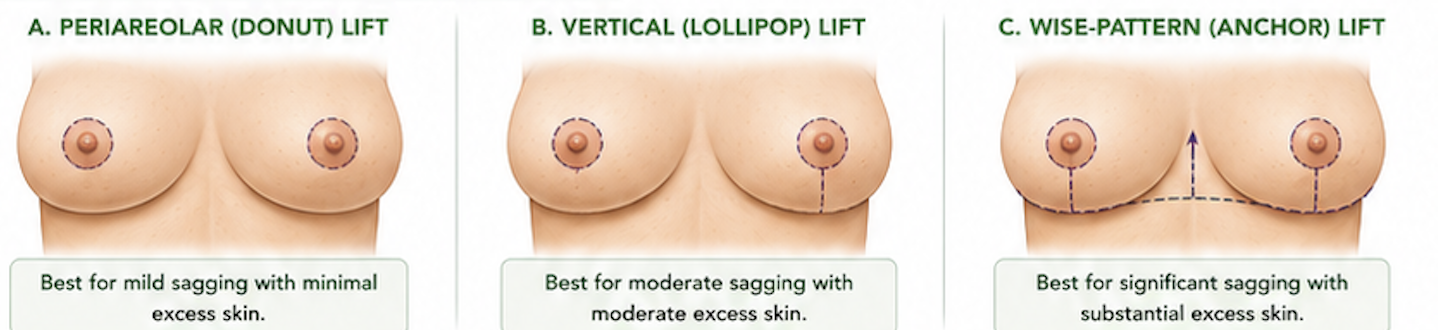
The pattern depends on the amount of sagging and may include:
- Around the areola only
- Around the areola with a vertical incision
- An anchor-shaped incision for more significant skin excess
Although permanent, these scars usually fade considerably over time and are strategically placed to be concealed beneath bras, swimsuits, and most clothing.
For most women, the improvement in breast shape far outweighs the visibility of the scars.
Recovery
Recovery from mastopexy is generally well tolerated.
Patients can expect:
- Mild to moderate discomfort
- Temporary swelling
- Bruising
- A supportive surgical bra for several weeks
- Progressive improvement in breast shape over several months
Most normal daily activities resume within a few days, while strenuous exercise is postponed until healing is more complete.
More Than a Breast Lift
Many women describe their breasts after surgery as looking more like they did before weight gain, pregnancy, or major weight loss.
A breast lift does not simply move the breasts higher—it restores balance, proportion, and a more youthful shape.
For women who are satisfied with their breast size but unhappy with sagging, mastopexy alone can be one of the most rewarding procedures after weight loss.
Key Takeaways
“A breast lift restores youthful breast shape and position. When additional fullness is desired, implants can be combined with the lift to restore both shape and volume.”
- A breast lift restores breast position and shape by removing excess skin and elevating the nipple.
- Mastopexy improves breast contour but does not significantly increase breast volume.
- Women with significant volume loss may benefit from combining a breast lift with implants.
- Several incision patterns are available depending on the degree of breast sagging.
- Restoring breast shape often has a profound impact on body proportions and self-confidence after weight loss.
The Anchor Breast Lift: Why the Wise-Pattern Is Often the Best Choice
After major weight loss, many women develop severe breast sagging that cannot be adequately corrected with a limited breast lift.
The combination of stretched skin, loss of breast volume, and significant nipple descent often requires a more comprehensive approach.
For these patients, the anchor breast lift, also known as the Wise-pattern mastopexy, remains the most effective technique for restoring breast shape and position.
Why Is an Anchor Lift Needed?
A breast lift works by removing excess skin and reshaping the breast.
When only a small amount of skin needs to be removed, shorter incision patterns may be sufficient.
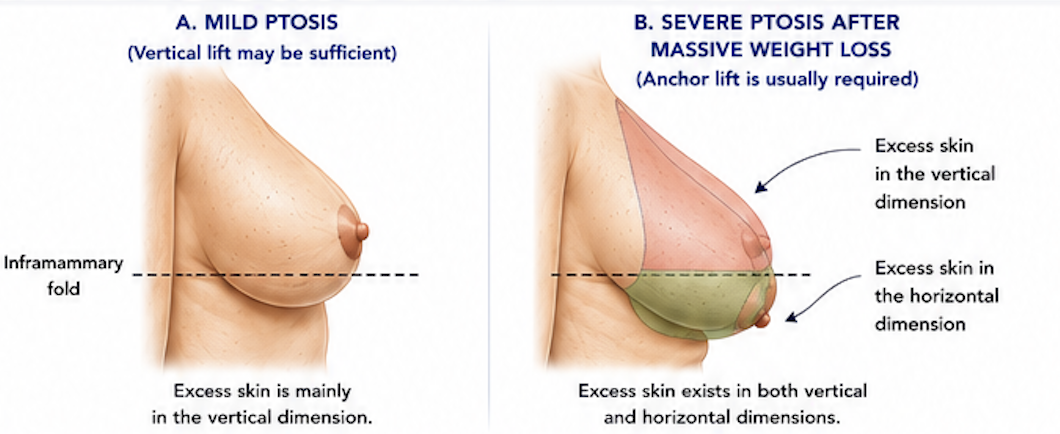
However, after massive weight loss, there is often excess skin in both the vertical and horizontal dimensions. Trying to correct this with a smaller incision can leave loose skin, flatten the breast, or create an unnatural shape.
The anchor pattern allows the surgeon to remove skin in multiple directions while creating a more youthful breast contour.
What Makes It an “Anchor” Lift?
The name comes from the shape of the incision.
It consists of three components:
- Around the areola
- A vertical incision from the lower edge of the areola to the breast fold
- A horizontal incision hidden within the inframammary fold
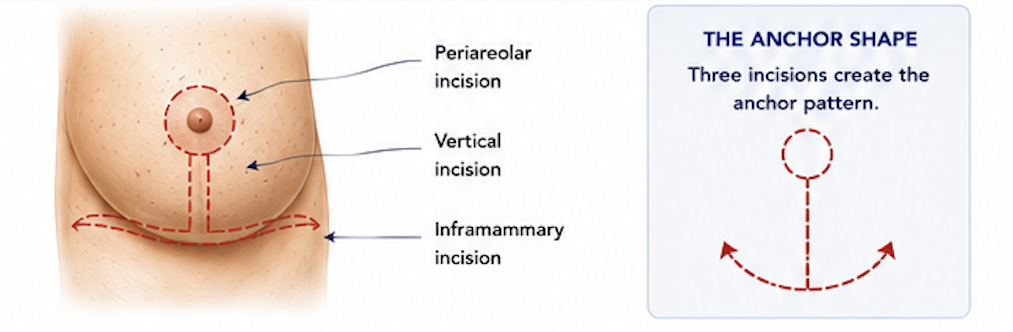
Together, these incisions resemble the outline of a ship’s anchor.
Although longer than other breast lift incisions, this pattern provides the greatest flexibility for reshaping the breast.
What Can an Anchor Lift Accomplish?
The Wise-pattern breast lift can:
- Elevate the nipple to a more youthful position
- Remove large amounts of excess skin
- Improve breast projection
- Reshape the breast into a more natural contour
- Correct severe breast ptosis after weight loss
It is especially valuable when skin laxity is too extensive for less comprehensive lift techniques.
Can Implants Be Added?
Yes.
Many women who have lost significant breast volume also desire fuller breasts.
In these patients, implants can be placed at the same operation.
The anchor lift restores breast position and shape, while the implants restore upper-pole fullness and overall volume.
Together, the procedures provide comprehensive breast rejuvenation.
The Trade-Off
The principal trade-off is a longer scar.
While the anchor pattern creates more visible scars than smaller lift techniques, it also produces the greatest improvement in breast shape for women with severe skin excess.
Fortunately, the horizontal scar is hidden within the breast crease, and all incision lines generally soften and fade over time.
For most post-weight-loss patients, the improvement in breast contour far outweighs the presence of the scars.
Why It Remains the Gold Standard
Newer breast lift techniques often promise shorter scars.
While these approaches can work well for women with mild breast sagging, they are frequently inadequate after massive weight loss.
For patients with significant skin excess, the Wise-pattern mastopexy continues to provide the most reliable, predictable, and aesthetically pleasing results.
It remains the gold standard because it addresses the problem completely rather than simply minimizing the incision.
Key Takeaways
“The anchor breast lift is not about creating a longer scar—it is about providing enough skin removal and reshaping to restore a natural, youthful breast after massive weight loss.”
- The anchor (Wise-pattern) breast lift is the most effective procedure for correcting severe breast sagging after major weight loss.
- The incision includes a periareolar, vertical, and inframammary component.
- It removes excess skin in both vertical and horizontal directions, allowing comprehensive breast reshaping.
- Implants can be added when breast volume restoration is also desired.
- Although the scars are longer, the improvement in breast shape and contour is often dramatically superior to shorter-scar techniques.
Breast Lift with Implants: Restoring Shape and Volume
After major weight loss, many women lose not only breast position but also breast volume.
A breast lift can restore the breast to a more youthful position, but it cannot replace the fullness that has disappeared with weight loss. Likewise, an implant alone can restore volume but cannot adequately correct significant sagging.
For many post-weight-loss patients, combining a breast lift (mastopexy) with breast implants provides the most complete breast rejuvenation.
Why Combine the Procedures?
Think of the breast as having two separate problems after major weight loss:
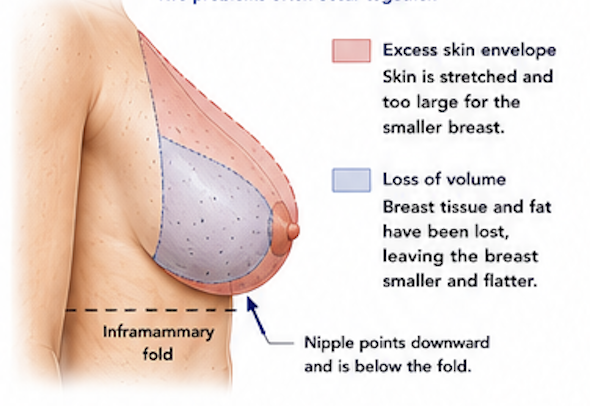
- The skin envelope has become too large.
- The breast volume inside the skin has become too small.
A breast lift addresses the excess skin by tightening and reshaping the breast.
An implant restores the lost volume by filling the breast and improving upper-pole fullness.
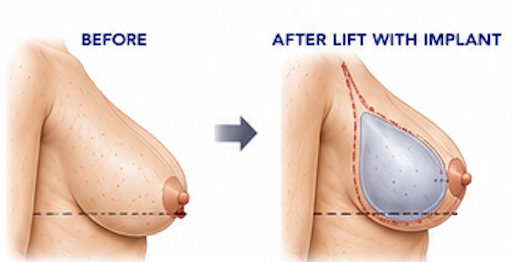
Together, they recreate a breast that is both elevated and proportionate.
What Does Each Procedure Contribute?
Breast Lift
A mastopexy:
- Removes excess skin
- Elevates the nipple and areola
- Reshapes the breast tissue
- Restores a more youthful breast position
However, it does not significantly increase breast size.
Breast Implant
An implant:
- Restores lost breast volume
- Improves upper-pole fullness
- Increases projection
- Enhances overall breast proportions
An implant alone, however, cannot reliably correct significant breast ptosis.
Why Not Simply Use a Larger Implant?
Some women wonder whether a larger implant could eliminate the need for a breast lift.
Unfortunately, it cannot.
A large implant placed into a loose, stretched skin envelope often creates a heavier breast that continues to sag over time. Instead of producing a youthful contour, it may accentuate the existing problem.
The best long-term results usually come from combining the appropriate implant size with a properly performed breast lift.
Choosing the Right Implant
Selecting the implant is about more than cup size.
Your surgeon will consider:
- Your chest width
- Remaining breast tissue
- Skin quality
- Degree of breast sagging
- Desired fullness and projection
- Overall body proportions
The goal is to choose an implant that complements the lift rather than overwhelms it.
Recovery
Recovery after a breast lift with implants is similar to recovery after a breast lift alone, although there may be slightly more tightness as the tissues adjust to the implant.
Patients should expect:
- Temporary swelling
- Mild to moderate discomfort
- Bruising
- A supportive surgical bra
- Gradual settling of the implants over several months
Final breast shape develops as swelling resolves and the tissues soften around the implants.
The Best of Both Procedures
For many women after major weight loss, combining a breast lift with implants offers the most natural and balanced result.
The lift restores youthful position.
The implant restores youthful volume.
Together, they recreate breast proportions that better match the healthier body achieved through weight loss.
Key Takeaways
“A breast lift reshapes the breast. An implant restores volume. Together they provide the most complete breast rejuvenation for many women after massive weight loss.”
- Weight loss often causes both breast sagging and loss of volume.
- A breast lift corrects position and shape but does not significantly increase fullness.
- Breast implants restore volume but cannot adequately correct major sagging by themselves.
- Combining the two procedures provides comprehensive breast rejuvenation for many post-weight-loss patients.
- Choosing the correct implant size is essential for achieving balanced, natural-looking results.
The Male Chest After Weight Loss: Restoring a Masculine Contour
Massive weight loss transforms the male chest as dramatically as it changes the abdomen or arms.
While losing excess fat is an important achievement, many men are disappointed to find that the chest does not develop the firm, athletic appearance they expected. Instead, loose skin, flattened muscles, and residual fullness may leave the chest looking soft or even feminine.
The goal of post-weight-loss chest contouring is to restore a flatter, firmer, and more masculine chest.
Why Does the Male Chest Change?
During weight gain, fat accumulates beneath the skin of the chest, stretching both the skin and the supporting tissues.
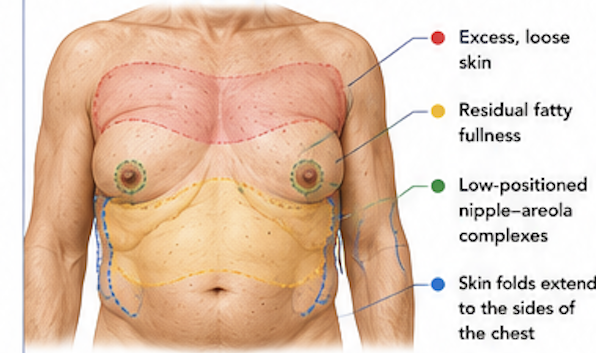
After major weight loss, much of the fat disappears, but the stretched skin often remains. Depending on age, skin quality, and the amount of weight lost, men may develop:
- Loose hanging skin
- Flattening of the chest contour
- Residual fatty fullness
- Enlarged or low-positioned nipples
- Skin folds extending toward the sides of the chest
Rather than revealing a muscular chest, weight loss may expose the effects of stretched skin and long-standing tissue laxity.
What Problems Need to Be Corrected?
Every patient is different, but treatment usually addresses one or more of three problems:
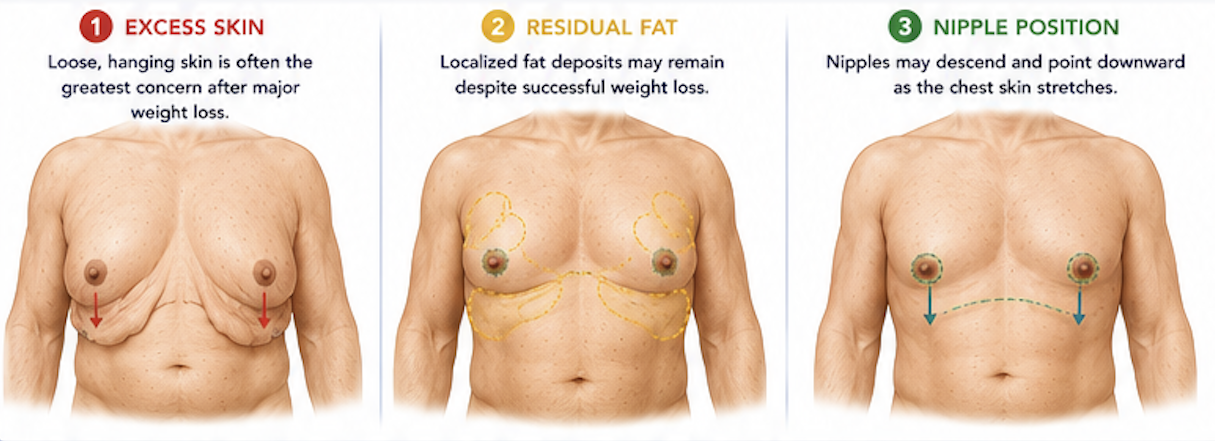
Excess Skin
Loose skin is often the greatest concern after major weight loss.
Removing this excess skin is usually the most important step in restoring a masculine chest contour.
Residual Fat
Some men retain localized fat deposits despite successful weight loss.
These areas can often be improved with liposuction when skin quality is adequate or combined with skin excision when necessary.
Nipple Position
As the chest skin descends, the nipples frequently move lower and may point downward.
Chest contouring surgery often includes repositioning the nipple–areola complex to a more natural, masculine location.
Surgical Options
The operation is customized to the severity of skin excess.
Treatment may include:
- Liposuction alone (selected patients)
- Skin excision
- Male chest lift
- Extended upper body lift when excess skin continues onto the lateral chest and back
The objective is always to create a flatter chest with smooth transitions into the surrounding torso.
Recovery
Recovery depends on the extent of surgery performed.
Most men should expect:
- Temporary swelling
- Bruising
- Compression garment use
- Activity restrictions for several weeks
- Gradual return to exercise as healing progresses
Final contour develops over several months as swelling resolves and scars mature.
The Trade-Off
The principal trade-off is the presence of scars.
For patients with significant skin excess, longer incisions are often necessary to create a flat, masculine chest.
Although permanent, these scars generally become less noticeable over time and are usually considered a worthwhile exchange for eliminating loose, hanging skin.
Completing the Transformation
For many men, chest contouring represents one of the final steps in completing their weight-loss journey.
Restoring a firm, masculine chest often allows clothing to fit better, improves confidence at the beach or gym, and creates body proportions that better reflect the effort invested in losing weight.
Key Takeaways
“Successful male chest contouring after massive weight loss is defined by restoring masculine shape through skin reduction, contour refinement, and appropriate nipple repositioning—not simply by removing fat.”
Major weight loss often leaves the male chest with excess skin, flattened contours, and residual fullness.
- Successful treatment addresses skin excess, fat, and nipple position.
- Liposuction alone is rarely sufficient when significant skin laxity is present.
- Surgical techniques range from limited chest contouring to extended upper body lifts.
- The goal is a flatter, firmer, more masculine chest that complements the rest of the post-weight-loss body.
Reshaping the Male Chest: Surgical Options After Weight Loss
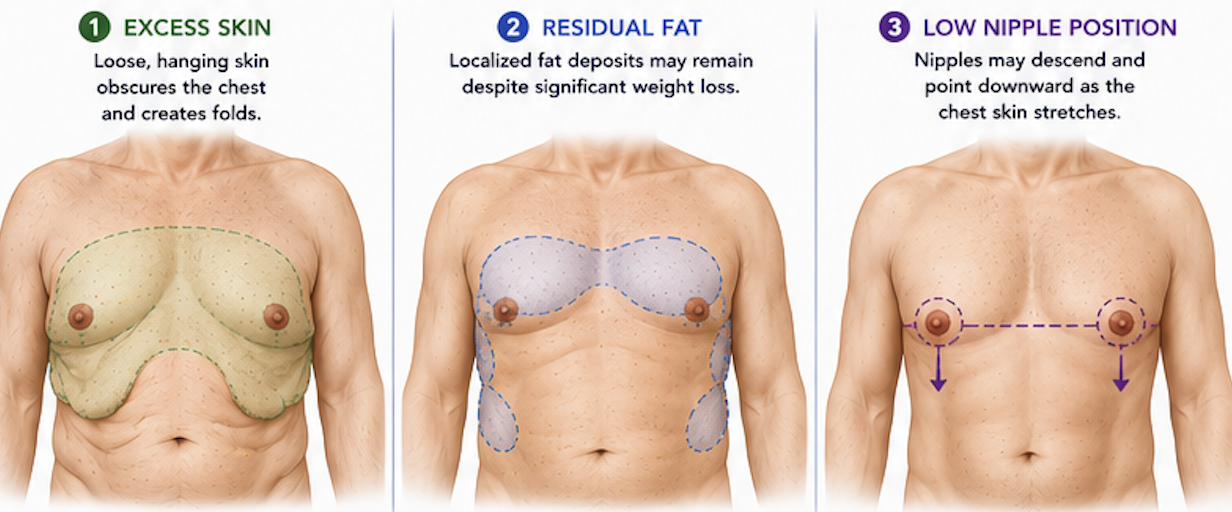
Most men who have lost a significant amount of weight have three separate problems: excess skin, residual fatty tissue, and changes in nipple position. Successful surgery addresses each of these concerns to create a flatter, firmer, and more athletic chest.
The operation is individualized because no two patients have the same pattern of skin laxity or tissue loss.
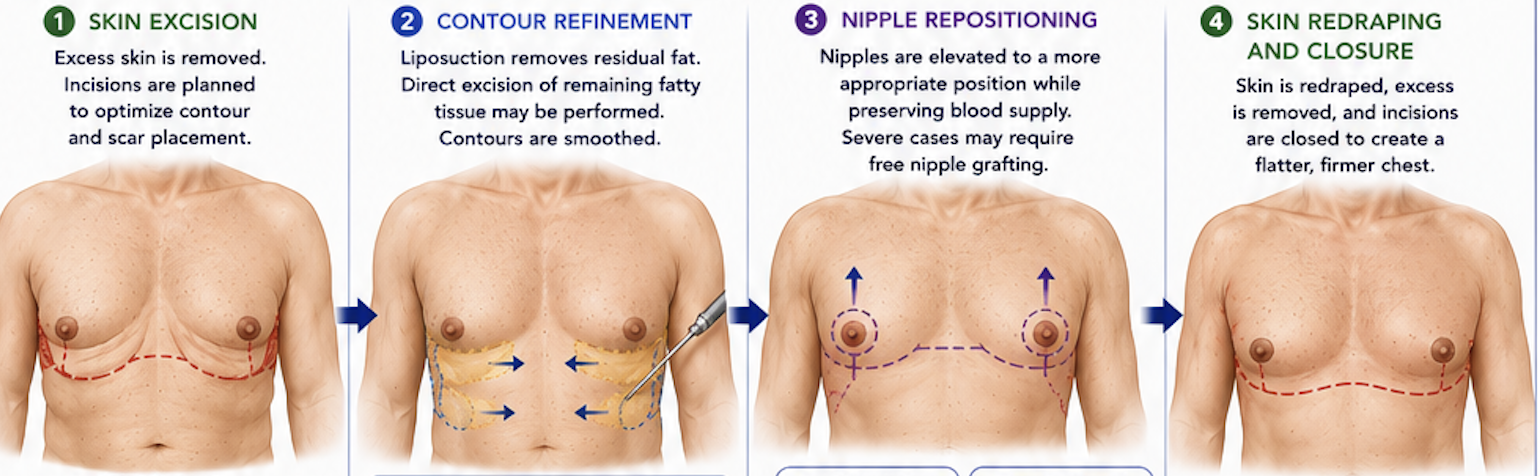
Step One: Remove Excess Skin
The defining feature of post-weight-loss chest surgery is skin reduction.
While liposuction can remove unwanted fat, it cannot tighten stretched skin. In men with moderate to severe skin laxity, skin excision is usually the most important part of the operation.
The amount and location of excess skin determine the incision pattern.
Step Two: Refine Chest Contour
After the excess skin has been removed, the remaining tissues are reshaped to create a smooth transition across the chest.
Depending on the patient, this may include:
- Liposuction to remove localized fat deposits
- Direct excision of residual fatty tissue
- Contouring along the lateral chest wall
- Blending the chest into the upper abdomen
The goal is a natural masculine contour rather than an exaggerated or overcorrected appearance.
Step Three: Reposition the Nipple
Weight loss often causes the nipple–areola complex to descend along with the surrounding skin.
During chest contouring surgery, the nipple can often be elevated to a more anatomically appropriate position.
In patients with severe skin excess, repositioning may require specialized techniques that preserve nipple blood supply or, in selected cases, free nipple grafting.
The choice depends on the degree of tissue redundancy and the amount of elevation required.
Tailoring the Operation
The procedure may range from relatively limited surgery to more extensive reconstruction.
Examples include:
- Skin excision with liposuction
- Male chest lift
- Chest contouring combined with brachioplasty
- Chest contouring combined with an upper body lift
Treating adjacent areas together often creates a more harmonious result than correcting the chest alone.
Recovery
Recovery depends on the extent of surgery.
Patients generally experience:
- Temporary swelling
- Bruising
- Compression garment use
- Activity restrictions for several weeks
Light activity begins early, while heavy lifting and vigorous exercise are delayed until healing is well established.
Balancing Contour and Scars
Men frequently worry about scars before surgery.
In reality, patients who have significant excess skin usually find that the improved chest contour is far more noticeable than the scars themselves.
Whenever possible, incisions are placed along natural chest borders or skin transitions to make them less conspicuous as they mature.
Completing a Masculine Appearance
A successful operation does more than flatten the chest.
It restores masculine proportions by creating smooth transitions between the chest, shoulders, upper abdomen, and lateral torso.
For many men, this procedure marks the completion of the physical transformation that began with weight loss.
Key Takeaways
“Successful male chest reconstruction after weight loss is a comprehensive contouring procedure that restores masculine anatomy by addressing skin, fat, and nipple position together—not simply by removing breast tissue.”
- Skin excision—not liposuction—is usually the key component after major weight loss.
- Nipple repositioning is often necessary to restore normal male chest proportions.
- Surgery is individualized and may be combined with arm or upper body contouring procedures.
- The goal is a natural, masculine chest that complements the rest of the post-weight-loss body.
Back Lift Surgery: Eliminating Bra Rolls and Upper Back Skin
After major weight loss, many patients discover that the back changes just as dramatically as the abdomen.
Loose skin and fat often collect across the upper back, beneath the shoulder blades, and along the bra line in women. These folds can remain visible beneath clothing, create discomfort, and make it difficult to fully appreciate the results of abdominal, breast, or arm contouring procedures.
A back lift removes this excess skin to restore a smoother, tighter upper torso.
Why Do Bra Rolls Develop?
During weight gain, the skin of the upper back stretches as fat accumulates beneath it.
After significant weight loss, much of the fat disappears, but the stretched skin often cannot retract completely.
The result may include:
- Bra-line rolls
- Loose upper back skin
- Lateral chest folds
- Skin extending beneath the arms
- Wrinkling and redundant tissue across the back
Although commonly called “bra rolls,” the problem often extends well beyond the bra line itself.
What Is a Back Lift?
A back lift removes excess skin and, when appropriate, localized fat from the upper back and lateral chest.
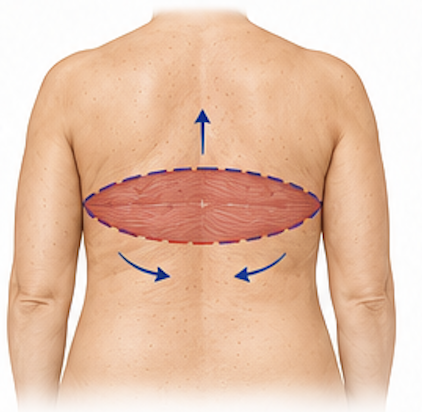
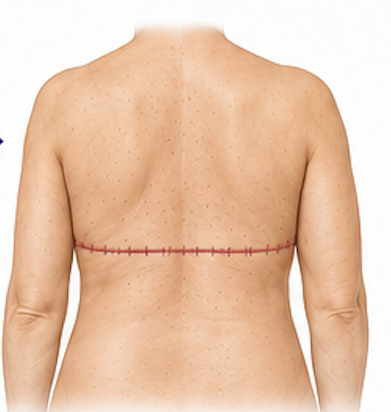
The remaining tissues are tightened to create:
- A smoother upper back
- Elimination of prominent skin rolls
- Better definition of the torso
- Improved transition between the back, chest, and arms
The procedure restores continuity across the upper torso rather than treating isolated folds.
Is It Part of an Upper Body Lift?
Often, yes.
A back lift is frequently combined with:
- Upper body lift surgery
- Brachioplasty
- Breast lift or breast reduction
- Male chest contouring
Treating adjacent areas together usually creates more harmonious body proportions than correcting only one region.
Where Are the Scars?
The incision is typically placed across the upper back or along the bra line, where it can be concealed beneath a bra, swimsuit, or many clothing styles.
The exact location depends on:
- The amount of excess skin
- The direction of skin laxity
- Planned accompanying procedures
Although the scar is permanent, it usually becomes much less noticeable as it matures.
Recovery
Recovery is similar to other body contouring procedures.
Patients should expect:
- Temporary swelling
- Bruising
- Mild discomfort
- Temporary restrictions on overhead arm movement
- Gradual return to normal activity over several weeks
Because the back is involved in nearly every upper-body movement, patients should avoid excessive stretching during the early stages of healing.
The Trade-Off
The greatest benefit of a back lift is the elimination of skin rolls that cannot be improved with exercise.
The principal trade-off is a scar across the upper back.
For patients with significant skin redundancy, this exchange is usually worthwhile because clothing fits better, the back appears smoother, and the overall body contour becomes more balanced.
Completing the Upper Torso
Many patients view the abdomen as the final step after weight loss.
In reality, the upper back often completes the transformation.
Removing bra rolls and upper back skin creates smoother contours from every angle, allowing the results of breast surgery, arm lifts, and upper body lifts to blend together into a natural, harmonious appearance.
Key Takeaways
“A back lift is designed to remove excess skin—not just fat—creating a smoother upper back and eliminating the bra-line rolls that commonly remain after major weight loss.”
- Back lifts remove excess skin and localized fat from the upper back after major weight loss.
- Bra rolls usually represent excess skin, not simply residual fat.
- A back lift is commonly combined with upper body lift, breast, or arm contouring procedures.
- Scars are typically positioned along the bra line or natural clothing lines whenever possible.
- Eliminating upper back skin folds completes the circumferential contour of the upper torso.
Buttock Reshaping After Weight Loss: Restoring Volume and Lift
After major weight loss, many patients are surprised to discover that the buttocks often change as dramatically as the abdomen or breasts.
As fat disappears, the buttocks lose volume and projection while the overlying skin stretches and descends. Instead of becoming firmer after weight loss, the buttocks frequently appear flatter, lower, and deflated.
Restoring a youthful buttock contour usually requires addressing both the loss of volume and the excess skin that remain after successful weight loss.
Why Do the Buttocks Flatten?
The buttocks are composed of muscle, fat, and skin.
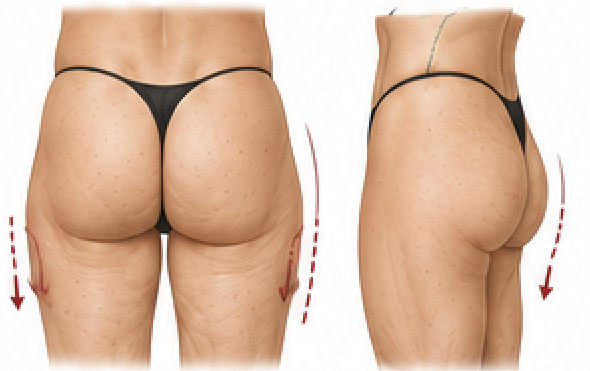
Weight loss primarily reduces the fatty layer that provides projection and fullness. At the same time, stretched skin often cannot contract enough to match the reduced volume.
The result may include:
- Loss of buttock projection
- Flattening of the buttocks
- Sagging below the natural crease
- Loose skin beneath the buttocks
- Poor transition between the lower back, buttocks, and upper thighs
These changes vary from patient to patient but often become more noticeable after abdominal contouring has been completed.
What Can Surgery Accomplish?
Successful buttock reshaping usually focuses on two goals:
Lift the Buttocks
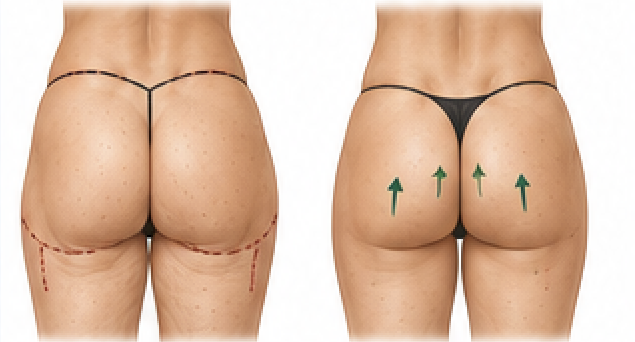
Removing excess skin elevates the buttocks and improves their overall position.
This is often accomplished during a circumferential body lift, where tightening the lower back and waist also lifts the buttocks.
Restore Volume
Some patients are satisfied with improved position alone.
Others desire greater fullness and projection.
Depending on the patient’s anatomy and goals, volume may be restored using:
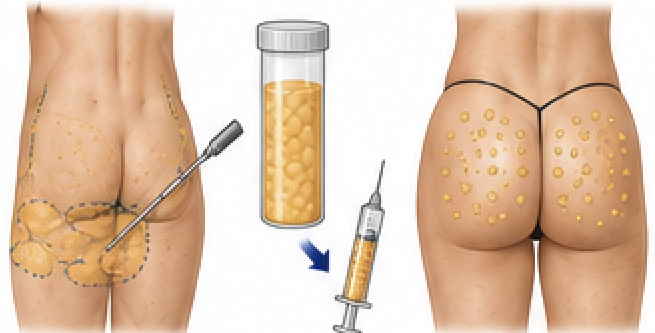
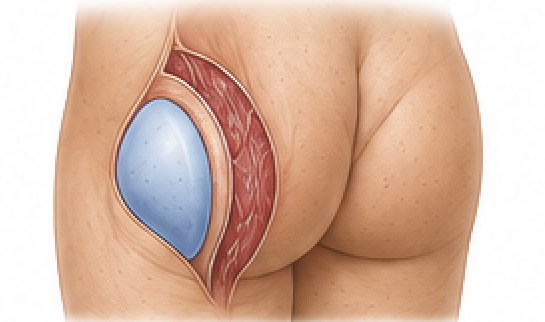
- Fat grafting (when sufficient donor fat is available)
- Buttock implants in carefully selected patients
The objective is to create natural projection that complements the patient’s overall body proportions.
Fat Grafting or Implants?
Many patients ask whether fat transfer is always possible after major weight loss.
Unfortunately, the answer is often no.
Patients who have lost large amounts of weight may have very little remaining donor fat. In these cases, fat grafting may not provide enough volume to achieve meaningful improvement.
For selected patients with limited donor fat who desire greater projection, buttock implants may be considered. However, implants require careful patient selection because they carry higher complication rates than many other body contouring procedures.
Your surgeon will recommend the approach that best matches your anatomy and goals.
Recovery
Recovery depends on whether the procedure involves:
- Buttock lift alone
- Circumferential body lift
- Fat grafting
- Buttock implants
Patients typically experience:
- Temporary swelling
- Bruising
- Activity restrictions
- Limited direct pressure on the buttocks when augmentation has been performed
Final shape continues to improve over several months.
Restoring Balance
The buttocks should never be viewed in isolation.
Their appearance depends on how they blend with the lower back, waist, hips, and upper thighs.
The best results restore harmony to the entire lower body rather than simply making the buttocks larger.
For many patients, achieving this balance is one of the final steps in completing their post-weight-loss transformation.
Key Takeaways
“Successful buttock reshaping after weight loss restores both support and volume, creating natural projection and balanced lower-body proportions rather than simply making the buttocks larger.”
- Major weight loss commonly causes both buttock flattening and sagging.
- Successful treatment often requires correcting both excess skin and loss of volume.
- Circumferential body lifts frequently improve buttock position by elevating the surrounding tissues.
- Fat grafting is an excellent option when adequate donor fat is available, while implants may be appropriate for carefully selected patients with limited donor fat.
- The goal is a natural, balanced buttock contour that complements the entire lower body.
Restoring Buttock Volume: Fat Grafting or Implants?
One of the most common complaints after major weight loss is that the buttocks become flat.
Many patients describe feeling as though they have “lost their butt.” Even after achieving a healthier body weight, they may be disappointed that the buttocks no longer have the projection or fullness they once did.
Fortunately, buttock volume can often be restored. The challenge is determining which method is best for each patient.
Why Does the Butt Lose Volume?
The buttocks derive much of their shape from the layer of fat that lies over the gluteal muscles.
When substantial weight is lost, much of this fat disappears. The muscles remain, but without the overlying soft tissue, the buttocks appear flatter and less projected.
In addition, stretched skin often fails to contract completely, making the buttocks look even smaller than they actually are.
Fat Grafting: The Most Natural Option
Whenever possible, fat grafting is the preferred method of buttock augmentation.
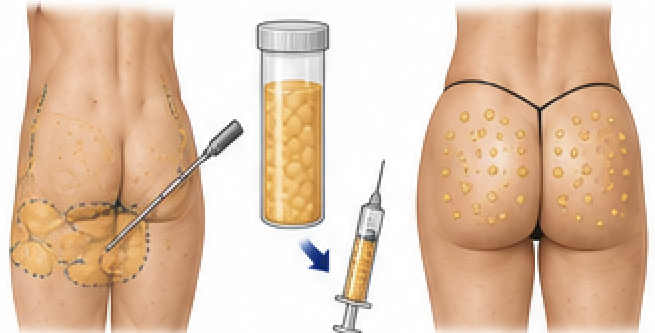
The procedure involves:
- Liposuction to harvest fat from another area of the body.
- Processing and purification of the fat.
- Careful reinjection into selected areas of the buttocks.
Because the patient’s own tissue is used, the results generally look and feel natural.
Fat grafting is especially useful for restoring:
- Upper-pole fullness
- Central projection
- Smooth contour transitions
The Limitation of Fat Grafting
The greatest limitation is simple:
Many post-weight-loss patients have very little fat remaining.
Patients who have worked hard to lose large amounts of weight often have few donor sites capable of providing enough fat for meaningful buttock augmentation.
In these cases, fat grafting may produce only modest improvement.
When Are Buttock Implants Appropriate?
For carefully selected patients with inadequate donor fat who desire greater projection, buttock implants may be an option.
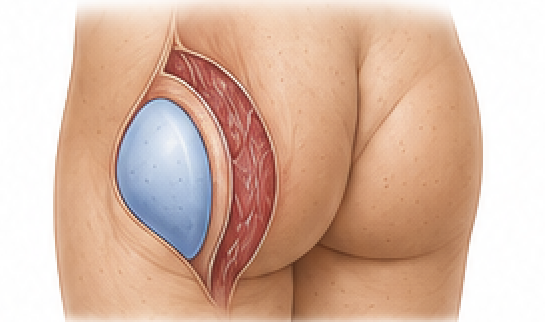
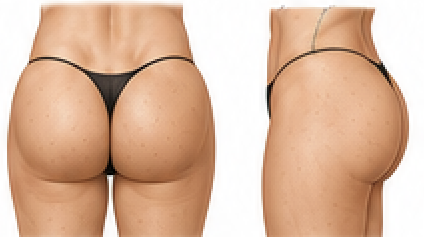
Implants provide predictable volume regardless of the patient’s remaining body fat.
However, they are associated with higher complication rates than fat grafting, including:
- Infection
- Implant displacement
- Wound healing problems
- Need for revision surgery
Because of these considerations, buttock implants are reserved for selected patients after careful evaluation.
Can Volume Restoration Be Combined with a Lift?
Yes.
Many patients benefit from combining augmentation with a buttock lift or circumferential body lift.
The lift restores support and position.
The augmentation restores projection.
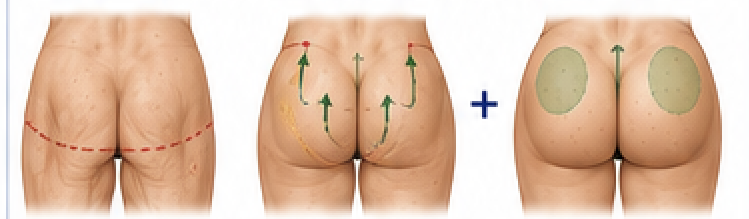
Together, these procedures recreate a buttock that is both higher and fuller than either procedure could achieve alone.
Recovery
Recovery varies depending on the method of augmentation.
Patients undergoing fat grafting or implants generally need to:
- Limit prolonged direct pressure on the buttocks during the early healing period.
- Wear compression garments as directed.
- Gradually resume normal activities over several weeks.
The final contour continues to improve over several months as swelling resolves and the tissues settle.
Restoring Balance, Not Just Size
The best buttock augmentation is not necessarily the largest.
Successful surgery restores natural projection while maintaining proper proportion with the waist, hips, thighs, and lower back.
The objective is a buttock that looks as though it belongs to the rest of the body—not one that draws attention because it appears unnatural.
Key Takeaways
“The best buttock augmentation restores natural volume and proportion. Fat grafting is preferred whenever possible, while implants provide an important option for carefully selected patients who lack sufficient donor fat.”
- Major weight loss commonly results in significant loss of buttock volume.
- Fat grafting is the preferred method of augmentation when adequate donor fat is available.
- Patients with limited donor fat may be candidates for buttock implants.
- Combining augmentation with a buttock lift often provides the best overall contour.
- The goal is to restore natural projection and balanced lower-body proportions rather than simply increasing buttock size.
Thigh Lift Surgery: Correcting Sagging Thighs After Weight Loss
For many people, the thighs are one of the most frustrating areas after major weight loss.
Although the legs become smaller, the skin often remains stretched and loose. The result is sagging that can cause discomfort, interfere with exercise, and make clothing fit poorly.
A thigh lift removes this excess skin to create smoother, firmer, and better-proportioned legs.
Why Do the Thighs Sag?
The thighs naturally store significant amounts of fat.
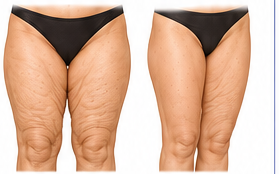
As weight increases, the skin stretches to accommodate the additional volume. After substantial weight loss, the fat disappears, but the skin often cannot contract enough to match the new, smaller thighs.
The result may include:
- Loose inner thigh skin
- Wrinkling and folds
- Thighs that rub together while walking
- Skin irritation or chafing
- Difficulty wearing fitted clothing or swimsuits
The degree of sagging depends on age, skin quality, genetics, and the amount of weight lost.
Can Exercise Tighten Loose Skin?
This is one of the most common questions patients ask.
Exercise strengthens the muscles beneath the skin, but it does not remove excess skin.
While stronger thigh muscles can improve leg tone, they cannot eliminate stretched skin that has lost its elasticity.
Once significant skin redundancy develops, surgery is usually the only effective treatment.
What Is a Thigh Lift?
A thigh lift removes excess skin and, when appropriate, a limited amount of fat from the inner thighs.
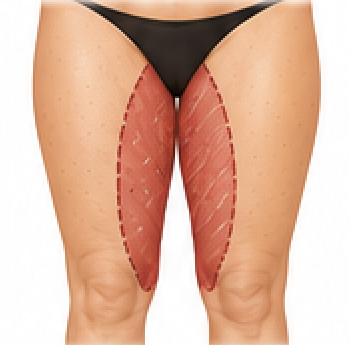
The remaining tissues are tightened to create:
- A smoother inner thigh contour
- Reduced skin rubbing
- Improved leg proportions
- Better clothing fit
The operation is customized according to where the excess skin is located.
Who Is a Good Candidate?
The best candidates typically:
- Have reached a stable weight.
- Have significant inner thigh skin laxity.
- Are in good overall health.
- Understand the trade-off between improved contour and permanent scars.
Patients whose primary concern is localized fat without loose skin may benefit from liposuction alone, but this is uncommon after major weight loss.
Recovery
Recovery generally includes:
- Temporary swelling
- Bruising
- Compression garments
- Walking immediately after surgery
- Temporary limitations on strenuous activity
Because the thighs are constantly moving during walking, careful attention to activity restrictions helps optimize healing.
The Trade-Off
The greatest benefit of a thigh lift is the removal of loose skin that cannot be corrected by exercise.
The primary trade-off is a permanent scar.
Fortunately, incisions are positioned along the inner thigh or groin whenever possible to reduce their visibility.
For most patients, smoother thighs, improved comfort, and easier clothing fit make this an acceptable exchange.
Restoring Confidence
Many patients avoid shorts, swimsuits, or fitted clothing because of loose thigh skin.
After a thigh lift, they often feel more comfortable being active and wearing clothes that better reflect their healthier body.
The operation is not about creating perfect legs—it is about allowing the thighs to match the rest of the body’s transformation after weight loss.
Key Takeaways
“A thigh lift is designed to remove excess skin—not simply reduce fat—creating smoother thighs, improving comfort, and restoring balance to the lower body after major weight loss.”
- Major weight loss commonly causes excess inner thigh skin that cannot retract completely.
- Exercise strengthens muscle but cannot remove loose skin.
- A thigh lift removes excess skin and improves thigh contour, comfort, and clothing fit.
- Liposuction alone is appropriate only for selected patients with good skin elasticity.
- The trade-off is a permanent but strategically placed scar that most patients consider worthwhile.
Inner Thigh Lift Surgery: Choosing the Right Incision
One of the first questions patients ask about a thigh lift is:
“Where will the scar be?”
The answer depends on how much excess skin is present and where it is located. Just as every patient has a different pattern of skin laxity after weight loss, every thigh lift must be tailored to those individual changes.
The goal is to remove enough skin to create a smoother inner thigh while placing the scar as discreetly as possible.
Why Does the Incision Vary?
The location and length of the incision are determined by the amount of loose skin.
Patients with only mild laxity near the upper inner thigh may require a relatively short incision hidden within the groin crease.
Patients with more extensive skin redundancy extending down the thigh usually require a longer vertical incision to achieve an effective result.
A shorter scar is attractive in theory, but it cannot remove skin that extends well below the groin.
Groin (Horizontal) Thigh Lift
A groin lift is appropriate when excess skin is confined to the upper inner thigh.
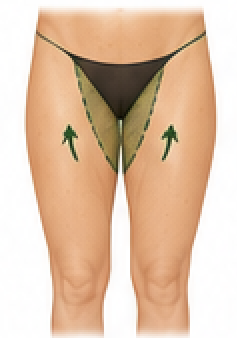
The incision is hidden within the natural groin crease, allowing the inner thigh to be elevated without a visible scar extending down the leg.
Advantages
- Scar concealed in the groin crease
- Excellent for mild skin laxity
- Shorter recovery
Limitations
- Limited amount of skin removal
- Not appropriate for most massive weight-loss patients
Vertical Medial Thigh Lift
Most patients who have experienced major weight loss require a vertical medial thigh lift.
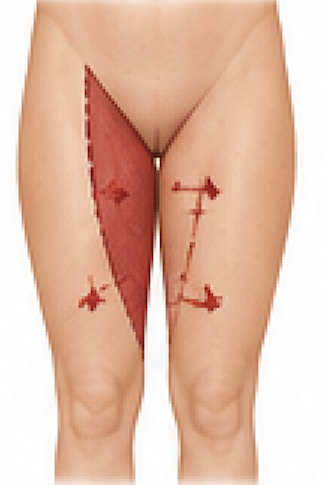
The incision extends from the groin down the inner thigh, allowing the surgeon to remove large amounts of redundant skin and reshape the entire inner thigh.
Although the scar is longer, it provides a much more complete correction.
Advantages
- Removes extensive loose skin
- Improves the entire inner thigh contour
- Reduces skin rubbing and chafing
- Produces the most predictable improvement after major weight loss
Trade-Off
- A longer permanent scar
Combining Both Incisions
Some patients benefit from combining a groin incision with a vertical medial thigh incision.
This approach removes excess skin in both the horizontal and vertical dimensions, producing the greatest improvement in contour for patients with severe skin laxity.
The incision pattern is individualized according to each patient’s anatomy.
Recovery
Recovery is similar regardless of incision type.
Patients should expect:
- Temporary swelling
- Bruising
- Compression garments
- Walking immediately after surgery
- Temporary restrictions on strenuous activity
Because the incision is located where the thighs move against one another, careful postoperative care is especially important during the early stages of healing.
Balancing Contour and Scar
Every thigh lift represents a balance between contour improvement and scar length.
Most patients who have lived with significant inner thigh skin laxity find that smoother thighs, reduced chafing, and improved clothing fit far outweigh the visibility of the scar.
The objective is not the shortest incision—it is the best overall contour.
Key Takeaways
“The best thigh lift is determined by the pattern of excess skin. Choosing the correct incision allows complete skin removal, smoother inner thighs, and long-lasting contour improvement after major weight loss.”
- The amount and location of loose skin determine the appropriate thigh lift incision.
- A groin lift is best for mild upper inner thigh laxity.
- A vertical medial thigh lift is usually required after major weight loss.
- Longer incisions provide more complete skin removal and better contour improvement.
- The best incision is the one that produces the smoothest, most balanced inner thigh contour.
Neck Lift Surgery: Correcting the “Turkey Neck” After Weight Loss
After major weight loss, many patients notice that their face appears thinner and healthier—but their neck tells a different story.
Loose skin beneath the chin and along the front of the neck may hang in folds, creating what is commonly called a “turkey neck.” Even younger patients can develop an aged appearance because the stretched skin cannot contract enough after significant weight loss.
A neck lift is designed to restore a smoother, firmer neck contour by removing excess skin and tightening the underlying tissues.
Why Does a Turkey Neck Develop?
The neck changes for many of the same reasons as the rest of the body.
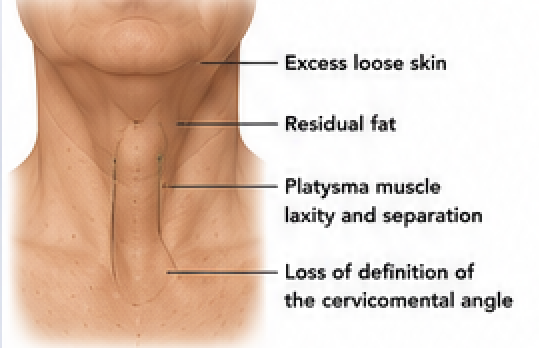
During weight gain, fat accumulates beneath the skin, stretching the skin and its supporting structures. After substantial weight loss, the fat largely disappears, but the skin often remains enlarged and loose.
Several factors contribute to the appearance of a turkey neck:
- Excess loose skin beneath the chin
- Separation or laxity of the platysma muscles
- Residual fat beneath the chin
- Loss of youthful definition between the jawline and neck
The combination of these changes softens the neck contour and makes the face appear older than it actually is.
Can Exercise Tighten the Neck?
Many patients hope that neck exercises, massage devices, or skin-tightening creams will eliminate loose neck skin.
Unfortunately, these treatments cannot remove excess skin or significantly tighten stretched neck tissues after major weight loss.
When substantial skin redundancy is present, surgery remains the most predictable solution.
What Does a Neck Lift Correct?
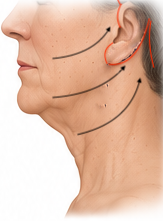
A neck lift, which more accurately described as a lower facelift or jowl-neckj lift, is tailored to each patient’s anatomy but commonly includes:
- Removal of excess neck skin
- Tightening of the platysma muscles when needed
- Removal of residual fat beneath the chin by liposuction or direct excision
- Redefinition of the jawline and neck angle throgh skin repositioning and removal back towards the ear where more favorable scar lines can be placed
The objective is to restore a smooth transition from the jawline to the neck while maintaining a natural appearance.
Can It Be Combined with Other Facial Procedures?
Yes.
A neck lift is often performed together with:
- Facelift surgery
- Chin augmentation
- Facial fat grafting
- Eyelid surgery
Combining complementary procedures often creates a more balanced facial rejuvenation than treating the neck alone.
Recovery
Recovery following a neck lift generally includes:
- Mild to moderate swelling
- Bruising
- Temporary tightness
- A supportive compression garment for the neck
- Gradual return to normal activities over several weeks
Most swelling improves within a few weeks, while the final contour continues to refine over several months.
The Trade-Off
The primary trade-off is the presence of scars around the ears and, in some cases, a small incision beneath the chin.
These incisions are carefully positioned within natural skin creases and hair-bearing areas whenever possible, making them difficult to notice once healed.
For most patients, the improvement in neck definition and facial balance far outweighs the visibility of the scars.
Restoring a Youthful Neck
The neck often reveals the effects of weight loss and aging earlier than the face itself.
Correcting loose neck skin restores a sharper jawline, improves facial proportions, and allows the face to better reflect the healthier body achieved through weight loss.
For many patients, neck rejuvenation becomes the finishing touch that completes their transformation.
Key Takeaways
“A neck lift restores a youthful neck by addressing excess skin, platysma laxity, and residual fat together—creating a defined jawline that better reflects the patient’s successful weight-loss transformation.”
- Major weight loss commonly leaves excess neck skin that creates the appearance of a “turkey neck.”
- Exercise and skin-tightening products cannot remove significant loose skin.
- Neck lift surgery addresses excess skin, platysma laxity, and residual submental fat.
- Neck lifts are frequently combined with facelift or other facial rejuvenation procedures.
- The goal is a smoother neck, improved jawline definition, and a more youthful facial profile.
Direct Neck Wattle Excision: A Limited Approach to Loose Neck Skin
Not every patient with loose neck skin requires a full neck lift.
In some individuals, the excess tissue is concentrated in the center of the neck, creating a hanging fold or “wattle” beneath the chin. When the skin redundancy is localized and the patient is willing to accept a scar on the front of the neck, a direct neck wattle excision may provide a simpler and more focused solution.
This procedure removes the hanging skin directly rather than redraping it toward the ears.
What Is a Direct Wattle Excision?
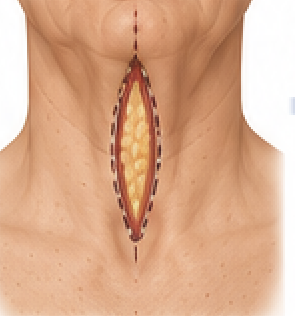
A direct wattle excision removes a vertical or elliptical segment of loose skin from the front of the neck.
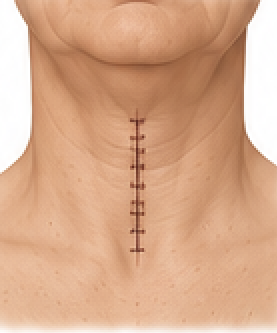
The remaining skin is then brought together and closed, creating a tighter neck contour.
Depending on the patient’s anatomy, the procedure may also include:
- Removal of localized fat
- Tightening of the platysma muscle
- Direct contouring beneath the chin
- Revision of a prominent central neck fold
The operation is designed to correct a specific area of skin redundancy rather than rejuvenate the entire lower face and neck.
Who Is a Good Candidate?
The best candidates are patients who:
- Have a localized central neck wattle
- Do not require extensive jawline or lower-face lifting
- Prefer a shorter and more direct procedure
- Understand that the scar will be located on the front of the neck
- Have medical conditions or personal preferences that make a full neck lift less desirable
This approach is often considered in older men, because a vertical scar may blend relatively well with natural neck creases, beard shadow, or existing skin texture.
How Is It Different from a Lower Face-Neck Lift?
A traditional lower face- neck lift tightens the neck by elevating and redraping the skin toward incisions around the ears.
A direct excision removes the excess skin where it hangs.
Direct Wattle Excision
- Shorter and more localized operation
- Directly removes central loose skin
- Does not require extensive skin undermining
- Leaves a visible anterior neck scar
Traditional Lower Face-Neck Lift
- Treats the entire neck and jawline
- Places most scars around the ears
- Provides broader contour improvement
- Requires a more extensive operation and recovery
Neither approach is universally better. The correct choice depends on the distribution of loose skin, the desired result, and the patient’s tolerance for scar location.
The Importance of Scar Acceptance
The major trade-off of direct wattle removal is the scar.
Unlike a traditional neck lift, where scars are largely concealed around the ears, direct excision leaves a scar on the front of the neck.
The scar may be designed as:
- A straight vertical line
- A broken geometric line
- A Z-plasty pattern
- An irregular line that follows natural neck creases
These designs help prevent contraction and make the scar less conspicuous as it matures.
Patients must understand that the procedure exchanges a visible hanging fold for a visible but flatter scar.
Recovery
Recovery is generally shorter than after a full neck lift.
Patients may experience:
- Mild swelling
- Bruising
- Temporary tightness
- Localized tenderness
- Progressive scar fading over several months
Because the operation is limited, many patients return to routine activities relatively quickly.
When Is It Not the Best Choice?
Direct wattle excision is not ideal for patients who have:
- Broad skin laxity extending toward the sides of the neck
- Significant jowling
- Poor jawline definition
- Extensive platysma banding
- Strong concern about an anterior neck scar
In these cases, a traditional neck lift or facelift-neck lift combination is usually more appropriate.
A Focused Solution for the Right Patient
Direct wattle excision is not a substitute for a comprehensive neck lift.
It is a specialized option for carefully selected patients whose main problem is a localized central fold of loose skin.
When chosen appropriately, it can create a cleaner neck contour with a shorter operation and a more direct recovery.
Key Takeaways
“Direct wattle excision is a focused operation for a focused problem. Its success depends on selecting the right patient and accepting the trade-off of a visible anterior neck scar.”
- Direct neck wattle excision removes localized loose skin from the front of the neck.
- It is best suited for patients with a central hanging fold rather than generalized neck laxity.
- Recovery is often shorter than after a traditional neck lift.
- The principal trade-off is a visible scar on the front of the neck.
- Careful patient selection and scar acceptance are essential for a satisfactory result.
The Final Step
Losing a significant amount of weight changes far more than the numbers on a scale.
It improves health, increases mobility, restores energy, and opens the door to activities that may have once seemed impossible. Yet for many people, the journey is not truly complete until the loose skin left behind has also been addressed.
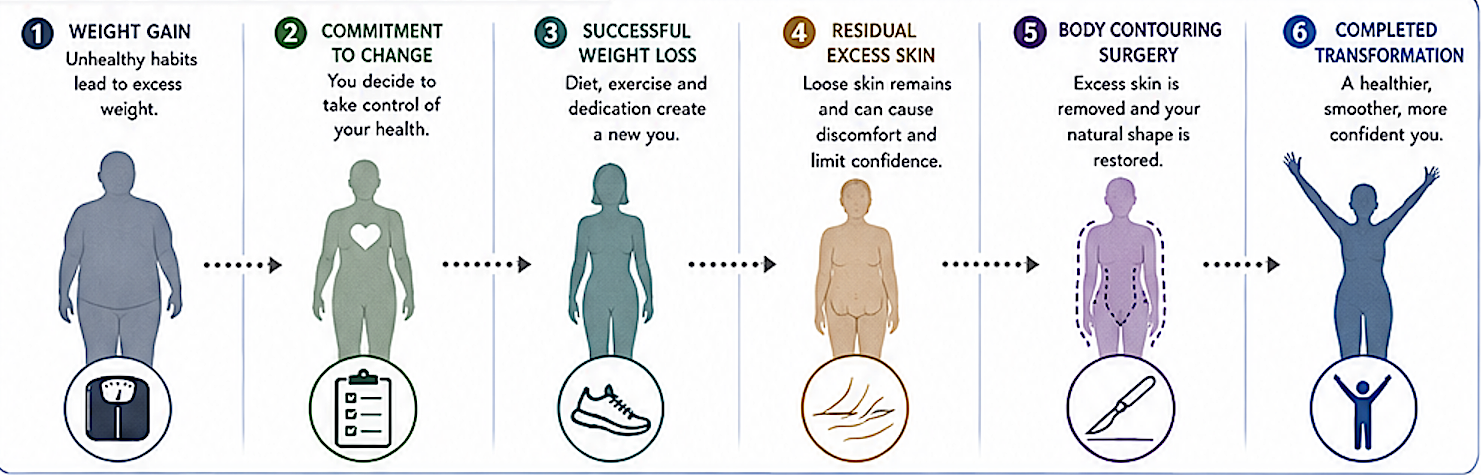
Body contouring surgery represents the final step in transforming the body to match the accomplishment of weight loss.
More Than Cosmetic Surgery
Many people mistakenly view body contouring as purely cosmetic.
For patients who have lost a substantial amount of weight, however, these procedures often improve much more than appearance.
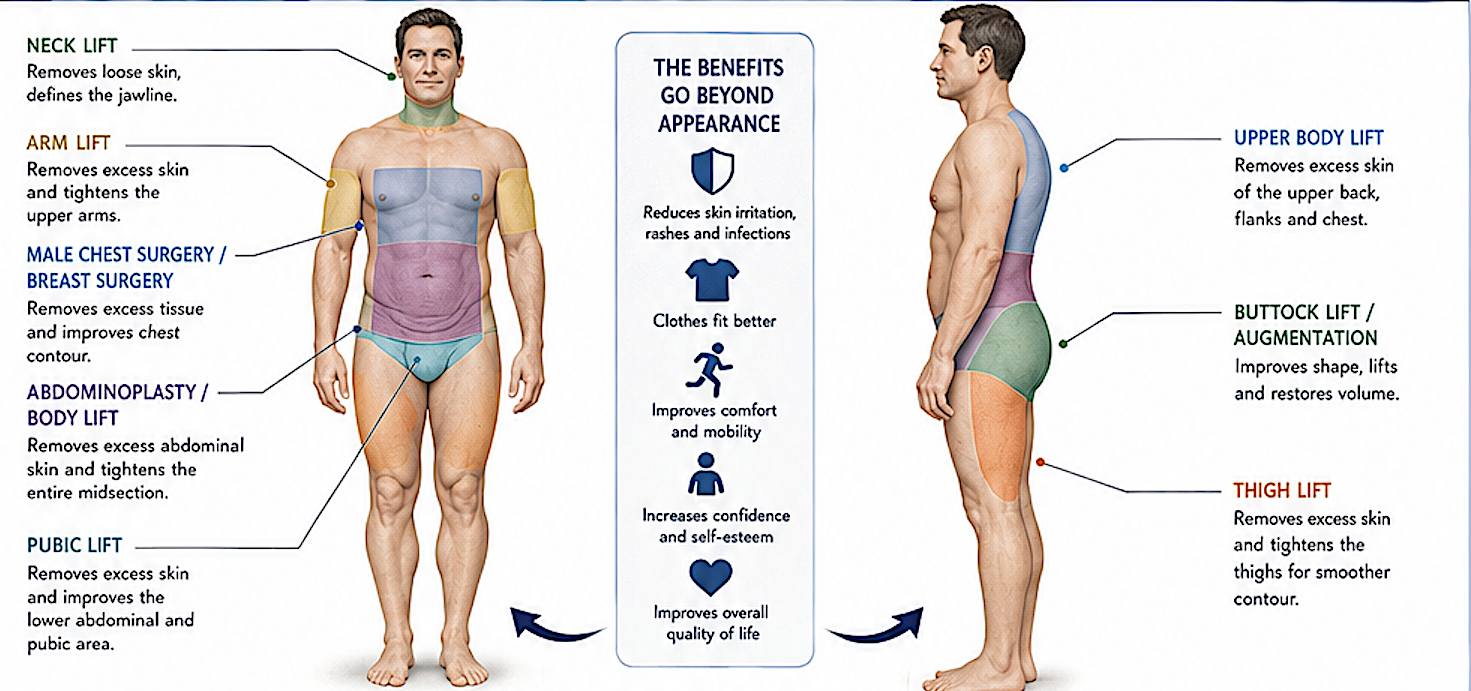
Removing excess skin can:
- Reduce skin irritation and rashes
- Improve hygiene
- Make exercise more comfortable
- Allow clothing to fit better
- Increase confidence in social situations
- Improve overall quality of life
The benefits extend well beyond the mirror.
A Process, Not a Single Operation
Few patients require only one procedure.
Depending on the amount of excess skin and the areas involved, body contouring is often performed in carefully planned stages.
Each operation builds upon the previous one, gradually restoring better proportions from head to toe.
Although the process requires patience, staging improves both safety and surgical outcomes.
Perfection Is Not the Goal
One of the most important lessons in body contouring is that every procedure involves trade-offs.
Loose skin is exchanged for scars.
Shape is improved, but perfect symmetry is not always possible.
The goal is not perfection.
The goal is a body that better reflects the tremendous effort required to achieve lasting weight loss.
For most patients, that exchange is well worth it.
Choosing the Right Surgeon
Successful body contouring requires thoughtful planning, technical expertise, and experience treating patients after major weight loss.
Every procedure must be customized to the patient’s anatomy, skin quality, medical history, and personal goals.
Choosing a board-certified plastic surgeon with extensive experience in post-weight-loss surgery is one of the most important decisions in the entire process.
Maintaining Your Results
Surgery creates a new starting point.

Maintaining that result depends on:
- Stable body weight
- Regular exercise
- Good nutrition
- Healthy lifestyle habits
- Realistic expectations
Future weight gain or significant weight loss can alter the results, making long-term weight stability an important part of preserving your outcome.
Looking Forward
Perhaps the greatest reward of body contouring is not simply looking different.
It is feeling that your appearance finally matches the healthier person you have become.
Many patients describe body contouring as the moment when they truly leave their former selves behind.
The confidence gained from completing the transformation often affects every aspect of life—from personal relationships to professional opportunities to daily activities.
Congratulations
If you have reached this point, you have already accomplished something remarkable.
Losing a substantial amount of weight requires determination, persistence, and resilience.
Choosing body contouring is not about changing who you are.
It is about allowing your body to reflect what you have already achieved.
May this book help you make informed decisions, ask better questions, and approach surgery with confidence and realistic expectations.
Your weight-loss journey has already transformed your health.
Body contouring can help complete that transformation.
Key Takeaways
“Weight loss transforms your health. Body contouring helps your appearance reflect that achievement. The ultimate success is not perfection—but becoming the healthiest, most confident version of yourself.”
- Body contouring is often the final stage of the weight-loss journey rather than the beginning.
- These procedures improve function, comfort, confidence, and body proportions—not just appearance.
- Multiple staged procedures frequently provide the safest and most effective outcomes.
- Long-term success depends on maintaining a stable weight and healthy lifestyle.
- The ultimate goal is not perfection, but a body that reflects the extraordinary achievement of sustained weight loss.





A detailed description and pictures of your concerns allow for the most informed response.
Disclaimer: By submitting a question, you agree that it may be used for educational purposes. Any identifying details or photos will be removed. Responses are general and not a substitute for medical advice.

North Meridian Medical Building
Address:
12188-A North Meridian St.
Suite 310
Carmel, IN 46032
Contact Us:
Phone: (317) 706-4444
WhatsApp: (317) 941-8237