Your Questions
Your Questions
Q: Dr. Eppley, my question is about face fillers. I had some permanent filler injections done on my cheeks 4 years ago. I am now developing hypersensitivity, not at the site of the filler, but over the sinus and neck muscles and headaches. Plus my eyebrows are thinning .The surgeon told me the filler used is BIOALCAMID .What is your opinion on can the filler be removed?
A: Bio-AlCamid is a gel polymer filler that is composed of a 3% to 4% concentration of alky-amide polymer and 96% water. It is used around the world but is not approved in the U.S. It maintains it volume through the attraction of water to the non-resorbable polymer which is then surrounded by a scar capsule. The manufacturer says that it can be removed relatively easily and this may be true if it is well encapsulated and can be palpated. Once the capsule is entered, the material will likely be expressible. The other key question is what to do after the material is removed as there may likely be a deflation effect seen on the outside of the face. While one could use any of the available temporary hyaluronic injectable fillers, I would strongly think about fat injection replacement. Otherwise, I see no direct correlation between it and your hypersensitivity symptoms.
Dr. Barry Eppley
Indianapolis, Indiana
Q: Dr. Eppley, I have a question concerning my “puppet” lines around my mouth that get infected often. Are some type of injections a reasonable answer to this problem? Thank you.
A: What you refer to as puppet lines are technically known as marionette lines. That is the groove area that develops as the face and jowls fall forward with aging against the fixed skin of the chin. They extend downward from the corner of the mouth to the jaw line. There are multiple treatment options for marionette lines, depending upon how severe they are. For mild to moderate depth marionette lines, injectable fillers may be a reasonable option albeit a temporary one. For moderate to deeper marionette lines, injectable fillers are not very effective at effacing them. Options include a jowl lift (mini-facelift) which really treats the cause of the problem or direct excision of them which may be a reasonable option in the older patient who does not want to undergo any form of a jowl lift. I would need to see a picture of your mouth or face to give you a more definitive answer.
You can always try injectable fillers first as they are easy to do in a few minutes in the office setting. An injectable treatment will prove, one way or the other, if it is effective. Whether that is ‘reasonable’ ultimately comes down to an issue of cost. Is the depth of the marionette lines worth that gamble? That is where seeing a picture of it will help.
Dr. Barry Eppley
Indianapolis, Indiana
Injectable fillers have come a long way since the approval of the first non-collagen based product in 2002. While once conceived as only a way to make lips bigger and nasolabial folds less deep, injectable fillers have evolved into a popular aesthetic technology that has a wide number of facial uses.
Injectable fillers are used for two aesthetic facial applications, spot filling and volumetric enhancement. It is the latter that is often coined as ‘non-surgical facial sculpting’. That term is probably more accurate than not as it definitely takes skill and a good eye to get pleasing facial results with fillers. There is more art to it than science.
When it comes to facial volumetric enhancement with fillers, they are often compared to and even viewed as a substitute for surgical solutions to the same problems. Some injectors view synthetic fillers as a better treatment choice as they are easier to do and have less risk of complications than surgery. While that is partially true, they rarely give better results than surgery or offer the best value for the money invested to do them. Fillers can be a quick non-surgical fix but the benefits will ultimately fade away.
For skeletal augmentation of the three facial highlights, chin, cheek and jaw angles, injectable fillers can be used to create a visible external effect. When placed down at the bone level, I prefer Radiesse. Its calcium hydroxyapatite composition makes it the most viscous filler which provides a better push of the overlying soft tissues per cc of volume. But when comparing it to synthetic facial implants that have been used for decades, it has several disadvantages. It takes a fair amount of syringe volume to get a visible effect, often at least two or three syringes depending upon the area. The effect will never be as significant as a surgical implant and the filler material will go away by about one year after injection. This makes using an injectable filler for bony augmentation very patient selective. Filler are best used when one is uncertain about how a surgical implant may look (trial ‘implant’) or if the effect is time dependent based on an upcoming event and one doesn’t have the time to recover from surgery.
The face is also made up areas whose shape is not dependent on the underlying bone. These include two large areas in the lateral face and the temples. In the triangular area between the cheeks, chin and jaw angles, lies the lateral facial region. This area has garnered a lot of attention in facial aging as it becomes more concave in some people as they age due to fat atrophy. Plumping it up with fillers has become popular as a rejuvenative manuever. I prefer Sculptra for the lateral facial triangle because of the volume of material needed. Using an 8cc reconsitution of Sculptra in an almost pure watery form, it is easy to get a good amount of material over this large area. Sculptra does not work immediately and it takes time and three total injection sessions to get a result. But its effect may last for up to two years.
Q: Dr. Eppley, I have had Restylane and Juvederm injections infrequently over the past 6 years. Two different Dermatologists did them. However even though my results were exceptional at times, the most recent Juvederm treatment seemed lumpy and inappropriately placed. I am hoping a surgeon might have a better result with better knowledge of where the product should be applied. Also, I was wondering about whether very slight eye injections to soften laugh/smile lines would be available? I am 65 years old look 40. I had a mini-facelift 24 years ago and it was the best decision I ever made. Now, however, I would like to also consider a Lifestyle Lift if possible. Less of course is more in the long run, although I am noticing a slight sag under the chin now. Possibly Juvederm or Restylane can smooth that with out changing my facial features. My hope would be to have this all completed in one or two visits as soon as possible. I would like to be treated on first visit as I am very busy with work.
A: While injectable fillers can make some wonderful facial changes, they are not useful for every facial aging problem. They are of little value in the crow’s feet or periorbital line areas as these are very superficial wrinkles. Injections of crow’s feet have a high incidence of irregularities and lumpiness. This is usuallya better area for Botox and fractional laser resurfacing. But it would depend also on how deep the smile lines are. Also injectable fillers will not be able to smooth out loose skin under the chin. This would be better treated by some type of a face or necklift.
Dr. Barry Eppley
Indianapolis, Indiana
Q: Dr. Eppley, I had my buccal fat pads removed nearly fifteen years ago at age 31 for some facial sculpting. Now that I am older, I look completely different. My face is very flat and not as attractive. What can I do to look like before? What are my choices for making my face now a little fuller?
A: As you have aged, your face likely has lost overall fat and the prior removal of the buccal fat pads has only accentuated this natural fat involution process. There are several options available to consider for facial volume restoration. The first approach is fat injections which focuses on replacing like with like. The only question is how much fat will survive after transplantation. This is an overall facial volume approach. The next approach is focal or spot treatment, just adding volume to the buccal or submalar area. This could dbe done with either submalar cheek implants or injectable fillers. The real value of injectable fillers in your case, in my opinion, is to be an initial test to determine if augmentation of this area is what you are looking for. It serves as a test to determine if more formal augmentation (implant) is worthwhile.
Dr. Barry Eppley
Indianapolis, Indiana
Q: Dr. Eppley, I am 38 years old and have had very noticeable nasolabial folds for the past several years. I have had injectable fillers, specifically Juvederm Ultra XC, placed into them with some improvement. I also had my cheeks injected also. Now, less than 6 months after the injections, my nasolabial folds are just about back again. I would like to something that is more permanent and may even have a greater effect. Do you think a cheek lift will work? Or should I just wait until I am older?
A: Deep nasolabial folds at a young age can be a very difficult problem. Some facial shapes and skin types are simply more prone to them and, if this is an issue at the young age of 38, it is going to continue to be a long-term facial issue. Injectable fillers for the nasolabial folds offer both advantages and disadvantages. Their advantage is that they work when properly placed. There is great debate of the many fillers as to which one is better but none has ever been shown to be really be ‘better’, they all work. Some simply last longer at a greater price. They work instantaneously and generally have no significant problems. Their disadvantage is that they are not permanent. No injectable filler is permanent, no matter what is said by some. However, a cheek lift is not the solution either…for now. You are too young to justify such surgery and it is not a permanent solution either. You would be best served to continue with injectable fillers at this point even though they have limited duration. The effectiveness of cheek or midface lifts depends on mobility of the cheek tissue across the zygoma or cheekbone. I doubt if you have much of at your age. This is why such cheek lifts are years away for you.
Dr. Barry Eppley
Indianapolis, Indiana
Aging is inevitable and it begins to appear first around the eyes. While eyelid and brow lifts provide immediate and significant improvements, many would prefer to lessen these eye flaws without the costs and recovery of an operation.
There are a variety of non-surgical eye treatments combining neurotoxins, fillers, lasers devices and topical products. Which ones are used often follows the age of the person. Those in their 30s and 40s usually just need Botox to control their frowning and squinting wrinkles. Fillers and light and laser treatments are added for those in their 40s and 50s. At age 50 and beyond, surgery is needed to remove extra upper eyelid skin and lower eyelid bags. But these non-surgical treatments are still needed to preserve one’s surgical investment.
Botox is the most known name when it comes to facial wrinkle reduction by injection. But it is not alone as two other injection drugs, Dysport and Xeomin, are also available. While there are some that believe one is better than the other, they all are really comparable. They all take a few days to a week to start working and their effects will last from three to four months. One is not more powerful than the other nor does one cost less. These injections are given by the unit and the cost per unit varies for each one but so does how they are prepared. As such their treatment costs are all about the same.
While Botox is the most common non-surgical eye treatments, injectable fillers can also play a role. Many people will develop shadowing and tear troughs under the lower eyelid, sometimes as early as the late 30s. This can be treated with fillers to plump the area out. While they are over a dozen types of injectable fillers, the hyaluronic acid-based fillers (e.g., Restylane and Juvederm) are preferred. They can be delivered under the thin tissues of the lower eyelids with a low risk of lumps and irregularities.
While eye wrinkles can be held in check with Botox and fillers, they can not reverse certain skin problems. Blood vessels and brown spots can be removed with pulsed light treatments. These are often confused with lasers which they are not. When it comes to improving skin texture and reducing fine lines and wrinkles, laser resurfacing can provide improvements beyond what an eyelid lift can do.
Topical skin care products complement eye the benefits of injectable and energy treatments. The skin around the eyes is so thin that it responds well to many Vitamin C, retinoid and antioxidant-containing products. A new topical product, Latisse, is great for thinning eyelashes and eyebrows and it works like nothing else. Eyelashes and eyebrows can become one-third longer and thicker in a few months.
While surgery may be needed or inevitable for some, younger and less tired looking eyes may be just a few injections or the wave of a laser wand away.
Dr. Barry Eppley
Indianapolis, Indiana
Q: Hi there. I see that you list Evolence filler on your website and wondered if you are still offering this? Also, do you offer Selphyl (“filler” using patient’s own blood plasma)? I am interested in these options for superficial glabellar wrinkles. I prefer using natural, non-toxic products. Botox is not something I am interested in at this time. Thanks!
A: The injectable filler Evolence has been pulled from the market and discontinued from being manufactured by J & J in 2009.
Selphyl and Platelet-Rich-Plasma/Acell mixtures are procedures that I do but neither would be a good option for superficial facial wrinkles. That is not what they are intended to be used for as the needles for injections are bigger than that of the fine wrinkles.
For glabellar wrinkles, the use of any type of injectable filler, without prior treatment with Botox is a wasted effort and exactly the opposite of what should be done. You must first control the muscle activity first, otherwise the unchecked muscle motion will make the injectable filler disappear quite quickly. There are no permanent injectable fillers and muscle action working against them makes them dissipate much quicker than normal.
Dr. Barry Eppley
Indianapolis, Indiana
Q: Is there no way to bringing out the midface with dermal fillers? Are the results not so good as with implants? What is the material of which midface implants are made of? What the advantages and disadvantages of injectable fillers vs implants for midface deficiencies?
A: For midfacial deficiency, albeit of the cheeks, maxilla, or paranasal region, synthetic implants are the preferred treatment. They are far superior to injectable fillers in both results and cost effectiveness. Injectable fillers are intended to treat small soft tissue deficiencies of the facial skin such as wrinkles or folds. They were never intended to be used for more significant bone-based facial deficiencies but rather to be placed into or just under the skin. The sheer cost of placing large volumes of injectable fillers down at the bone level would quickly equal or come close to the cost of implant surgery. When you factor in that they are all temporary, the value proposition of injectable treatments for facial skeletal deficiencies becomes quite poor.
Most facial implants, including those of the midface region, are primarily composed of solid silicone. Silicone is one of the most biocompatible of all implant materials and also offers the largest array of facial implant designs. All midfacial implants are introduced and placed through incisions inside the mouth so there is no external scarring with their use.
Dr. Barry Eppley
Indianapolis Indiana
Q: I live in New Jersey and loved reading your advice articles on injectable fillers. I am a 42 year-old female with dark circles under my eyes with hollowing, upper lip wrinkles, and horizontal forehead ceases. I would love to know if you could recommend a skilled Dr in my area who could do my eyes? Thank you for your time.
A: Injectable fillers can be used to create a variety of instantaneous facial effects by adding volume under the skin. While once limited only to lessening the depth of the nasolabial folds or increasing the size of one’s lips, their uses are being expanded. One of these newer areas is around the eyes, specifically for hollowing of the lower eyelids or treatment of the tear trough depression. This lack of volume can be one of the contributing factors to the appearance of dark circles under the eyes. Suborbital injection filling is one of the more technique sensitive (trickier) areas to inject well however. There is definitely much greater risk of bruising due to the many blood vessels in this area. Missing all of them can not always be predicted. Proper placement of the filler in the deeper tissue level down to the bone is important to not only get the best fill but to avoid lumps of the material if injected just under the skin. For those physician injectors that regularly perform blepharoplasty (eyelid) surgery, they will more likely feel comfortable placing the injectable filler into the proper tissue level. They will also be in better position to judge whether an injectable filler is the best treatment option and how it might compare to other methods of treatment such as fat grafting.
Dr. Barry Eppley
Q: I am interested in what a limited facelift or lifestyle lift might do for me or if I can get away with fillers or something like that. What is the comparative recovery time? Costs? How long do they last?
A: One of the common misconceptions in management of the aging face is that injectable fillers and some form of a facelift treat the same problems. They do not and, as a result, are not comparable treatments. They are often companions (done together or in separate stages) but are never substitutes for each other. Injectable treatment are for the central part of the face and do things that surgery generally can not either achieve or do very well. These include Botox for forehead and eye wrinkles and fillers for nasolabial fold depth reduction and lip wrinkle reduction and lip size increase. Any form of a facelift deals only with the sagging skin and excess fat in the neck and jowls, lower third of the face sagging.
There are procedures touted as ‘liquid facelifts’ but these are a bit (or maybe a lot) misleading and are associated, in my opinion, with a relatively poor value. By using injectable fillers, the sides of the face and cheeks can be puffed up which does create a mild temporary lifting effect due to the expansion of the tissues. The operative word is temporary (six months or less) and, when one compares the cost of numerous syringes of injectable fillers, one could already be more than halfway to one of the variations of a facelift. This injectable approach will also do nothing for the neck area which is the primary target of facelift surgery.
For the patient with lesser amounts of facial aging, the combination of a limited facelift (aka Lifestyle Lift) and injectable fillers can create a very dynamic effect by being able to treat the entire face more effectively. There is a very definite role and benefit to injectable fillers but their results are not comparable to facelift surgery.
Dr. Barry Eppley
Indianapolis, Indiana
Q: I am 55. I love wearing pierced earrings. I notice that they are sagging a little bit. I wonder if putting filler in the ear lobes is the best action to take, or would it just allow me to wear heavy earrings and destroy the cartilage that much faster?
A: The earlobe, unlike the rest of the ear, is only composed of skin and fat. It does not contain any cartilage which would give some stiffer support. This is why earlobes get stretched out, sag with aging, and even develop splits or tears in them from earring wear. If they had cartilage in them, none of these problems would develop.
Your question is based on the concept of adding a ‘stiffener’ to the earlobe to make it more resistant to sag or to be able to wear heavier earrings.While injectable fillers are quick and easy to do, and they can immediately make the ear lobe bigger, they will not make it more resistant to the pull effect of earrings. Injectable fillers are soft and much more like ‘jello’. The one exception to that would be the injectable filler, Radiesse, which has tiny ceramic particles in it and is more like toothpaste than jello. If you were to consider an injectable filler into the earlobe, Radiesse would be the one of choice.
The best long-term approach to prevent earlobe sag or stretching is to place small curved cartilage grafts beneath the underside of the piercing hole. This is done through a small incision on the back of the ear. The graft is harvested from above from the backside of the concha. One conchal harvest is enough for both sides. This then makes the earlobe more like the rest of the ear as the ear cartilage graft directly resists earring wear better.
Dr. Barry Eppley
Indianapolis Indiana
This advertising phrase has been used countless times in the world of cosmetic surgery. I usually just gloss over it and write it off as exuberant advertising. After all, very few things in life of any value can really be obtained in just five minutes…even a good cup of coffee takes almost that long to get. But seeing this phrase as the main topic on the cover of a major magazine of good reputation made writing about it irresistible.
The concept of the ‘5 Minute Facelift’, beyond the slathering on of alleged beauty crèmes that ‘really work’, relates to the contemporary use of injectable fillers. Not to be confused with Botox (which paralyzes small areas of facial muscles) which is also injected, fillers add volume to the face underneath the skin. Most commonly used for the lips and the facial parentheses (a.k.a. lip-cheek grooves), it has become more widely used for many other areas of the face. Since one’s face is known to lose fat as we age, plumping up the face with fillers can have some rejuvenative effect. Inflating the face pushes out the skin and accounts for the claims of ‘making wrinkles disappear instantly’.
The allure of the 5 Minute Facelift, however, must be looked at more closely to see if it is real. The five minute part for any injectable treatment is not exactly accurate. Since placing the material requires multiple needle sticks, most people would prefer to take a little longer…if they could be numbed up for it. Getting good local anesthesia before having your face injected is appealing to just about everyone. As I always say…nobody ever says they are too numb. (or conversely, can I have just a little more pain?) While the actual injections may only take five or ten minutes to do, the preparation for it is much longer.
Time is not important, however, if the procedure does what it promises. I’ll bet most people would be willing to spend several hours if it would take away five or ten years in such a short period of time. Does plumping up the skin really achieve a facelift? Not by what most people would consider a facelift to be. While inflating a hot air balloon will lift it, such a phenomenon does not really occur in the aging face. While some areas of the facial skin can be made smoother and little volume added to the cheeks and lips, those falling eyebrows, heavy eyelids, or jowls and sagging neck will not be improved. A few wrinkles may be better but calling that a facelift is more than just a bit grandiose.
But for the sake of argument, let’s assume that the 5 Minute Facelift was really possible. Would it be a good idea? If you were going to an event or wanted any improved look for a few months, then it is clearly better than any surgical alternative. When viewed from the perspective of value, however, it is not a good investment. The volume of injectable fillers needed and their cost could easily be several thousand dollars. For a treatment that lasts six months or less (there are no permanent injectable fillers) that money would be better saved and eventually invested in a surgical facelift which is proven to last many years.
The 5 Minute Facelift, also called the Liquid Facelift, sounds too good to be true because it is. It undoubtably appears on magazine covers because it makes you instantly grab it off the rack and turn to the article. Injectable fillers have been a revolutionary facial treatment for adding small areas of temporary plumping. But to say they can lift a sagging face is like that hot air balloon…over plumped and soon to be lost in the horizon of hope.
Dr. Barry Eppley
Indianapolis, Indiana
Q : I have heard that regular use of Botox and injectable fillers over years can reduce the need to do them so often. Is that true or just wishful thinking?
A: Recent research presented at plastic surgery meetings have indicated that such a ‘rumor’ may have some truth to it. A study out of Oregon looked at women between the ages of 30 and 50 who received Botox every four months for two years. After that time, the frequency of their injections could be adjusted down to every six months and still have sustained satisfying results.
The same observation has been seen with injectable fillers. If the treatments are done long enough, they seem to be needed less often. One possible explanation may be the filler’s ability to stimulate new collagen.
Is less Botox and fillers really needed if they are done long enough? One of the problems is assessing long-term effectiveness is that it is very subjective and not able to be quantified objectively. Can facial muscles be re-trained by long-term Botox? Can injectable fillers create new collagen? Or are these apparent effects more of a function of the patient being able to tolerate a few wrinkles longer or less full lips or deeper nasolabial folds between injection sessions? The economics of regular injection treatments can certainly make patients space out their injection treatment intervals and still be satisfied.
It is tempting to want to believe that Botox and filler’s effects have some long-term benefits after they wear off…but it is far from a proven fact.
Dr. Barry Eppley
Indianapolis, Indiana
Q: Hi Dr Eppley, I was wondering if fillers can be used on a sagging elbow area instead of the surgical procedure?
A: Sagging of skin around the elbow area can be the result of age, body type, and weight loss. Most commonly I have seen it to be an issue in the extreme weight loss patient (greater than 75 to 100 lb weight loss) and it is one of the areas dealt with using bariatric plastic surgery techniques. While the usual approach to loose skin is to cut it out, the creation of a scar around a joint area can be problematic. The skin around joints, such as the elbows and knees, is not meant to be fixed. Rather it needs to have some flexibility and movement so the joint can go through its range of motion. Scarring around the joint may cause joint motion restriction in the long run and wound healing problems in the short run. (motion across a suture line) Known as elbow or knee lifts, the excision of loose skin must be carefully done to avoid these problems.
I suspect in this question that it is not a weight loss issue. Rather it likely is aging and the development of some loose skin around the elbow in an otherwise non-overweight person. (can particularly happen in an aging thin person) Therefore, excision and the scar that it creates is not an acceptable solution. This changes the approach to maybe an opposite solution…filling or reinflating the tissues. While injectable fillers can be placed anywhere, their temporary effects and the large volumes needed for a body area make them impractical. The only soft tissue filling option to be considered would be fat grafts. Harvested by liposuction, fat can be purified and then reinjected into soft tissue spaces. This is the only option I would consider when it comes to injecting any body area.
Dr. Barry Eppley
Indianapolis, Indiana
Q: I have a very asymmetrical jawline and am thinking about having a custom implant formed to the side of my jaw with the deficiency. For the rest of my face, I am hoping to achieve a balanced look, trying to get the best of both sides of my face, without exactly mirroring either side. One side is overly large, the other side is overly small. Both sides are appealing but different, except for the major sallowness to my face in my cheek area due to the smaller jawbone. I only want to have that filled in.
I was hoping to being treated with Radiesse or a facial filler to help even out the side with the deficiency without going through a drastic implant that might take away some of what I like about my face or compromising the way my muscle system has developed. Would it be a possibility to achieve some balance as a short term option?
A: One of the best benefits to injectable fillers is their immediate volume adding effects without having to undergo surgery to get it. For the soft tissue zone below the cheek bones but above the jaw line, only a filler material can add volume. This is not a facial area where a synthetic implant can be effective, there is no underlying bone to push off of.
The downside to facial fillers is that they do not last. And most will not last as long as the manufacturers claim in my experience. For this submalar facial area, good choices can be Juvaderm or Radiesse. One can expect about six to eight months of added volume before it dissipates.
Indianapolis, Indiana
Q: Have you ever used a patient’s own fat to fill in the nasolabial folds? I had it done in the past and it seems to last longer than other injectable fillers. Besides, I find it more appealling as it is completely natural.
A: The nasolabial folds have been injected with every conceivable form of injectable filler, including fat. To date, there does not appear to be an ideal filler for this, or any other, facial area. Off-the-shelf injectable fillers offer convenience but last less than one year at best. The use of fat injections is less convenient, as it must be done in the oeprating room in most cases, but does offer a natural material. Unfortunately, it has not proven to be permanent in most cases and has not been shown to last longer than commercial injectable fillers.
I do use fat as an injection material when one happens to be in the operating room anyway doing other procedures. This is a good time to take advantage of the natural or autogenous injection opportunity. This is particularly convenient when one is having some liposuction performed. In this case, some of the discard can be used for injection into the nasolabial folds.
Another fat option, not thought of very often, is that of the dermal-fat graft. Using a strip of skin with fat attached (and the top layer of epithelium removed), these grafts can be threaded into the nasolabial folds through small incisions above and below the folds. This type of fat graft provides very consistent survival. It does require a donor site, however, and that is a disadvantage if an excisional procedure (such as tummy tuck or breast reduction) is not being simultaneously performed.
Dr. Barry Eppley
Indianapolis, Indiana
Q: Hello Doctor, I just had juverderm ultra injected into my lips several weeks ago. But I am not happy with the amount of lip size that I got from it. I am interested in having more filler put in and want to change to Aquamid. Is it safe to use Aquamid a few weeks after having a Juvederm treatment ? What are the potential problems that could happen?
A: There are no studies that provide comfort that the mixing of different injectable fillers is safe. In fact, a recent report that looked at multiple different injectable fillers used in the same patient indicates that complications do arise from doing so. It may be one thing to mix and match different hyaluronic-acid based fillers (such as Juvaderm and Restylane, for example), but putting two completely different chemical compounds into the same facial site is unknown in terms of their compatibility and asks for problems. No facial area is more sensitive to inflammation and granulomatous reactions from injectable materials than the lips.
I would highly recommend that you want at least 6 months before considering injecting another filler into your lips because of these concerns.
I would also not recommend the use of any semi-permanent or particulated injectable filler be placed into the lips. Fillers, such as Radiesse, Artefill and Aquamid, are comprised of a mixture of polymer beads suspended in some form of a more liquid carrier vehicle. In the lips, these particles have been shown to have a higher incidence of foreign-body reactions, lumps, and even infection. The injectable fillers with the best track record of safety in the lips are of hyaluronic-acid derivation. Do not risk long-lasting results at the price of soft tissue problems. This is a particularly poor trade-off in the lips.
Dr. Barry Eppley
Indianapolis, Indiana
Celebrities who undergo plastic surgery without question have a compelling influence on the general population, particularly those under the age of 40. One has to look no further than the checkout aisle in the grocery store to see how celebrity visibility is thrust upon us. From these consumer magazines to numerous television shows, anyone with a Hollywood connection is tracked and speculated upon about their cosmetic surgery, even if they have never had it. The media’s desire to push these cosmetic surgery tales of the stars fuels the public’s obsession with discovering the secrets to what keeps the beautiful and famous looking so.
While the star’s experiences may fascinate, they do little to actually educate. It is easy to confuse entertainment with reality because it is simply more interesting. Take the recent case of 23 year-old Heidi Mondag who had numerous cosmetic procedures done to satisfy her narcissistic and career agendas. While she may have had a lot of procedures, they were all quite small in scope. Most of her procedures were really ‘nip and tucks’ and not major overalls. After all, how many physical problems could a young person really have particularly given her appearance beforehand? But this is not how the media interpreted her surgery. Rather it was made to sound like it was a great undertaking and required supernormal surgical skills to complete.
These ‘tweakments’ are largely what is fueling the increasing visibility of plastic surgery. Botox, injectable fillers, lasers and minor skin lifts of the face have created a whole new set of treatment options that did not exist just a decade ago. While a 23 year-old partaking of this cosmetic menu does border on the overly self-indulgent, those in their late 30s and 40s have a more significant purpose. Fending back the early signs of aging is proving to be a more effective strategy than awaiting the day when major plastic surgery is needed. While my mother may have waited until retirement to wage the battle against the effects of time, today’s middle agers understandably what to look better and more rested now.
What is unique about these minimal procedures is that most of them are fueled and promoted by the cosmetic device and pharmaceutical industry. Plastic surgeons have taken a back seat to the promotions and marketing that billion-dollar-in-sales companies can do. The once retail approach to cosmetic and beauty products has expanded to include drugs and surgery. Targeting consumers through popular magazine and internet strategies, rebate coupons for Botox and eyelash stimulants are widely available as well as even franchise surgery for facelifts. Breast implant sizer kits are mailed to prospective patient’s homes with incentives for other procedures packed inside. Plastic surgeons collectively spend an insignificant fraction on marketing compared to that of the corporate world. This wave of industry’s promotion for profit and media attention for sales is why most people today know something about cosmetic enhancement and why it is now mainstream.
But like all entrepreneurial endeavors, making a profit and driving sales does produce some good byproducts that have wide benefit. Like the old commercial slogan from decades ago, there is ‘better living through modern chemistry’.
Dr. Barry Eppley
Q: I have read numerous blogs that talk about the value of facial exercises. With so many debates on this subject, I wonder if there is any benefit to doing facial exercises to tone up the face. Plastic surgery seems so drastic.
A: Much has been written over the past fifty years about using exercise to lift up a sagging aging face…or to prevent it from happening. This concept is not new. I have an original copy of a book entitled ‘Lifting Up Your Face’ from 1951. The more recent books that I have seen today in the book stores are beautifully done, and even have their own DVDs in the cover, but they are just modern re-inventions of this original concept.
It is certainly reasonable to do anything to avoid actual surgery, if it has some benefit. The problem that I have with facial exercising is three-fold. First, most of the signs of facial aging that are bothersome to people (appearance of jowls, loose skin in the neck, dropping brows, etc) are not muscular in origin. They did not occur because the muscles were loose and sagging. Anatomically, they are the result of the skin and the subcutaneous fat becoming loose and sliding off of the deeper tissues. That is not something that muscle tightening, even if it were possible with facial exercises, can really treat or prevent. Secondly, all facial wrinkles that develop are the result of muscle movement. That is why Botox is so popular, because it decreases this wrinkle-causing muscle movement. Moving those muscles a lot more through facial exercising will likely increase, not decrease the age signs of wrinkling. Lastly, I have yet to see adequate before and after photographs of believeable results from any facial exercising program. The photographs shown are never standardized. There are always some subtle changes in angle and lighting that can make a big difference in how the result looks. We know this very well in plastic surgery. It is very easy, intentional or not, to have an after result that appears to show a facial change that does not really exist.
For the sake of discussion, however, let’s us assume that there is some minor benefit to facial execising. In most patient cases, it is likely that the result would not be adequate…a lot of effort for a minor improvement. With todays’ minimally invasive and limited downtime facial procedures, they quickly surpass what exercising could do and require less effort. Plastic surgery does not have to be so drastic, one can get a few ‘tweakments’ that can make a real visible difference.
Dr. Barry Eppley
Q : Which is better for my laugh lines, Botox or fillers?
A: It is very common that Botox and injectable fillers are confused as to what they do. Because both are administered by a needle and are used in the face, many assume that they do similar things. In fact, they are quite different both in chemical composition and the effects that they create and in how they are used.
Botox works its magic by being a muscle weakening or paralyzing agent. It is primarily used in the forehead and around the eyes to decrease unwanted expressions caused by overactive muscles. As a result, Botox (and now Dysport) is really a ‘northern facial’ procedure. It effectively reduces horizontal forehead lines, furrows between the eyebrows, and crow’s feet around the eyes.
Injectable fillers (there are now over a dozen commercially available brands) work by adding instant volume to deep wrinkles and folds as well as enhancing the size of the lips. By adding a material under the skin or into the lips, the outer skin and lips is pushed outward. Injectable fillers are primarily used around the mouth making it a ‘southern facial’ procedure.
While there are crossover areas in the face where Botox and fillers are otherwise used, they are largely separated in application to these northern and southern hemispheres.
Folds around the mouth are commonly referred to as laugh lines. When one smiles, indentations or wrinkles are created beyond the sides of the mouth. They are different than the nasolabial folds which run from the side of the nose to outside of the corners of the mouth which are situated above the laugh lines. Injectable fillers can be effective at softening one’s laugh lines.
Dr. Barry Eppley
INSIGHTS FROM ‘BEHIND THE NEEDLE’
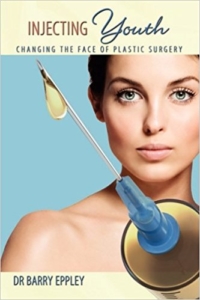 In the past, plastic surgery was all about having operations to reverse the effects of aging on the face. Time was, once you could no longer stand to see yourself in the mirror or in pictures…facelifts, eye tucks and the like became appealing with all of the associated swelling and bruising, recovery, and expense.
Over the past ten years, non-surgical injectable treatments have become popular for men and women of all ages…and have become part of mainstream society in ways that rival Starbucks, energy drinks, and iPhones. The concepts of muscle paralysis, plumping fillers, and fat dissolving agents have made it possible to have smooth foreheads, fuller lips and softer laugh lines, and maybe some subtle tightening of the jowls and neck in a few simple visits to the doctor’s office. Unlike surgery, injectable facial treatments are as much about the prevention of the effects of aging as they are about reversing what has already taken place.
Along with this explosion of available injectable treatments have come the inevitable, unbelievable marketing claims, and so-called ‘expert’ injectors. But, like much of what you may read on the internet, in popular magazines, and hear in commercials , what can you really believe? How do you separate reality from marketing hype? How can you decide where-or if-injectable treatments are for you? And if so, which ones??
Dr. Barry Eppley, board-certified plastic surgeon of Indianapolis, takes you on a broad tour of every injectable treatment option. Providing insight into Botox®, the many injectable fillers, and lipodissolve, Dr. Eppley provides the current science behind the treatments, and talks plainly about his experience and observations. These insights from ‘behind the needle’ about these incredibly popular injectable treatments are available nowhere else.
Whether you are just researching Botox® or fillers, or are a seasoned expert with an upcoming consultation about the next new option, Dr. Eppley gets you ready for Injecting Youth!
The greatest trend in plastic surgery in the past decade has been, ironically, the explosion of procedures that don’t involve actual surgery. Comprised largely of injectable therapies, such as Botox and fillers, and laser and light treatments, making the face look rested, supple and youthful has become as easy as a quick visit to the doctor’s office. By sheers numbers, non-surgical facial enhancement far exceeds the actual number of cosmetic surgeries performed per year.
Such ‘beauty treatments’ have been very successful for concerns of facial aging but the same approach has not seen the same successes for body concerns. The search for an effective non-surgical method for the reduction and removal of fat remains as elusive as finding the magic pill or diet for weight loss. Much has been promised, but little has been delivered so far.
The allure of ‘non-surgical’ is always a compelling one and any device or product that offers it always attracts a large amount of public interest. But within that appeal lies the often ignored fact that non-surgical treatments are not equivalent to surgery. They produce results that are far less and should be of thought as a delaying tactic or a complement to what surgery can do, not a substitute.
Non-surgical facial methods should never be equated to what actual surgery can do. You can reduce a few wrinkles, plump up some thin tissues, and get your skin to look fresher. And, to be sure, those are great changes for many people, but many patients often expect or believe much more will occur. This is unfortunately not helped by the sometimes very ‘broad’ promotional claims of product manufacturers and doctors alike. Unless properly advised, it is easy for one to undergo some form of office treatment, often not inexpensive, and be disappointed with the results. This is especially seen when it comes to a wide variety of ‘facelift-like’ methods. I have seen many such patients, all of whom in the search for something less, did indeed end up with less.
While seriously ‘injurious’ complications are rare with underperforming and overpromised cosmetic treatments, there is always the economic loss. Wasted money may prevent someone from contributing to and having a more significant procedure that would provide much better long-term benefit. The point being is that one must keep an eye on the concept of value when comparing non-surgical versus surgical cosmetic procedures.
One good illustration of this concept is in the highly promoted ‘Liquid Facelift’ procedure. Plumping your face up with injectable fillers does create some more fullness in the face and it could be called a lift of some sort (it does nothing for the neck which is why most people seek a facelift). But its effects last perhaps six months and costs several thousand dollars. Some form of a real facelift (and there are many variations) may cost two or three times more but the results are much more significant and could easily last a decade or more. Is either one wrong? No. Each person has their own objective and needs and either approach could be right for different people. But from the concept of value, removing, lifting and tightening is actually more economical in the long-run than plumping and a little smoothing.
Most non-surgical office treatments have no recovery, a near instant result, and cost less …and do so at the ‘price’ of being less effective as well. Expectations are the key to any plastic surgery procedure and simple office treatments should be judged more for their contribution to value than their ease of doing them.
Dr. Barry Eppley
The mere mention of the word ‘facelift’ is to many people a frightening concept that is best avoided. Beyond implying surgery, images of ‘perpetual surprise’, ‘wind-tunnel’ and ‘unnatural’ come to mind. It is these very misconceptions and fears that have led to a surge of procedures that have become broadly known as non-surgical facelifts.
Cleverly marketed as appealing improvements known as ‘lunchtime facelifts’ and ‘liquid facelifts’ , these facial procedures are hopefully performed in a doctor’s office with a combination of Botox, injectable fillers (such as Juvaderm and Radiesse), and light and laser treatments. They are tremendously appealing precisely because they are not surgery, and involve no scarring or downtime. And they are based on a recently appreciated anatomic understanding of facial aging which is that of volume deflation (loss of fat) and not just sagging tissues alone. ‘Re-inflation’ of the face is the result of these treatments, even if it is only temporary (there are no permanent injectable fillers).
Under the guise and enthusiasm of anything that is pain and recovery-free being better than a real facelift, a patient inquired about the ‘new’ Y-facelift published this past weekend in New York Times Sunday Magazine. Buried in the center pages of this magazine was a story entitled ‘Houston, We Have Facelift’. Reading this story got me thinking about everything that is both good and bad about the non-surgical facelift ‘revolution’.
The concept: Developed by a dentist who claims to have taken four years to develop this approach, the Y-facelift involves filling the face with large volumes of injectable fillers, molding it around with one’s fingers, and then treating the skin with radiofrequency treatments to tighten it. I am not sure what the Y means but some filling out of the face is most certainly achieved, without surgery, for a subtle improvement.
The bad:. It may be shocking for some that everything in New York isn’t always better (although always twice as expensive) and the New York Times Style magazine does not carry the same scientific clout, for example, as the New England Journal of Medicine. Cosmetic procedures are fraught with a common problem- marketing that frequently gets way ahead of proven science. This practice is so prevalent that doctors and companies alike have learned that appearing in Allure, Cosmopolitan and other beauty magazines with exaggerated and unfounded claims drives business better than a scientific discourse in any medical peer-reviewed magazine. (and much easier to get published) Even the pharmaceutical industry has this figured out which is why almost one-third of television ads today are for some prescription drug. The bottom line is the ‘Y-Lift’, while based on a few known plastic surgery procedures, is an unproven amalgamation which most likely benefits the treatment provider more than the recipient.
What matters: The debate between non-surgical or surgical facelifts can be debated ad nausem. Both may be appropriate for any patient under the right circumstances. The practitioners of both will hotly contest each one’s merits. But the non-surgical boom of cosmetic procedures speaks to an important issue that is rarely discussed…value. What does one get for what one pays? The non-surgical Y-facelift retails between $4,000 and $8,000 for results that will last one year, maybe slightly more. The price of non-surgery, when looked at long-term, is frequently more than that of actual surgery…with results that are not nearly as long-lasting.
There are many factors that go into deciding what is the best facial rejuvenation procedure. Never forget that the concept of value in plastic surgery, like any other retail purchase, is extremely important. But the medical merits of such procedures should not be determined by what is written in a trendy magazine whose sole intent is newsstand and ad sales, not satisfied and happy patients.
Dr. Barry Eppley
I have heard many patients say “Can you fill up my lips with Botox’ or ‘I need a filler between my eyes to stop me from frowning’. This confusion comes from the fact that all these in-office anti-aging treatments come out of a needle. But the reality is not all that comes out of a needle is the same. While such confusion is understandable due to the relative newness and apparent similarity of these injectable treatments, that is a little like saying that one scalpel can do all the same surgeries. Injectable agents are treatments which have different mechanisms of action, even if the end result is often times similar. (facial wrinkle or fold reduction)
To clear up the confusion, I often explain to patients the difference between static wrinkles and dynamic wrinkles that appear on one’s face. Dynamic wrinkles are those wrinkles and lines that appear when your face is moving or expressing yourself such as smiling or frowning. When we were younger, the only lines and wrinkles we had were dynamic. Our face was otherwise wrinkle-free when we weren’t expressing ourselves. Static wrinkles are those facial lines that are evident even when our face is not moving. All dynamic wrinkles, with time, will eventually lead to static wrinkles. When we are older, those static lines look even worse when they become dynamic. What looks cute on a child’s face when they laugh, decades later, will someday be viewed quite differently.
These two types of wrinkles are what separates Botox and any of the injectable fillers. (e.g., Restylane, Juvaderm and eight other brands) Botox is for dynamic wrinkling. It is a muscle-paralyzing or muscle weakening agent so it will soften the wrinkles and lines that occur from a dynamic facial movement, such as between the brows with frowning….or the crow’s feet around the eyes from smiling. Injectable fillers are for static wrinkling. They soften lines and larger wrinkles by plumping them out so they look less evident at rest. In some cases, the combination of Botox and fillers are used at the same when the line or wrinkle is very deep and weakening the muscle action will help preserve the longevity of the filler material but not being ‘beaten on’ by continuouosmuscle movement. This dual combination is almost exclusively in the furrows between the eyebrows from frowning. (also known as the ’11 sign’)
One other important difference between Botox and injectable fillers is where they are used. Botox is primarily a ‘northern’ facial procedure used on the forehead and around the eyes. Injectable fillers are a ‘southern’ facial procedure, used mainly around the mouth.
Feel free to contact me and get a free copy of my book on this subject entitled ‘INJECTING YOUTH’.
Dr. Barry Eppley