Your Questions
Your Questions
Q: Dr. Eppley, I have done some research on an occipital augmentation cranioplasty for a flat back of the head. I am still about 18 months away from having the money to receive such an operation but in the meantime I have two questions.
1.) What are the long term effects of such a operation?
2) How long is the scalp incision to do the surgery?
3) If I sent in a picture, is there any way to get a good estimate of the size of the needed incision? And is there a way to see what possible results would look like on myself?
Thank you for your time!
A: In answer to your questions:
1) Based on my extensive occipital augmentation experience, I have yet to seen any long-term untoward consequences such as implant problems (infection), skull or scalp issues. There can be some aesthetic issues such as smoothness and edge transition blending into the bone.
2) The size of the incision is going to be based on what implant method is used, preformed implant (6 to 7 cms) or PMMA bone cement. (9 to 10cm) That is predictable up front.
3) Side view pictures can be used to show potential result predictions using computer imaging techniques.
Dr. Barry Eppley
Indianapolis, Indiana
Q: Dr. Eppley, I have an occipital knob on the back of my head just like the one you have shown in your website. It’s destroying my self confidence and I would like it removed. How is it done, what is the recovery like and how much would a procedure like this cost?
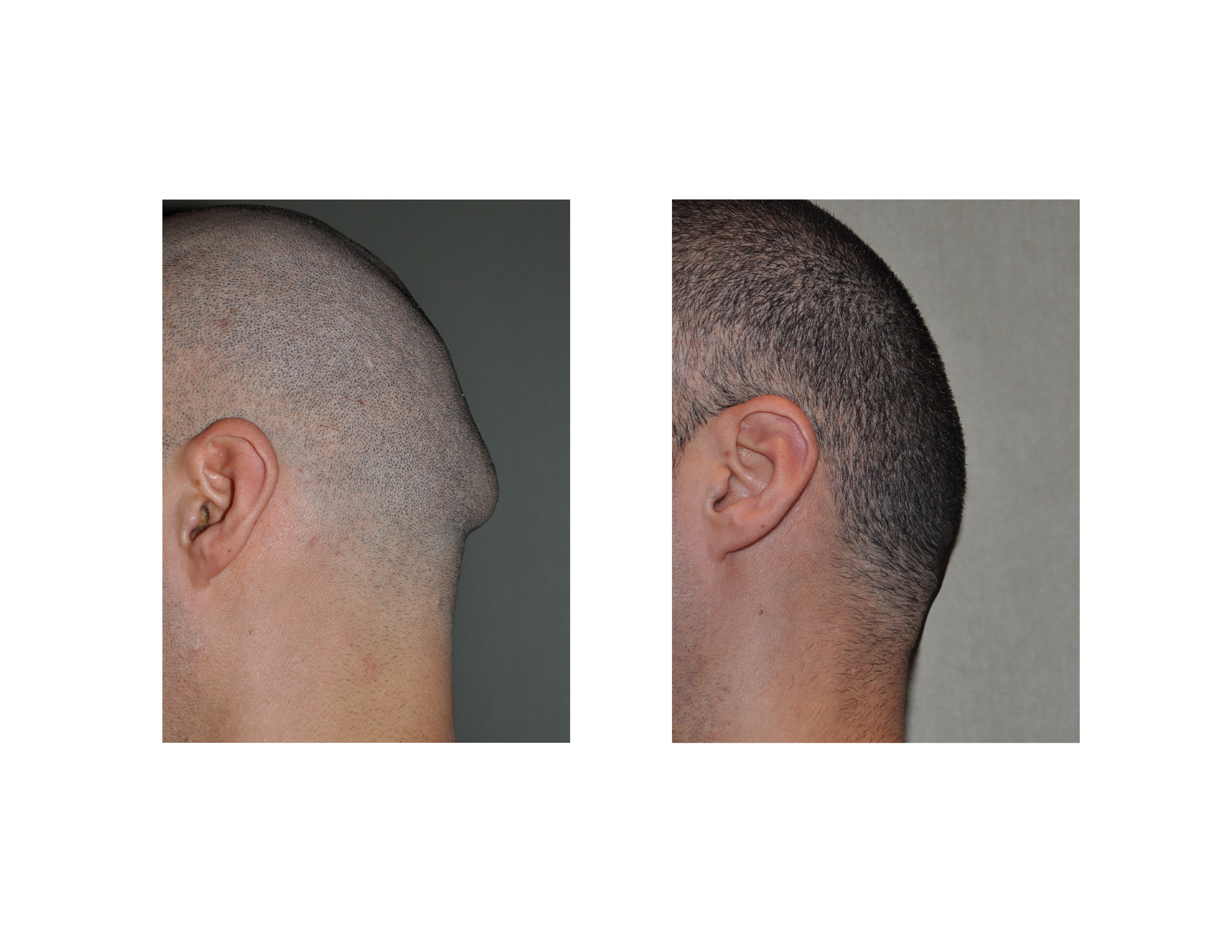
A: The occipital knob is a prominent bulge of bone at the back of the head on the lower edge of the occipital bone along the nuchal line in the midline. It is an abnormal thickening of completely cortical bone that sticks out like a knob. It is most commonly a concern for men who shave their head or have very short hair. I have seen some really impressive occipital knobs that are extremely prominent. Surgical reduction/flattening of this bone knob is done through a small horizontal incision over it, usually no greater than 3 to 3.5 cms in length. (limited incision occipital reduction cranioplasty) The knob is burred down to be smooth with the surrounding bone. Usually I will then suture the soft tissues down to the bone surface through bone holes to make sure no fluid develops between the skin and the reduced bone. The skin is then closed with small dissolveable sutures. This procedure takes about one hour under general anesthesia and is done as an outpatient procedure. The cost of the procedure, all expenses included, can be obtained by contacting my office for a quote.
Dr. Barry Eppley
World Renowned Plastic Surgeon
Q: Dr. Eppley, I have a few questions regarding occipital cranioplasty. the back of my head is kind of flat and it’s been bothering me since high school. As I get older I notice that it gradually get flatter, to a point where I don’t tie up my hair anymore because I am so self conscious about it. Now that I am 36 years old and am financially capable of fixing this problem, I am contemplating on getting the surgery done.
Below are my questions:
1. If I decide to have the occipital cranioplasty done, will I have to shave all my hair off for the surgery?
2. Since I will have extra material at the back of my head will it affect the growth of my hair or the health of my scalp?
3. What are the possible side effects of the surgery?
4. Do you have patients who already had the surgery done for solely aesthetic purposes? And are the cases with these patients successful?
5. Where is the best place to have the surgery done? ( country/state/doctor)
Your advise will be much appreciated.
A: Thank you for your inquiry. In answer to your questions
1) No hair is ever shaved to perform an occipital cranioplasty.
2) Any placement of material on the skull bone does not affect the growth of the hair or the health of the overlying scalp tissues.
3) While infection is always a concern when any material is placed in the body, that is not a problem I have yet seen in cranioplasty. The most common side effects for any form of cranioplasty are aesthetic is the material smooth, even and symmetric? Was the buildup enough?
4) Most skull augmentations that I perform today are done exclusively for aesthetic purposes. The most common type of aesthetic cranioplasty that I perform is to treat a flat back of the head.
5) I can not speak for who else in the world performs aesthetic cranioplasties, I only know that I do.
Dr. Barry Eppley
Indianapolis, Indiana
Q: Dr. Eppley, I wrote you before to inquire about a Skull reshaping using implants. I saw the archive “Cranioplasty Category” in your web site which shows the case were a 42 year old male was operate, and an implant was inserted in the back of his skull (occipital) in order to lengthen and correct a deformity, in this case a flat spot area. I must to say that it is a great job.
I have a similar problem, although it is not exactly like the example posted, in my case the flat spot is less notorious, but the overall profile of my skull is short. Moreover the rear of my skull is slightly above the level of the forehead. I think its because of some postural plagiocephaly caused when I was a baby.
I have some questions I want to ask you.
1) How much my scalp could be elongated in the back of my skull and the final appearance would look natural?
2) Would there be a very visible scar ?
3) Would I have to shave my head for the operation?
4) There is a risk that no hair grows up in the area of the implant ? cause i´m not bald
5) How long would I be hospitalized before and after the process?
I want to have the shape of the occipital area more pronounced. in order to have a more symmetrical shape of my skull. I know it´s difficult to answer my questions without seeing any images, So I could send you pictures of my two profiles to have a better idea.
A: In answer to your questions:
- A s a general rule, the skull can be expanded 10 to 15mm across the back without making scalp closure to tight or precarious for good wound healing.
- All forms of craniplasty require access through an incision. It heals as a fine line but there is a scar nonetheless. That needs to be taken into account when considering a cosmetic skull procedure.
- We do not shave any hair for cranioplasties. It is easier for the surgery if a patient did shave their head but we do not do it if the patient does not want to.
- The only risk of any hair loss is at the scar, not in the raised scalp flaps.
- This is usually done as an outpatient procedure in a surgery center, not a hospital.
Dr. Barry Eppley
Indianapolis, Indiana
Q: Dr. Eppley, I’m interested in occipital cranioplasty, and I have a couple of questions. The flat area is on the upper part of my head. I will be having hair transplant surgery and right now I’m probably a Class V. If I want to go ahead with the cranioplasty should I do it before the transplant procedures or after. I will have to have at least two sessions and I might not be a candidate for FUE. If that’s the case then the strip method will be used and the doctor will have to undermine my scalp. I’m afraid that if the cranioplasty is done first the doctor might have trouble undermining my scalp for the transplant. Second, with the cranioplasty I would want the stronger material (acrylic) and would want it to be fixed to the bone with screws, mostly because I’m active. The question is, would I be able to do a headstand with the material attached to my skull? Would it hold up to my full weight even if I do neck bridges, like in judo? Or once I have it done I would have to kiss those kinds of exercises goodbye? I would want that puppy in there permanently and solidly attached to the back of my head.
A: When it comes to occipital cranioplasty and hair transplantation done with the strip method, they are mutually exclusive. Occipital cranioplasty requires scalp expansion of which strip harvesting takes away scalp in the same general area. The two can never be done on the same patient no matter how they are sequenced. There is also the issue of vascular compromise to the posterior scalp caused by strip harvesting which make the blood supply to the scalp precarious in the midline if an occipital scalp flap was ever raised.
Dr. Barry Eppley
Indianapolis, Indiana
Q: Dr. Eppley, I am looking to fill the dent in the back of my head to achieve a more normal, round head. My flat spot/indentation is very obvious and noticeable from certain angles. It is located in the back left side of my head, a bit higher and closer to the top of the head. The dent leads to another minor flat spot right where the head curves from the top to the back. What I would like is an injectable cranioplasty operation and suggestions if there are any better options. Also, what is the recovery process of the operation? Thank you very much and your feedback and insight is tremendously appreciated.
A: Injectable cranioplasty is a technique that I have developed to avoid any significant scalp scarring with limited build-ups of the skull. Small back of the head indentations/flatness are the most ideal areas. The concept is based on having a cranioplasty material that is liquid enough during its initial mixing that it can be injected and then sets in a reasonably short length of time there after. A small one inch is needed to lift the scalp tissues off of the bone and develop the desired recipient pocket. It is through this small incision that the material is injected. Once injected the material must be molded into shape from the outside through the scalp. While Kryptonite was initially the material I used, it is no longer available as the manufacturer has withdrawn it from the market. (the reason I do not know) I am now working with another calcium phosphate material, OsteoVation, which I actually like its handling properties better.
While the injectable cranioplasty approach certainly has its appeal, it is not without any downside. Its biggest drawback is that getting the material smooth is a blind procedure and rarely does it ever become perfectly even. The other issue with it is cost. These materials generally cost 2X to 3X more than conventional PMMA cranioplasty material which needs to be placed through an open incision. (about 9 cms) The guarantee of optimal smoothness shape requires an open cranioplasty approach.
Dr. Barry Eppley
Indianapolis,Indiana
Q: Dr. Eppley, I have a few questions about building out a flat spot on my skull. I have attached some pictures for your evaluation. My questions are:
1) Since the Kryptonite material is no more available there is only the PMMA,Hydroxyalite(HA) and custom silicone implant available. If I understand well all these materials are requiring an open approach under general anesthesia for two hours
and they all leave a scar between 8-10cm when they are introduced under the scalp. Will the scar be visible if i keep my hair a little longer then short?
2) Other than a scar ,minor contour issues remain as the only risk. If these contour issues ever occur later after surgery, what have to be done and how?
3) Hydroxyapatite material bonds to the bone with no risk of osteolysis. Does it make then (HA) safer than PMMA in that matter?
4)What is the biggest disadvantage in using hydroxyapatite material?
5) The safety is my biggest concern long after the surgery, which of these materials are best proven over the years?
6) I would be traveling from abroad. How long do I have to stay in the U.S. and do I need some special medical insurance in case something goes wrong during the surgery.
A: Based on your photos, what I see you are demonstrating is a severe flatness to the back of the head, lack of occipital projection. In answer to your questions:
1) The posterior scalp scar is about 8 to 10 cms that with hair will remain hidden. There are numerous bald.shaved patients who have the procedure as well but I think it is a good idea to be well aware of the scar potential.
2) If any contour issue arises, such as an edge than one can feel or some asymmetry, it can be easily adjusted/fixed through the same scar approach. I go to great lengths to avoid that happening for the obvious reason…no patient wants to go back to surgery. But despite my best efforts, surgery is not always perfect.
3) HA does have a direct bone to bone so, in theory, it is a more biocompatible material. I wouldn’t use the word safer as both materials have been used successfully for decades. But if I was a young person and had a choice between the two materials (cost is the big issue) then I would go with HA>
4) Cost is the only disadvantage to the HA material. By volume alone, it takes twice as much HSA to get the same volume effect as PMMA>
5) PMMA has been used as a cranioplasty material for over 40 years. HA has been used for over 25 years.
6) Almost all cranioplasty patients return home within 48 hours after surgery. No special medical insurance is needed as nothing is going to go wrong that would warrant any catastrophic medical care. This is the simple addition of a material on the outside of the skull bones, it is very safe. The risks of this surgery are aesthetic concerns not significant medical complications.
Dr. Barry Eppley
Indianapolis, Indiana
Q: Dr. Eppley, I am a young man with a skull that is flat at the back. It has caused me a lot of grief as a teenager and to this day and I think it’s time I did something about it so I can stop being so extremely subconscious about it. I have attached pictures which show how flat the back of my head is when the hair is parted in such a way or id wet. The flatness is pretty much only isolated to the back of my head. At the very top of the head near the crown there is a noticeable ‘bump’ then the skull goes in a drastic decline. The forehead, and front sides of the head appear and feel normal/symmetrical it just the back which is causing the aesthetic issues for me.
From my research you appear to be the most qualified to do such an operation as you’ve had a great number of patients with the same issue as me therefore I would fully feel comfortable with you doing this procedure because of your extensive experience. This brings me to my next question, can you help me? From the pictures provided do you think you could give me the normal male skull I desire? There is nothing more I want than being able to shave my head really short. I understand there are different methods of operation some more intrusive than others. I am actually not concerned with the scars the operation will leave so long as it gives me the normal shape I have always desired, a skull that appears normal and wouldn’t get a second look from passers by because it’s normal. I would only want one operation to fix this issue and would like to avoid having to come back to do revisions to the operation. Now, having that in mind what type of procedure would you recommend for me?
A: Thank you for your inquiry and sending your pictures. I can clearly see that your degree of occipital flattening is significant. It is probably one of the more flat back of the head cases that I have seen. When it comes to correction, I think you have two options. First, using a standard open technique a cranioplasty can be done to build out the flat area somewhat. Stretching of the scalp is the limiting factor and you could get about a 10 to 15mm build-up. That I feel would be a mild improvement but I think is inadequate for a significant improvement. It would be better but not ideal. The second and more ideal option is a two-stage approach using a first-stage tissue expander followed by a secondary cranioplasty build-up. This could get upt to 25 to 30mm of skull expansion which ideally is what you need. The tissue expansion provides the necessary creation of additional scalp tissue to cover the size of the build-up tension-free. Computer imaging will show the differences in the result between the two approaches.
Dr. Barry Eppley
Indianapolis, Indiana
Q: Dr. Eppley, I’ve been reading on your website and found a lot of interesting information. I was looking at pictures for patients, but did not see any that resemble my condition. Do you have any with flat spots that have been filled out in the back of the head? From what I have gathered while reading your site, you can only build out up to 10 cm. I’m just trying to picture how a fix for my condition would look after. My head is normal except for the back and then it has a slope. However, the slope is not uniform. It’s less of degree on one side vs the other. So from the top down there is a slope in the back, but from left to right it is almost like it is angled. Meaning if you looked at me from the back, the right side is not as sloped as the left. In fact, the right side is a little more “normal” I guess. Thanks for your help and information.
A: The most common skull augmentation procedure that I do is an occipital cranioplasty for a flat spot on the back of the head. You are correct in assuming that the buildup would be about 10 to 12mm maximum. Much greater buildup than this may pose problems with incisional scalpclosure or undue tension on the wound which usually lies directly over it. Bony asymmetries are dealt with by a differential application of the material.
Dr. Barry Eppley
Indianapolis, Indiana
Q: Dr. Eppley, I have a significant flat spot on the back of my head. Starts at the area of my crowns and then goes out. It is kind of big in size (12 oz can circumference). It is really a flat spot/slope down. Is there a procedure for fixing this or can material be injected to build up the low area? What options are available to help make an area like this look normal? Thanks in advance for your help.
A: There is only one basic option for your concern, a procedure known as an occipital cranioplasty. That is a sophisticated medical term meaning to build up the deficient or flat bone area. This is done with a variety of potential cranioplasty materials including PMMA, hydroxyapatite and even custom silicone implants. These materials need to be placed through an 8 to 10cm posterior scalp incision. This is a fairly straightforward procedure that is done as an outpatient surgery. Since the buildup is on the outside of the skull, there are no major medical risks in having it done.
Dr. Barry Eppley
Indianapolis, Indiana
Q: Dr. Eppley, I have a very large head that sticks out in the back (about one inch), is pointy on top, and comes out on each top-corner as well. This has caused me much mental distress ever since I was a chiold, and now that I am in my late twenties, and my hairline has receded a bit, I am noticing it even more. I am unable to wear most hats becuase they do not fit. I am wondering what sort of optiond I have to reshape/reduce my skull size. I don’t think there is anything that can be done to make it completely normal, but anything would be better than what it currently lokos like. I would appreciate any feedback you can give me. I have a few specific questions that I hope you can answer.
- As an African-Americn man that wears relatively short hair cuts, I ama concerned about having a large scar across the back of my skull. Are there any other otpions that would work equallya s well as an open procedure?
- What are the general costs for the procedure i m requesting?
- If an open procedure were to be done, how long of a scar would it be?
- If an open procedure were to be done, what happens to the excess scalp skin? is it removed as part of the procedure?
A: Since I have not seen your particular skull problem, I can only provide some general answers. The question will come down to…can the back of the skull be reduced enough to justify an occipital reduction cranioplasty surgery by burring? That will ultimately require a plain skull film from the side view to take a measurement and see how much can safely be removed.
To answer your specific questions:
1) No.
2) Probably in the range of $6500 to $8500.
3) 10 cms. (4.5 inches)
4) A little maybe, although it usually shrinks back down.
Dr. Barry Eppley
Indianapolis, Indiana
Q: Dear Dr. Eppley, I have done a lot of reading on your website and interested in the cranioplasty procedure to fix the flat spot on the back of my head (on the top area on the back). I am a female and have noticed this since my teens and always thought there was no help until I came upon your website, now I am hopeful. I am scared and nervous about this procedure and have several questions:
1) Is this a new procedure because I don’t see where this has been performed for purely cosmetic purposes before by other doctors?
2) Would you say the injectable approach doesn’t achieve as much as an effect as the open incision approach?
3) Also, in the open incision approach, I know you use either PMMA or HA materials. If the PMMA is used, does that mean you will need to use screws to attach the material? Is it riskier than using HA since screws are used?
4) When did you first start performing this procedure and approx how many have you done?
5) Have there been any complications with any of them? If so, what were the complications and how did you fix them?
6) I live in Houston, TX and would be traveling alone. From what I read, this is an outpatient procedure, therefore I am concerned about being without care the first night after surgery. Would you recommend that I get this done in the hospital as inpatient, so I am under care?
7) Also, how do you determine how much material to add?
8) Do you place expanders to stretch out the skin if I want more material added to achieve my desired result?
9) Will there be a noticeable difference afterwards?
10) Do you take any sort of imaging to determine the shape you plan to mold?
11) Will you ‘sketch’ out the final shape beforehand so I know what results to expect?
12) How many visits will this procedure require? Including pre-op and post op/follow-up visits?
13) What is the recovery? How many nights will I need to spend in IN? When am I ok to fly back home? When can I go back to work?
A: In answer to our detailed questions:
1) Although this is a relatively ‘new’ procedure from a cosmetic standpoint, it is based on the decades old principle of reconstructive cranioplasty from craniofacial plastic surgery. The only thing that is really new about it has been the development of some new cranioplasty materials to use.
2) The injectable approach can achieve just as much as an open approach. It is about volume of material used and its costs that partially controls the result achieved.
3) There is no increased risk of screw fixation for a PMMA cranioplasty technique.
4) I have done cranioplasties for nearly twenty years. In the past three years, I have developed some techniques for cosmetic skull augmentation.
5) The main complication with an injectable approach is getting a smooth contour to the material. I have had one wound healing complication from an open PMMA cranioplasty when using an old hair transplant scar for access.
6) Having an occipital cranioplasty as an outpatient is just fine. Patients report virtually no pain afterwards.
7) One of the key issues is how much material to use. That will be determined by the approach used and what the scalp tissues can tolerate. My experience has shown that open cranioplasties through small incision use about 30 to 40 grams with either PMMA or HA. Injectable kryptonite usually uses 25 grams for the occipital region.
8) While the use of tissue expanders does allow for more material to be placed, it has not been necessary in my experience. This would also make the procedure an unappealing two-step process.
9) There will be a noticeable appearance afterwards. It is a question of how much.
10) No imaging is required. It is an artistic molding based on the extent of the defect and the patient’s after surgery shape desires.
11) Computer imaging can be helpful in understanding what to expect.
12) There are no after surgery visits required for an occipital cranioplasty. A good presurgical consultation can be done by phone or Skype video in addition to seeing patient pictures. Patients come in the day before surgery for a formal consultation.
13) Most patients return home the very next day and return to work in just a few days after
Dr. Barry Eppley
Indianapolis, Indiana
Q: Dr. Eppley, I have a flat spot on the back of my head that I would like corrected. It is at the back of the crown of my head and it gives me a funny looking head. I have attached pictures and have drawn on them the shape that I would like to have. Can you tell me I how this can be corrected? What material and how would it be placed? What is the recovery after this type of operation?
A: Having done quite a few occipital cranioplasty procedures for skull flattening that looks just like yours, I would recommend PMMA. This is because it will take about 40 to 60 grams of material to create the desired effect. PMMA offers the most cost effective material when it comes to this amount of cranioplasty augmentation. Other material options include HA (hydroxyapatite) and Kryptonite but they will cost anywhere from 3x to 5X more in terms of material cost, that can add thousands of dollars to operative costs. The procedure would be done through an open approach through a low horizontal incision on the back of the head, where hair loss is not likely to ever occur. This is done as an outpatient procedure done under general anesthesia with an operating time of approximately 90 minutes. There is actually very minimal recovery afterwards other than some non-visible swelling on the back of the head. Occipital cranioplasty is a much simpler procedure to go through than most people envision.
Dr. Barry Eppley
Indianapolis, Indiana
Q: Dr. Eppley, I am very interested in skull contouring for the back of the head using acrylic, although I do have a couple of questions. What is the maximum thickness that can be added? Where is the incision to put it in located? I have a scar running horizontal across the back of my head from a hair transplant several years back. Can the incision be placed in the existing scar line or is it a must that it be vertical? Thanks for your time.
A: When building up the back of the head (occiput), the limiting factors on the thickness of the augmentation is the scalp and the incisional approach. How much the scalp will stretch is important as its expansion is what creates the space for the material. Usually the augmentation can be anywhere from 10 to 20mms at the greatest point of the arc of convexity. (midline occiput) Where the incision is located and how long it is always influences the shape and volume of the augmentation. While a traditional bicoronal incision provides unparalleled access for any location of skull augmentation, that scar is aesthetically unacceptable. For this reason, I use a vertical incision for an occipital cranioplasty. It provides good exposure over the most important part of the occiput where the buildup needs to be the greatest. Whether your existing horizontal scar can be used depends on where it is located. Most hair transplant harvest sites are usually fairly low but I would need to see a picture of the scar location to tell if it can be used for incisional access. I would certainly be motivated to try and use it if possible for the obvious aesthetic benefit.
Dr. Barry Eppley
Indianapolis, Indiana
Q: Hi, Dr. Eppley. I have a really flat head. I can hide it by blow drying my hair, using gels and any volumizing products to make my head look not so flat. My hair is very short and has lots of layers at the back of my head so it hide it pretty well.. Is there a surgery for flat heads to make it not flat? If so, what’s it called? Have you done any surgeries for flat heads before?
A: When most people refer to having a flat head, there are talking about the back part. Sometimes it is one side but, most of the time, it is both sides. This is called occipital plagiocephaly, either unilateral (one-sided) or bilateral. (both sides) This flatness is always at the upper part of the back of the head, which is the bony or skull part. Down low, it become more neck muscle and less bone. Building this area ouot (augmentation) is done the same way as it is in the forehead through an onlay cranioplasty technique. This is done by adding a bone-like material onto the top of the bone in the amount that will satisfactorily expand out the bony contour and make it more rounded. The critical decisions about occipital cranioplasty is what type of incision to place and what type of cranioplasty material to use. The type of cranioplasty material influences the incisional approach. A vertical incision is used down the back of head (open technique) where either acrylic or hydroxyapatite materials can be placed. This offers the best and smoothest shape. A smaller vertical incision can also be used (endoscopic or injection technique) in which only Kryptonite material can be used. While offering a smaller incision, the trade-off is in the difficulty in getting a perfectly smooth shape.
Indianapolis, Indiana
Q: The back of my head is very flat. As a child in school, they used to make fun of me because the back of my head was so flat. While I want to wear my hair short, I can’t because it becomes really apparent. I have attached some pictures showing how flat it is. Because of my longer hair, I have drawn a line indicating the actual shape of my head beneath my hair. I want to add up to an inch to the whole backside of my head to give a more rounded shape. Do you think it is possible with the Kryptonite material and not having to make a big incision across the back of my head?
A: Thank you for sending your pictures. It is easy to see, even with your hair, how flat the back of your head is. Yes it is possible to build out the back of your head with a minimally invasive cranioplasty technique using Kryptonite. However there are several caveats about the outcome with this cranioplasty method. The build-out of your skull can not go below the lowest level of the occipital bones which is about at the mid-level of the ear. (you can feel how high the end of the occipital bone sits with your fingers. Most people think that the bone goes much lower than it does. Any cranioplasty material can only be put on bone not muscle. A skull build-out of as much as an inch may be too extreme due to scalp expansion issues, a more likely result is 1/2″ to 3/4″ at the very center. (midline)
Dr. Barry Eppley
Indianapolis, Indiana
Q: Hi, I’m 25 and have a really flat area at the back of my head. I’m very self-conscious about this since I was 15. Is there any way that I can fix this for a cosmetic purpose. Can something be implanted at the back of my head? You are my only hope now. If I can get the new round back of the head, I will also get a new life with your help. I have attached some of the pictures of my head taken on the side. Whenever I look at it, i just want to cry. And I’ve mentally suffered from this flat head shape since I was a teenager. If you could possibly please tell me, what needs to be done, and how long does it take to recover after the operation, I would appreciate your help and time so much.
A: Thank you for sending your pictures. I can see how flat the back of your head. The best and most economical way to augment and expand the back of your skull is through an onlay cranioplasty method. This involves putting a material on top of the bone to build it out. Given the amount of material needed, I would recommend acrylic or PMMA. Other materials exist but they are exponentially more expensive. There is even an injectable technique using Kryptonite Bone Cement, and that would be a good option for you, but that would be a cost issue.
To summarize, you can do an occipital cranioplasty by either:
1) An open cranioplasty approach with acrylic or PMMA, PMMA is a very firm material, is the least costly and must be put in through an open approach. (meaning a long fine line scar in the hairline) It would be a two hour procedure under general anesthesia.
2) The other option would be an injectable approach using Kryptonite cement. This would only need about a 2 inch incision. This procedure would take about an hour to do.
The fundamental difference between the two procedures, besides the incision/scar, is the cost of using the material.
Indianapolis Indiana
Q: Hi, I am 25 and have a really flat area at the back of my head. I’m very self-conscious about this since I was 15. Is there any way that I can fix this for a cosmetic purpose. Can something be implanted at the back of my head? You are my only hope I have. I almost cried of joy after reading your articles that it is possible to reshape the back of my head by some materials and that you have done this so many times. This really means so much to me if I can get a new round back of the head, I will also get a new life with your help. I have attached some opictures of my head taken on the side. Whenever I look at it, i just want to cry. And I’ve mentally suffered from this flat head shape since I was a teenager. What needs to be done, and how long does it take to recover after the operation? I would appreciate your help and time so much.
A: Thank you for sending your pictures. I can see how flat the back of your head. The best and most economical way to augment and expand the back of your skull is through an onlay cranioplasty method. This involves putting a material on top of the bone to build it out. Given the amount of material needed, I would recommend acrylic or PMMA. Other materials exist but they are exponentially more expensive. There is even an injectable technique using Kryptonite Bone Cement, and that would be a good option for you, but that would be a cost issue.
Recovery from this type of surgery is fairly quick, particularly if an injectable method was used. (since there is only a one inch incision to do it)
Indianapolis Indiana