Your Questions
Your Questions
Q: Dr. Eppley, I have been dissatisfied with my lower third for years. Specific concerns include an undefined jawline, deep nasiolabal folds, lip incompetence, mentalis muscle strain when I try to close my mouth, and a slight overbite. I also have non-cosmetic issues like chronic snoring. Recently, I’ve realized many of my issues may be due to a weak/short chin. I like the idea of a genioplasty for my chin because while I would like to improve its projection and slightly reduce its vertical height, I do not want to change my appearance drastically or look like someone else; my goal is simply to improve my overall facial harmony and address structural issues. Based on this and my photos, would I be a good candidate for sliding genioplasty?
A: Thank you for your inquiry, detailing your chin concerns and sending all of your pictures to which I can say the following:
1) You are a good candidate for a sliding genioplasty to which you have addressed the correct dimensions…forward and shorter.
2) How much forward and shorter is open to discussion. But, as a general rule, the real aesthetic risk is in too much forward projection in women. It is usually important to keep a more retroclined profile chin position from the nasal tip and lips. (see attached)
3) Given the amount of chin bone movement I would not expect any improvement in your snoring. It usually takes 10 to 12mms of bony chin advancement for that to occur.
Dr. Barry Eppley
Indianapolis, Indiana
Q: Dr. Eppley, I have facial implants that goes around my entire jawline, cheek and paranasal implants, Goretex material. I thought this would fix my problem but turns out orthognathic surgery (Bimax) is what I should have done.
I have now consulted with a maxillofacial surgeon and he said that it was best was to remove all the implants and around 6 months later do the bimaxillary surgery.
The reason is because he can’t give an accurate image of what I would look like with the implants in my face. He has not removed Gore Tex material before but has worked with Medpor.
My question is, what are the risks and complications of removing goretex implants and especially by some who has not done it before with that material?
A: Removing ePTFE implants is very similar to that of Medpor. There will just be a lot more of them in your face.
Dr. Barry Eppley
Indianapolis, Indiana
Q: Dr. Eppley, I am a black male considering a chin implant. I am Fitzpatrick skin type V/5. I am told the submental incision route for placing the implant is best but I am quite worried about scarring on my more melanated skin. I can’t seem to find any images of a submental scar on darker skin that has healed. Do you know where I might find this? I see lots of examples of caucasian incisions that have healed beautifully but I am skeptical about how camouflaged the scarring will be on darker skin.
Thanks a lot.
A: I have never seen adverse scarring in darker skin pigments such as Fitzpatrick 5 from a submental skin incision for a chin implant. In reality the greatest concern for reactive scarring is in the intermediate skin pigments not on either ends of the Fitzpatrick scale. But even in these risker intermediate skin pigments even they do fairly well.
Dr. Barry Eppley
Indianapolis, Indiana
Q: Dr. Eppley, I’ve attached your original morph (which I like very much) as well as 5 clear photos of myself from all angles. Forgive me for being so thorough, but I want to give you as much to go off of as possible since it is not feasible for me to meet him until the day before surgery, and my original photos were not as clear.
I have slight natural chin asymmetry. I believe he stated that he may be able to position the implant so as to not accentuate asymmetry, but I want to be sure I am clear on this aspect. What is the difference in approach, if any, when using a standard implant on someone with mild asymmetry like myself? Or is it likely that the implant will also be asymmetrical?
A: As I stated earlier the dimensional changes you seek for your chin can be equally achieved by either a standard chin implant or a sliding genioplasty. In these circumstances the decision between two then comes down to cost, any predilection towards either an autologous vs alloplastic approach and the procedure’s reversibility/ease of secondary modification.
Of these three deciding factors the only one I can provide insight about is the latter…the ability to secondarily reverse or modify the result. This is certainly more easily done with an implant. While patient’s understandably never think before surgery about this very important concept, the reality is that in the broader world of facial reshaping surgery this is not uncommon at all. You can look at all the computer imaging you want but, in the end, you have to ‘wear it’ to really know how you feel about it. There is no way to predict beforehand with unerring accuracy any patient’s emotional acceptance of any type of facial shape change.
While one can try and shift the implant to camouflage a bony chin asymmetry, it is important to remember this is not a custom chin implant made specifically for your bony anatomy. Thus efforts at trying to correct the asymmetry by a standard chin should be viewed as hopeful but not assured. Its improvement is best viewed as a bonus but not absolutely expected.
Dr. Barry Eppley
Indianapolis, Indiana
Q: Dr. Eppley, I am planning to get Sculpra filler (I think at cheek area and temples). Do my cheek, jaw, and chin implants make Sculptra riskier? Do you think that I would be substantially more likely to have some sort of abnormal growth or other unusual response? Thank you for any thoughts you have.
A: Good to hear from you. You can certainly have Sculptra injections for the cheeks and temples. For the injections near the cheeks I would just let the injector know there are cheek implants deep down at the bone level. For Sculptra injections they are usually placed more superficial than other types of injection materials. Just because you have implants will not make the Sculptra material (PLLA crystals) act in any way abnormally.
Let me know if you have any further questions,
Dr. Barry Eppley
Indianapolis, Indiana
Q: Dr. Eppley, I am a transgender male to female and I would like to get more curves. I am interested in rib removal for waistline as well as buttock and hip augmentations.
A: Good talking to you this morning and sending all of your pictures. In looking at them your obvious fundamental goal is to take a straight body shape and give it some curves. In that regard, the first question a patient such as yourself needs to ask themselves is which is more important for you…..buttocks or hips? I recognize that both are but I ask this question because the following surgical principles apply:
1) You can not satisfactorily augment the buttocks and the hips at the same time….as a significant part of those results are going to come from implant augmentations.
2) Rib removal waist reduction is important for either hip or buttock augmentation but you can’t recovery wise have all three at the same time.
3) You have enough fat to harvest to use for buttock or hip overlay grafting. (meaning composite buttock augmentation = intramuscular implant placement and overlay fat injections OR hip implants with buttock fat grafting)
4) Putting that together means the options if buttock augmentation is more important than the hips:
Rib Removals with Buttock Implants and Fat Injections (with full abdominal, flank and back liposuction for harvest)
5) If the hips are more important:
Rib Removals with Hip Implants and Fat Injections to the Buttocks (with full abdominal, flank and back liposuction for harvest)
6) Of course any of these procedures can be done separately or even:
Rib Removals and Fat Injections to the Buttocks (with full abdominal, flank and back liposuction for harvest)
Dr. Barry Eppley
Indianapolis, Indiana
Q: Dr. Eppley, I previously had surgery to install Implantech’s Flower Mandibular Glove in size L https://www.implantech.com/product/flowers-mandibular-glove/
Unfortunately, I had to remove the chin implant due to an infection from a fishing-related accident; a fishing hooking was lodged into my chin – and an infection ensued.
Instead of going with same implant I am thinking to add a square chin implant style.
I feel like I have a round face feel like It could be improved with more of square chin and square jawline … I also plan to have buccal fat removal done as well.
I would really appreciate your opinion on this.
I have attached photos with and without the implant
A:Thank you for your inquiry and sending your pictures. Sorry to hear about the fishing accident….that is a new one for getting a chin implant infected based on my experience. When selecting a new chin implant style, the one advantage you have is that you had a prior chin implant style and you know what look that created. Certainly a square chin implant style would produce a less round look and the style 2 is appropriate for your face as the style 1 has too narrow a chin width. With your rounder face the buccal lipectomy can only help. The combination of a new square chin implant with the buccal lipectomy, together, will help your facial reshaping efforts better than either one alone.
Dr. Barry Eppley
Indianapolis, Indiana
Q: Dr. Eppley, I have a deficient chin and would need an advancement of 8-10mm to bring my chin in line with my lips. I’ve done a fair amount of research and understand that I have a choice between chin implant or sliding genioplasty. I have no preference other than I would like to look my absolute best, but I have heard some testimonials that a sliding genioplasty tends to be a more visually pleasing procedure in this range of advancement.
My issue is my side profile. My question is whether or not he believes one of these procedures has an edge over the other in efficacy or aesthetic outcome if I do not need much (or any) vertical lengthening. Is this too large a range of advancement for a non-custom implant? Do you tend to lean towards the genioplasty in advancements of this size?
A: Thank you for your inquiry in regards to chin augmentation. The classic ‘debate’ between a chin implant and a sliding genioplasty is not really a debate at all most of the time. The key question is what are the patient’s dimensional requirements for their chin augmentation. In side profile both proceeds can achieve an 8 to 10mm advancement. But where they differ is in their ability to achieve any vertical and width changes. A chin implant can make the chin wider or more square, a sliding genioplasty can not. A sliding genioplasty can make the chin more narrow, a chin implant can not. A sliding geniopalsty can make the chin vertically longer or shorter while a chin implant is much more limited in that regard. So as you can see these dimensional changes must be factored into the choice between the autologous and alloplastic chin augmentation options.
Dr. Barry Eppley
Indianapolis, Indiana
Q: Dr. Eppley, Hello I am an Asian male and I have a large complex with my head shape. I have a very prominent side head, so the head width is very wide. When I was photographing a head ct, I was told that there was not enough temporal muscle and the skull was only 5mm thick. In this case, can the head width be reduced by more than 1 cm? And is it true that men have at least 5 mm of posterior temporal muscles? Since I out of the USA, if I went to the United States to have surgery, I am worried that I will have to come back because the operation is impossible. Should I send CTpictures to you to make sure? And what is the estimated cost when you’re contracting the temporal muscles and the skull?
A: Thank you for your inquiry and sending your picture. In my experience the average Asian male has a posterior temporal muscle thickness than ranges from 8 to 10mm per side. This is thickest just above the ear and then gradually thins as it heads up to the bony temporal line of the skull. I do acknowledge that the typical Asian skull is naturally wider at the posterior temporal area but the bone is thin and the focus is on the muscle removal. I have yet to see any male patient who had posterior temporal muscle reduction that did not have a visible improvement.
Dr. Barry Eppley
Indianapolis, Indiana
Q: Dr. Eppley, Can you please let me know if you think I’d be a good candidate for a chin implant? If so, what type of implant would you recommend? Do you typically use general or local anesthesia for chin implant surgeries? Please see attached photos of my chin. Despite my recessed chin, my bite is normal. I used to have an extreme overbite but I corrected it with braces as a child.
Thank you!
A: Thank you for your inquiry and sending your pictures. Ideally you would be far better served by a sliding genioplasty because your chin needs vertical lengthening as well as increased horizontal projection. With a vertically short chin and a deep labiomental sulcus it is more ideal to vertically unravel the compresses chin tissues. It is also better for your submental neck tissues as well. But since you asked about a chin implant that also would be beneficial but not as good as the sliding genioplasty. I would use either an anatomic or small vertical lengthening chin implant style. The key about using an implant in the patient who is better served by moving the chin bone is to not ask the chin implant to do too much. With your soft tissue anatomy this is how you get into undesired aesthetic effects.
Dr. Barry Eppley
Indianapolis, Indiana
Q: Dr. Eppley, I had a hair transplant procedure recently and they tried to build up my temple area with more hair follicles. After it was done not long after my left temporal artery began to bulge and now it’s staying that way and it’s look very much bothers me, especially when I workout. I’m desperate for a solution to remove the bulging artery but would not like a noticeable scar in its place. If you could help me I’d be very grateful.
A:Thank you for your inquiry and sending your pictures. That is the classic pattern of the superficial branch of the anterior temporal artery. That is treated by a multi level ligation technique through very small (5mm) incisions. Those incisions heal well and have never posed any adverse scarring issues. This is a procedure performed under local anesthesia with minimal recovery and no post ligation physical restrictions.
Dr. Barry Eppley
Indianapolis, Indiana
Q: Dr. Eppley,The problem that plagues me is the shape of my head. I have a small head, behind it is flat and above and narrow and has indentations, irregularities. A surgeon promised me the transfer of fat. He told me that the insertion of prostheses is a risky, very, very expensive operation that leaves scars on the scalp. I am unsure about the method because I know that the fat is reabsorbed and therefore I should intervene again. Are there other materials that can be used that do not leave scars and are long lasting ? I do not know what to do. This malformation has conditioned my whole life. What do you recommend? Is there is a solution for my case. Pending your reply, I offer you my best regards.
A: Thank you for your inquiry and detailing your head shape concerns. In essence you are asking for skull augmentation of unknown amounts. (at least to me at this point) While injectable fat grafting can be a very useful technique in the face, it has a very poor outcome in the scalp/skull for a variety of reasons. But most importantly it can never provide an adequate push on the tight overlying scalp tissue to create a substantial head shape change. While there would be no harm in doing a fat injection operation it is simply not going to work for a visible head shape improvement. But I can fully understand why almost any plastic surgeon would offer a fat injection solution because that is all they know how to do. But I have yet (short of the forehead) ever seen a successful skull augmentation result with fat grafting. It is also common that plastic surgeons, who have never seen or done aesthetic skull augmentation surgery, would make comments about the operation that are inaccurate. (if they have no first hand experience they would serve the patient better by simply stating they have no knowledge about that type of surgery)
Effective skull augmentation requires the placement of a custom designed skull implant made from the patient’s 3D CT scan. These are typically inserted through relatively small scalp incisions. Whether this wold be effective for your aesthetic head shape change would require doing some computer imaging of pictures of your head to determine what type and magnitude of change you are seeking.
Dr. Barry Eppley
Indianapolis, Indiana
Q: Dr. Eppley, Hello Doctor! I’ve read many of your answers and have seen your results and would love to go to you for my lip aug. I was wondering how you do the smile/lip widening and bull horn lip lift. I just had one syringe of lip filler last month for vertical height.
A:Thank you for your inquiry and sending your pictures. They dilemma that you have with your upper lip is that the central part is very long from a skin standpoint with a good cupid’s bow shape but the sides of the upper lip vermilion are very thin. Thus a subnasal lip lift done alone, which only affects the central portion of the upper lip, is going to create a significant upper lip vermilion disparity when the cupid’s bow area vermilion gets bigger and the sides of the upper lip remain the same. As a result a subnasal lip lift has to be combined with direct lateral vermilion lifts to keep the upper lip vermilion show more in balance. The other alternative is a total upper lip vermilion advancement, which is what you really need, but the fine line scar across the whole upper lip is more than I would do when you have such a good cupid’s bow shape.
Dr. Barry Eppley
Indianapolis, Indiana
Q: Dr. Eppley, You did my breast implant surgery two years ago. I had wanted the silicone implants removed and a silicone implant put in at a total of 1600 ml. Due to my physical limitations you were only able to bring my liquid up to 1050. Since it has been almost 2 years is it possible for you to add saline to bring me up to 1600, or some larger amount than I presently have, without removing the present implants? Can you do this in your office? I don’t know much about the required procedure. Thanks.
A: Good to hear from you. One can always add more saline volume after the tissues have been relaxed a bit from prior expansion. To add more volume to a saline implant (breast implant overfill) a small areolar incision is used to access the filler port of the implant from directly above it. Then volume is added until the tissues feel tight again. There is no question that more volume can be added, the only question is how much. I suspect it would be at at least 300cc and may be possible up to 500ccs. That would just depend on what the tissues fill like when doing it. While this would be a virtually painless after surgery with no real recovery, it is challenge to access the filler port on the implant without rupturing it. Thus it is not an office procedure but could be done under IV sedation in the operating room.
Dr. Barry Eppley
Indianapolis, Indiana
Q: Dr. Eppley,, is it possible to vertically advance the bottom jaw via the ramus? I understand that most surgeries involving the ramus are used to correct jaw asymmetries but I would simply like to lower the position of my bottom jaw as it is poorly positioned and makes my face appear crowded to the centre. Is that possible? And if it is I would like to pair that surgery with a Lefort 1 or 2 and genioplasty or other chin advancement surgery.
A: If I understand your question I believe you are referring to doing a horizontal osteotomy and vertically lengthening the ramus. (jaw angle lengthening) While this is surgically possible there are several technical issues that make its use very limited…it would require an external skin incision, plate fixation and a bone graft to do so. Such an effort seems aesthetically adverse when there are simpler alloplastic methods to accomplish the same effect.
However the broader question of how ramus lengthening fits in with a LeFort and sliding genioplasty procedures is not a question that can be answered without pictures, x-ray and dental analysis.
Dr. Barry Eppley
Indianapolis, Indiana
Q: Dr. Eppley, For my face what would be the best procedure to chisel out jawline and cheekbones? Kybella? Buccal fat removal?
A:Thank you for your inquiry and sending your picture. I can certainly see why you seek more defined cheekbones, and possible the jawline , because of your long and narrow face. Your cheeks seem structurally deficient compared to your jawline so providing some increased width and prominence would create improved facial balance. As a general rule trying to defat the fat to create more defined or chiseled cheeks never works…unless one has great cheekbone structure (which you don’t) and there is a lot of fat in their face. (which you also don’t) Do not waste resources on facial fat removal…focus on cheekbone augmentation as that will have a far greater effect. Whether that would be with the use of standard or custom cheek implants is an issue open for further discussion.
Dr. Barry Eppley
Indianapolis, Indiana
Q: Dr. Eppley, I am interested in getting a chin implant as well as jaw angle implants. I had a couple of questions I was hoping to get answered:
– Are you currently open for virtual consultations and procedures during coronavirus?
– For your implants, is the material used made of silicone?
– I see that there are many different shape options for the implants, how is the best shape for my face determined prior to the procedure?
– I would need to come from out of town, what is the recommended length of stay to handle both the procedure and all follow up appointments after the procedure, and how does acquiring the pain medication post-procedure work?
I’ve attached a profile image to confirm that the 2 procedures I’ve mentioned are doable and whether or not you would recommend them.
A:Thank you for your inquiry and sending your chin augmentation imaging. In answer to your questions:
1) My surgery center has been open since May 30th.
2) As you may know there are multiple materials available for both standard chin and jaw angle implants as well as a custom jawline implant. (solid silicone, porous polyethylene and PEEK) Each has their advantages and disadvantages and it is up to the patient with my education guidance to make a selection that suits them the best.
3) Computer imaging is used to determine the patient’s aesthetic goals. A side view picture alone is inadequate to do so. It requires at least a front, side and three quarter view pictures to use imaging to determine what you like and don’t like. From that information the implant style and size are selected for standard implants or designed for custom implants.
4) All preoperative evaluations are done virtually, patients usually come in to meet me the day before surgery, most patients return home 1 to 2 days after the surgery and all followups are done virtually.
5) Pain and antibiotic medication prescriptions are provided before surgery of which the pain prescription has to be filled in state.
Dr. Barry Eppley
Indianapolis, Indiana
Q: Dr. Eppley, Hi I’m interested in calf implants and possibly implants put in my ankle. I have very skinny legs below my knees that don’t match the rest of my body?
A:Thank you for your inquiry and sending all of your pictures. It is also very helpful that you were clever enough to send a back view picture with you on toes which shows the full extent of the inner and outer gastrocnemius (calf) muscles. I can certainly see why you have interest in lower leg augmentation as the size of the your leg between your knees and ankles is disproportionate to that of the upper legs and hips. Calf implants can only be placed where the muscle is located. Your calf muscles are small in width but they are also vertically short. Thus calf implants, while providing some improvement, are restricted as to how low they can go down the keg. (see attached imaging prediction) There are no implants for the lower half of the lower and ankles as there is no space to put them with very tight tissues.
Dr. Barry Eppley
Indianapolis, Indiana
Q: Dr. Eppley, I have an asymmetric orbital rim problem where my left eye is lower than my right eye. I have taken a picture and drew a red line where the horizontal plane should be. Since I have a long face is it possible to move my right eye down to the same level as my left eye?
A:Thank you for your inquiry and sending your picture. In vertical orbital dystopia the debate is whether to raise the lower eye (orbital floor augmentation) or drop down the higher eye. (orbital floor downfracture) The augmentative operation is moron predictable because you are directly choosing the amount of orbital floor augmentation. Trying to drop down the higher eye is a bit more unpredictable as how much the the orbital floor should be lowered is not always 1:1 with the vertical position of the eye. Preoperative assessment with a 3D CT scan of your bony orbits would provide further insight into that consideration.
Dr. Barry Eppley
Indianapolis, Indiana
Q: Dr. Eppley, I had a sliding genioplasty about two years ago. It has left me with a deep and tight labiomental fold. The maxillofacial surgeon who performed the procedure suggested division of the muscle and overlapping them to release the fold. I see on your website that you strongly suggest a fat graft to correct the deep fold. Is that what you would suggest for me?
A:Thank you for your inquiry and sending your pictures, With your tight and indented labiomental sulcus a release and interpositional graft is clearly the best treatment in my experience. Tissue tightness and a depressed contour indicates a soft tissue deficiency. Any form of manipulation of the muscle alone will either not work or make it worse. Like any form of a scar contracture you can’t make it better but just moving around the already scarred tissue, that is a conceptually flawed approach.
Dr. Barry Eppley
Indianapolis, Indiana
Q: Dr. Eppley, For my sliding genioplasty post concerns am I correct in understanding that the best options for me are (1) a submental chin tuck with ePTFE implants or (2) total reversal of the genioplasty and placement of a new implant? Would one or the other yield better results?
Do you have any before/after photos of option 1?
A: When you are in a complicated chin situation like yours, there really is no absolute best operative choice. It is more of a question of how much risk does one want to take for what level of aesthetic benefit. Meaning the submental approach is a lesser operation with an associated modest amount of improvement. Conversely completely reversing the sliding genioplasty with concurrent implant placement offers the most aesthetic benefits but is the bigger operation. It is all about what the patient desires. In short you can’t do a minimal operation and get more than a minimal result. Bigger operations almost always offer better results but is a bolder maneuver in a revisional patient.
What happens in other patients isn’t really going to help you decide. Just because another patient gets a certain result is no guarantee you will. In primary surgery patient pictures have more relevance because the starting point is more similar. But not in revisional surgery where each patient’s problems and anatomy are all different.
Dr. Barry Eppley
Indianapolis, Indiana
Q: Dr. Eppley, I read what you wrote about the bone on the chin. “The alveolar bone is less thick than the lower cortical bone and is more prone to see deeper implant settling. This can look very dramatic and ominous in x-rays and there probably have been a handful of such chin implant cases where lower tooth sensitivity resulted.”
I’m concerned because I’ve had an implant inserted 9 months ago and it’s currently sitting too high and I’m wondering if my recent lower teeth sensitivity has anything to do with the erosion.
Photos attached shows the progression of the erosion and the most recent is the one on the far right.
Thank you.
A: That is not indicative of bone erosion. That is typical soft tissue settling from an implant result that can take up to a full year to fully see. If you want to see if these are any significant bony changes (which I doubt) you would need an x-ray to make that evaluation not an external facial picture.
Dr. Barry Eppley
Indianapolis, Indiana
Q: Dr. Eppley, I am a middle aged female with facial asymmetry that is worsening with aging. Left mid face flattening, left dropping nasal tip, uneven nostrils, split columella, weak chin and jaw. Interested in options. Facial implants vs orthognathic surgery? Rhinoplasty? Ideas for staged approach.
A: Thank you for your inquiry and sending all of your pictures. The one critical piece of information that is missing and critical in facial asymmetry assessment and treatment planning is a straight on frontal view non-smiling non-tilted face picture. That is the most important picture that I need. The other piece information that is very helpful for all facial asymmetry patients in their treatment planning is their list of the most important asymmetry facial feature they see to the least to try and fix.
Dr. Barry Eppley
Indianapolis, Indiana
Q: Dr. Eppley, I have two questions, one relating to the custom midface implant and one about the custom wraparound jaw implant.
1. When I put my fingers in my nostrils and pull my nose forward, I really like the “tightening” effect of the area around my nose, and I presume the implant will permanently realize this effect. But I also like how the width of my nose significantly decreases, and the columella also lowers in the frontal view. Will a midface implant replicate the effect of pulling out the bottom part of the nose and the subsequent decrease in nose width as well as slight lowering of the columella relative to the nostrils, or will there just be an increase in the projection of the nose as a whole without any frontal changes (excluding the tightening effect)?
2. When you do a custom jaw implant, is it possible to advance the labiomental fold through fat grafting within the same operation?
A: In answer to your questions:
1) In regards to a midface implant the answer is yes and no. With your manual maneuver you are externally pulling the nose forward. (traction) Conversely an implant works by an internal pushing effect. Those do not create exactly parallel effects on the overlying soft tissues. A midface implant will push the base of the nose forward (pyriform aperture) which will make the tissues feel tighter. But it will not cause nostril narrowing, lowering of the columella or an increase in nose tip projection. Those effects can be created but would require separate rhinoplasty procedures to simultaneously accomplish.
2) Fat grafting is the adjunctive technique need to reduce the depth of the labiomental sulcus whether it is an isolated chin implant, sliding geniopasty or a custom jawline implant.
Dr. Barry Eppley
Indianapolis, Indiana
Q: Dr. Eppley, Since our last email, I have definitely been thinking about the custom jawline implant, swaying back and forth and honestly, I would like to have the implant, I believe it will give me a great result. Like any patient, I am nervous particularly of the outcome of how it will look and just having a foreign body inside me for the rest of my life .Below are various questions:
1. When it comes to scarring, particularly on the submental region ,which is where it is the only small incision on the skin, is it possible for the scar to heal to a point where it is undetectable?
2. Is the sensation from the surgery of getting an implant comparable (incisions aside) to getting filler in the jaw and chin?
3. How exactly do the screws get secured? ( I thought you screwed it in, but I read somewhere that it does it itself?)
4. With your knowledge and experience, what are some questions that you think I should be asking but am not?
5. You also mentioned that idea of a neck liposuction to increase the profile of the jawline implant, is a neck lift a possibility too? ( I read that one surgeon “performed a special muscle tuck under the chin with 3D telescopes to achieve a better result than with just normal liposuction. This procedure is done with a small incision under the chin and does not involve incisions around the ears.” Do you use special procedures like this?
6. Is the implant a mold placed over (i.e encircling) the bone or just on top (or along) the bonet?
7. Post-op, how long do I have to be NPO? Or would I only be on a liquid diet?
8. Would you agree that given the thickness of my skin, I run a lower risk of having an “overdone” look?
9. When you make your imaging/models, do you take into account other facial features such as nose and cheeks? (I ask as I wonder about those who decide to get other procedures later i.e like a cheek implant or rhinoplasty).
10. Also do you have any thoughts about my jowls? Would any of these procedures (i.e implant, neck liposuction etc) have any positive effect on that?
Thank you!
A: In answer to your custom jawline implant questions:
1) Scars can heal to be minimally detectable but there is no such outcome as invisible scarring.
2) There is no comparison to the feeling afterwards from injections to that of more extensive implant surgery. It is very different.
3) I always use screws for implant fixation.
4) You are asking all the right questions.
5) You are referring to a submentoplasty which is a step up from liposuction of the neck. This is a procedure that is done under direct vision through the same submental skin incision as the implant is introduced. Any mention of the use of ‘3D telescopes’ to perform it is a marketing ploy.
6) How the implant fits around the bone is as function of its design, which is not yet completely known. It fundamentally provides inferolateral bone coverage.
7) NPO is what you are 8 hours before surgery, this is not relevant after surgery.
8) The ‘overdone’ look is a function of the size and shape of the implant, not due to skin thickness.
9) Imaging is done to see what the patient wants, not what I want or what I think looks good. It is just a starting point for discussion ti fully reveal what type of change they seek.
10) The implant will definitely improve jowls, particularly the there is a vertical component to the design.
Dr. Barry Eppley
Indianapolis, Indiana
Q: Dr. Eppley, I had a sliding genioplasty six weeks ago in order to correct my microgenia. My main concern was that I always got a double chin when I put my head down slightly (I am not overweight), and the fact that I did not have a lot of definition in my chin/jaw line area (my chin and neck sort of blended together). My chin was advanced forward 7mm and down 4mm. The surgeon also moved my chin to the right 2mm and down 1mm to correct some asymmetry. I have healed nicely, except for some numbness in my gums under my lower 6 front teeth. I just am not happy with the results aesthetically. I think my chin looks too long/big and the procedure has changed my smile for the worse. My lower lip looks very flat and sunken in when I smile. It’s not as full as before. I also have some tightness and a scar at the incision site that I can feel with my tongue. I spoke to the surgeon about all of this, hoping he would say I was still swollen or that once the tightness inside my lower lip goes away that my smile would return to normal. He did say that the tightness would go away in about 6 months but that my smile would not change. He offered to do a revision or a complete reversal, or he said that I could consult another surgeon. He recommended that I not wait until 6 months (when the tightness goes away) and that I do the revision as soon as possible. He said that he could bring my chin up, but no more than 2mm because then my mentolabial fold would start to get too deep. Will that be enough to get my lip to roll back out again or should he (or another surgeon) reduce the horizontal projection as well? Or is there another option that I have not mentioned? I am not looking forward to doing another surgery and going through the recovery process again. I am afraid that I will have more nerve damage/numbness or that I will still be unhappy with the results. I wanted to know what you would advise that I do. What options do I have in order to bring my smile back to normal and to make my face look less masculine? Any help or advice would be appreciated. Thank you.
A:Thank you for your inquiry and sending your before and after surgery pictures. If I just looked at the pictures and knew nothing of your current postoperative concerns, I would say that not only was that the correct surgery for your anatomy but that the postoperative result was excellent and a major improvement. In other words everything was done ideally and the dimensional changes appropriate and certainly not overdone. I have looked and done many sliding genioplasties and that is a textbook example of a good aesthetic result.
That being said I have seen more than one female patient who has a similar story as yours. Very good results aesthetically but the patient simply can not adjust to their new look despite how good it may appears to others. This may seem strange to most surgeons but not to me as a sliding genioplasty falls into the category of facial reshaping surgery, which constitutes much of my practice and experience, which carries with it its own unique patient psychology to it. For some facial reshaping patients, no matter how much the preoperative plan made sense and looked good, they have a hard time adjusting to their new face. It looks overdone and just doesn’t ‘fit their face’. When you combine that with the many common postoperative symptoms from surgery that take a a lot of time to full resolve (stiffness, some numbness and smile alterations), the patient feels compelled to make a change. Whether this is some form of subtotal or complete reversal will vary with the patient and the facial procedure done. In theory and what I advise all of my patients is that no one should consider any change for at least 3 to 4 months after surgery until they are in more of the benefits phase where many of the early uncomfortable symptoms have improved and they have ‘worn the result for a awhile’. For some such patients they do develop more comfort with the result while others never do and proceed with a revisional surgery. I can not tell you which direction you may head if you wait…no one can. But all you can do, now or months later, is some degree of subtotal setback. As a general rule there is a reason you had the surgery so I always split the difference from where they started to where they are now dimensionally.
Dr. Barry Eppley
Indianapolis, Indiana
Q: Dr. Eppley, I am interested in learning more about shoulder augmentation. I am 24 year female old and the shape of my shoulders have always bothered me. I have pretty narrow shoulders and wide hips, which makes my hips look wider and I want to know what options there are for widening my shoulders in order to make them seem more proportionate to the rest of my body. I saw that the main options are deltoid implants and fat injections, and I am leaning towards implants as I don’t have much extra fat/am at a healthy weight and am nervous about how fat injections would look. I just want to just enhance the top of my deltoid/shoulder area. I will include a picture of one of my shoulders now (labeled “Current”) and one that I altered to be what I am hoping to achieve with implants/injections (labeled “Goal”). I understand this is a less common surgery in general and is more for men, however the narrowness of my shoulders has always been a huge insecurity of mine and I would love to know more about what you think is best and pricing information, if possible. Thank you so much and have a great rest of your day.
A: Thank you for your inquiry and sending your pictures. Looking at them side by side by side you have imaged a high deltoid augmentation of about 1 cm per side. What you are actually showing is a ‘derounding’ of your shoulders which, by definition, is shoulder widening but is more of a shoulder reshaping which seems appropriate for a female. You are correct in that I would have little confidence in fat injections injections in a long person with limited harvest sites. In the opposite end of the treatment spectrum is clavicle lengthening by bone grafting which, while effective, seems an over treatment for the degree of change that you seek. Thus deltoid implants would be a good choice given that it is more effective than fat grafting but less invasive with a more rapid recovery than clavicle lengthening.
Dr. Barry Eppley
Indianapolis, Indiana
Q: Dr. Eppley, Could you clarify a few more things for me? I may look to move forward with a consultation soon.
1) is 8-10mm on the large side for an implant? I’ve heard over 7mm can look unnatural and this is my biggest concern.
2) I notice the implant is significantly more affordable. Is there a reason the more expensive sliding genio should be considered in my case? Is it more reliable or natural looking?
3) are the chances of complications/shifting more with the implant? If the results are really almost identical, the implant sounds more appealing to me, but I have heard some people express regret in choosing an implant over the genioplasty.
4) can the implant fix the asymmetry?
A: In answer to your questions:
1) The amount of horizontal chin augmentation is based on what the patient needs/desires, there is no absolute right or wrong number. It is only too big or too small if it doesn’t come close to the imaging projections that the patient desires.
2) Patient choose sllding geniopalsty in general because they either absolutely don’t want an implant in the body or that the sliding genioplasty can make a dimensional change a chin implant can’t. (e.g., vertical shortening or significant vertical lengthening)
3) Regret in choosing between a chin implant or a sliding genioplasty comes from either some failure of the implant to achieve their aesthetic goal, a complication failure to be fully informed of the differences between the two operations. (e.g., infection, asymmetry) There is always going to be some regret when one type of operation doesn’t work well and one has to replace it with a different type of operation. That doesn’t necessarily mean the operation is bad. The avoidance of regret comes from full knowledge of the pluses and minuses of all available operations, Then no matter what happens, good or bad, one is fully aware of the potential adverse outcomes.
4) Only a custom chin implant made from the patient’s 3D CT scan reliably address the bony asymmetry. Assume, until the outcome may demonstrate otherwise, that such asymmetry will persist with either the use of standard chin implants or a sliding genioplasty.
Dr. Barry Eppley
Indianapolis, Indiana
Q: Dr. Eppley, I’ve always been self conscious of my eyes, I think I have a mild ptosis and a somewhat negative canthal tilt. If I open my eyes all the way I look crazy, but everyone thinks I’m always high if I just let my eyes do their own thing. I was wondering if there was anything that could be done to make me look less high all the time, I feel like on top of eyes, a stronger brow bone would definitely help. Thanks so much for the help!
A: Thank you for your inquiry and sending your pictures. I would agree that you do have some upper eyelid ptosis which accounts for your ‘sleepy or ‘high’ appearance. An eye opening procedure (upper eyelid ptosis repair) with a lateral canthopexy to provide some canthal tilt improvement would be a good combination. While you may benefit by brow bone augmentation, such implant procedures cause a large amount of eyelid swelling which would be counterproductive to your ptosis repair. It would reasonable, however to do fat injections into the brows which causes none of that swelling. The end result may not be as magnanimous as implants but it does offer some very modest improvement.
Dr. Barry Eppley
Indianapolis, Indiana
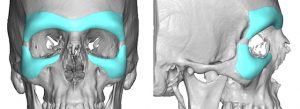 Q: Dr. Eppley, Hello dear doctor, I hope everything is all right .
So, I attach an image taken from your instagram profile . This implant interests me greatly .
I think it goes to modify the upper orbitals , lateral and inferior .
Now I ask you, kindly if you could answer these questions .
-What changes would they make in a male face ?.
-They would increase the distance between the eyes ?.
-They would eliminate scleral show ?
-It is a good idea to insert these implants , before undergoing a cantoplasty and surgery to make the canthal positive ? ( I think it should facilitate the ‘ anchoring of the new eye cut to the ‘ bone and then to the orbital rims ).
-You can mix it with the ‘ implant for the low and prominent brow ridge ?.
– Where would this implant be inserted , eyelids or other area ?
-Would there remain visible scars or risk of damage and therefore it is quite dangerous surgery , given the ‘ delicate area ?
-The most ‘safe’ material in the eye area would be ?
Thank you very much!
A: In answer to your questions:
1) That was made for a male face. I have never yet seen a female request largely because there is a brow augmentation component.
2) It wouldn’t change the distance between the eyes.
3) It may improve scleral show.
4) If one was interested in changing their canthal tilt, such an implant should be done before any attempts at lateral canthoplasty or perform a lateral canthoplasty with it. (which is common)
5) The implants are inserted through a combination of upper and lower eyelid incisions, and possible with a small scalp incision to assist endoscopic dissection and brow bone implant placement.
6) This not a dangerous surgery nor does it create adverse scarring.
7) The most safe material near the eye is the one that is easiest to insert, secondarily modify and/or remove……solid silicone.
Dr. Barry Eppley
Indianapolis, Indiana