Your Questions
Your Questions
Q: Dr. Eppley, I came across your web site and would like to ask what would cause a persons chin to recede. I am now in my 50’s and have noticed a distinct change in the lower portion of my face. I am considering corrective action but I have never had surgery. Can a chin implant procedure be done without general anesthesia? Also, what is the usual time required for healing when this type of surgery is done. Thanks for any feedback you can provide. I appreciated the case studies and the beautiful outcomes you shared.
A: The observation that one’s chin seems to be getting smaller as one ages is not rare. But only in exceptional cases does the chin bone actually recede or lose bone structure. Most of the time it is really a change in the neck that creates that impression. As the neck drops or begins to droop, the change in the neck angle can make the chin appear more recessive even though it has not really changed. This effect can be magnified in someone who may have always had a slightly recessive chin but never considered it so until this aging effect appeared.
Chin implant augmentation can be done under local or IV sedation fairly comfortably provided that is the only procedure they are having done. Recovery is really just limited to swelling with no functional restrictions. One can expect about 3 weeks until most of the chin swelling is gone.
Dr. Barry Eppley
Indianapolis, Indiana
Q: Dr. Eppley, I have buttock implants placed into the gluteal muscle right now. 500cc each. It doesn’ t look good. They are to high, it gives my buttock a pointy projection that I don’t like at all. I think I need subfascial placed buttock implants, probably custom made as well. I am looking for a fuller volume in the lower part of my buttocks. I need wider implants with less projection and as far I understand -that is only possible with a subfasial placement of the implants. Hope to hear from you soon. I added some pictures of how it looks now.
 A: Generally, it is very difficult if not next to impossible to get a buttock implant greater than 350cc to 400cc in the intramuscular space. Even if they were initially placed there, they likely would herniate back through the muscle and end up in some modified location partially under the fascia but mostly in the subcutaneous space. Your pictures suggest that this is so with a very high and visible outline of the implants. All intramuscular implants, even in the right location, will look higher in the buttocks than subfascial implants. It would also be helpful to know the dimensions of your existing implants which likely are round with a relatively narrow base.
You are correct in assuming that only the subfascial location will allow more of the lower buttocks to be augmented. And it will take a very broad-based implant with less projection to cover the area you have shown. It would be interesting to know what is the diameter in cms that you are showing by the marks in the pictures you have attached. The largest round implant diameter is just over 18 cms and what you are drawing may or may not be wider than that. It is impossible to have any sense of scale in close-up pictures.
In planning any buttock implant replacement surgery, it would first be important to get a non-contrast MRI of your buttocks to have an accurate idea as to exactly what tissue plane the implants are currently located in. That will help with surgical planning and to see how much subcutaneous fat exists between the skin and the fascia. From there it could be seen if any stock sizes will meet the dimensions you need or whether a custom design is really needed.
Dr. Barry Eppley
Indianapolis, Indiana
Q: Dr. Eppley, Hello! I am sending this request with my photos. As you may notice, the right side of my face is “larger” than my left, I feel its mostly the cheek bone. Hence I wanted to inquire about “cheek bone reduction” for my right side. I know it is not that simple, but to not make this very long I am writing in the most general way possible. I understand perfect facial symmetry with surgery is realistically impossible, I just wish to find a way that my facial cheek bones may be more proportioned, (with out the use of an implant or fillers), this cheek bone asymmetry is an insecurity I have when people look at me. I look forward to hearing back and thank you for taking time to read.
A: I can see the asymmetry in your cheek area and, for now, we will assume this is due to a difference on the zygomatic (cheek) bones between the two sides. Right-sided cheek bone reduction can be done but it would be very important to know where the differences in the bones are so that the right bone reshaping technique can be used. In make that assessment, a 3D CT scan of the face is needed so that exact location and magnitude of the cheek bone differences can be seen and the right surgical plan done. Whether yours would be a ‘typical’ cheek bone reduction (anterior and posterior bone cuts) or just anterior awaits what the 3D CT scan shows.
Dr. Barry Eppley
Indianapolis, Indiana
Q: Dr. Eppley, I am interested in getting the abdominal and flank liposuction. However, I currently need to get surgery done on my ankle by an orthopedic surgeon. The surgeon will not do it, however, until I quit chewing tobacco. Therefore, I want to ask you another question. Could both surgeries be done close to each other or do I wait a period of time between both? Should I get liposuction first or does it matter? The chewing tobacco issue is still a work in progress but my ankle is hurting worse by the day and I need to get it fixed soon.
A: Quitting tobacco is a good idea regardless of any type of major surgery you are considering. The nicotine in tobacco has as very negative effect on bone healing, particularly in the lower extremity. Certainly these two surgeries can be spaced relatively close together (one to two week sapart) and the order is dependent on how one affects the other in terms of recovery. It is question of which one is going to make you more immobile and what type of physical therapy would be needed afterwards. I assume that the ankle surgery will put you in a boot/cast with some limitation of movement afterwards. it would make the most sense then to have the liposuction first and then the ankle surgery afterwards. There is also the issue of typical bacteremia (release of bacteria in the blood stream) which occurs after any surgery. With a load of bacteremia released from liposuction, you do not want that to adversely affect the ankle bone healing. (seed the healing bone with bacteria) This would also require input from your orthopedic surgeon to see his thoughts as well as on this issue.
Dr. Barry Eppley
Indianapolis, Indiana
Q: Dr. Eppley, I am 32 but since I was born my upper lip has never had shape or definition. It’s quite flat. I want to know if it’s possible to have lovely Rihanna type lips. I know there are lots of different types of lip enhancement procedures but I don’t know what would work for me if any of them will.
 A: I don’t know whether you could ever have lovely lips like Rihanna, since I don’t know what type of lips you have now. But procedures such as lip lifts, li advancements and other filler volumizing techniques (fat injections, lip implants, synthetic fillers) can go a long way to improving the size and shape of your lips. Depending upon how flat (lack of a cupid’s bow) your upper lip is, either a subnasal lip lift (if it is sort of flat) or a lip advancement (if it is completely flat) can help create a much more prominent cupid’s bow.
A subnasal lip lift can improve the prominence of an under projected upper lip cupid’s bow. If no cupid’s bow is present at all, a lip advancement can completely create a well defined cupid’s bow shape. Adding volume with these excisional lip procedures can complement the additional shape achieved.
Dr. Barry Eppley
Indianapolis, Indiana
Q: Dr. Eppley, I want to ask about the skull reshaping using the bone cement.
1- what are the side effects, honestly?
2- how much will it cost?
3- if i want to do a hair transplant shall i do it before the head surgery or it doesnt matter and i can do it after?
4- can the doctor show me how my head will look in a computer before the surgery?
I really hope I hear these answers from the doctor himself.
A: To properly answer your questions, I would need to see some pictures of you and know exactly what you want to change in your skull shape. But to provide general answers to your questions:
1) Other than some type of scalp incision (scar0 to do the surgery, the only other side effects are how well is the goal achieved, is it smooth and is the result symmetric.
2) I would need to see exactly what needs to be done to give you an accurate cost of the surgery by sending some pictures of your head.
3) You should do any hair transplants AFTER skull reshaping surgery.
4) Pictures would be needed to see potential surgical changes by computer imaging.
Dr. Barry Eppley
Indianapolis, Indiana
Q: Dr. Eppley, I had a botched ear surgery and need to come to you for correction for more prominence. I also want to build up my nose for taller nasal bridge. I know it is best to use rib cartilage for surgery rather than a foreign material like Medpor. My concern is that I am a dancer and have to be shirtless a lot for work. I worry the scar needed for rib removal will be big and also will change my physique? Then I read about rib removal for cosmetic surgery purposes. If this is the case maybe it will give me a more defined figure because rib removal gives a more slender slimmer lower waist? Is that correct? Would you be able to use the same scar? I plan to do the surgery separately, first do ear revision and then few months later do nose. Would they use rib from one side for ears and then rib from other side for nose? Or is there not going to be enough rib? Can they use one scar to remove rib and symmetrically remove rib for each side?
A: Rib removal, whether it is done for otoplasty correction, augmnetative rhinoplasty or for waistline reshaping, will create a scar. It is not a large scar, usually about 4 cms in length, but it is a scar nonetheless. If harvesting just for the nose or ear, it will not change your physique or cause an indented chest area. The amount of rib cartilage length removed is not that long.
Because of the recovery from rib harvest, it is probably best to do the otoplasty revision and rhinoplasty at the same time. While two separate surgeries could be done the amount of rib cartilage needed for the ears is small and does not seem worthy of a separate surgery to do it.
Rib removal can help define the upper waistline by removing the lower free floating ribs but whether that is worth that effort and the two scars to do it must be considered carefully.
Dr. Barry Eppley
Indianapolis, Indiana
Q: Dr. Eppley, I have some questions about custom wrap around jaw implants. Firstly, how secure are the wraparound implants regarding the likely of it becoming displaced or dislodged? What level of force or impact could it withstand without being dislodged? Secondly, when considering the probable chin length projection provided by the implant, is there a means to prevent my labiomental crease from becoming deeper/more exaggerated, as I am already unhappy with its current depth?
A: Wrap around jaw implants are very secure given their custom design and fit and the use of multiple point miniscrew fixation. I could not tell you how much force it would take dislodge a custom jaw implant as that has never been tested. I would imagine that it would be considerable and would have to be of the magnitude that would be enough to break the jaw.
When any portion of the chin is advanced forward, some deepening of the labiomental fold is likely. This is unavoidable in a straightforward horizontal chin increase since the labiomental fold is a fixed point caused by the superior attachment of the mentalis muscle. When the chin is also advanced vertically, any change in the depth of the labiomenal fold will be less. I would use the imaging to be a good test as to what happens to the labiomental fold since it has not been moved with the chin change. Lessening of any labiomenal fold depth increase can be told by simultaneous fat injections to it.
Dr. Barry Eppley
Indianapolis, Indiana
Q: Dr. Eppley, I am curious about my options regarding skull reduction surgery. I believe I have a pretty normal skull shape but I’d like to smooth down the bump on the lower back of my head, I believe it to be the occipital although I’m not certain. From where the top of the back of my neck transitions to the skull it seams like a bit more exaggerated of a curve than normal. I was curious if it would be an option to smooth it down, if allowably possible. Let me know if you have any questions or what you would initially require in order to assess. I would be willing to take an X-ray or CT scan if necessary. Thanks.
A: The prominence of the occipital bone can be burred down, usually about 7mms across its entirety based on its inherent thickness. The question is not whether it can be done but whether enough can be safely removed to make a difference. That can be simply answered by a plain lateral skull x-ray which will show how much skull reduction can be obtained by the removal of most of the outer cortex. It is not advised to go past the outer cortex of the trilaminar skull layers.
Dr. Barry Eppley
Indianapolis, Indiana
Q: Dr. Eppley, Thanks for speaking with me last week for my breast implant replacement consultation. I am scheduled for breast implant replacement surgery next month and I have a question. On my pre-op papers, I noticed you are recommending a change from my current round 390 cc moderate profile to high-profile 595-655 cc implant. I am familiar with the moderate profile, but not so much the high. I just wanted to make sure the high profile is not going to be the “round ball” look. I am wanting a more natural look. Could you explain the use of the high profile for me? Again, thank you for you time and for seeing me last Friday. Im looking forward to my procedure.
 A: Your question about the profile of your breast implant replacements is a good one and understandably can be confusing. When comparing saline (your current implants) and silicone (your new implants) implants, the projection/profiles between them are not comparable or 1:1. Saline implants naturally sit higher (have more projection) than silicone breast implants because they are under some pressure or distension from the saline. (particularly if they are overfilled) Silicone is softer and not distended because they really are to some degree underfilled for the bag. (this is demonstrated by looking at a silicone implant sitting on the table and it will have an ‘ashtray’ effect while a saline-filled one will be very round and puffy) Thus a moderate saline implant profile is really comparable to a high silicone implant profile.
There is also the issue that as you go bigger in implant size, you do not want the implant to be too wide. Thus a higher profile silicone implant allows for the increased volume but without adding substantial more implant width.
Dr. Barry Eppley
Indianapolis, Indiana
Q: Dr. Eppley, I hope you can help me. I am almost 30 and I have had ‘fat’ legs since my early teens. My grandma and mother have the same. When I lose weight my legs still stay fat; I go to the gym regularly and this has gone some way to improve muscle tone but not to achieve any fat loss from my ankles or calves. I would love my legs to look slimmer and more shapely.
A: Lower leg liposuction can be effective at improving the fuller lower leg from the knees to the ankles and making them more shapely. But it is not done in a circumferential manner as many people think. Rather it is done by treating selective areas to improve their silhouette or profile through inner knee, upper medial calf, and inner and outer lower ankle liposuction. While such lower extremity liposuction can be very effective it can take several months to get to see its benefits. As the lower legs have increased venous pressure and slower lymphatic outflow due to gravity they hang onto swelling for some time after the surgery. It usually takes about three full months to see the final results of the lower leg reshaping.
Dr. Barry Eppley
Indianapolis, Indiana
Q: Dr. Eppley, I’ve had this large bump on the back of my head y for as long as I can remember. I think they call it an occipital knob. I would like it removed. I have many questions about the procedure. Here they are
1. How do I get an appointment with you?
2. Is there a hospital stay for this surgery or is it same day surgery?
3. Have you found that insurance willpay for the operation?
4. Is this skull deformity a common problem?
5. How soon would an operation be scheduled?
I’m very excited about finding a doctor who can help me feel better and not have any more headaches.
A: In answer to your occipital knob reduction questions:
1) We can talk by phone or Skype as soon as you would like
2) This is an outpatient procedure that takes one hour to complete under general anesthesia.
3) This would not be an insurance covered procedure to my knowledge.
4) I can not speak for exactly how common it is but I suspect it occurs in about 1:1000 people.
5) Since it is a relatively short operation, it can be scheduled fairly quickly.
You made an interesting statement about relief of headaches. I am not aware that an occipital knob reduction does relieve headaches although I can see how that might occur. There are tight muscle and fascial attachments at the base of the occipital knob and release of these may provide relief of some occipital-based headaches.
Dr. Barry Eppley
Indianapolis, Indiana
Q: Dr. Eppley, After our liposuction consultation last week, I have a few more questions to help me decide about the surgery. (abdominal and flank liposuction) 1. What will be expected for time of discomfort and movement restriction? 2. What are possible complications after Liposuction ? 3. Can you help me with your past customers (males) experiences and were they satisfied with the outcome considering the cost and rehab? I realize that everyone is different, but just need some case history with men similar to my build. 4. Will I be a sleep during the procedure? Thank you.
A: In answer to your liposuction questions:
- While I do not place any liposuction patient on any after surgery restrictions, there will certainly be some. The most discomfort of course would be in the first few days but you will remain sore for weeks. It probably takes 2 to 3 weeks to begin moving close to normal again.
- The most common complications after liposuction are aesthetic in nature, symmetry of the reduction and how well the skin will lay back down. Men generally have few skin irregularity issues because their skin is thicker and has never been stretched by pregnancy.
- I think every male liposuction patient I have ever done has been largely satisfied..but the time to ask them is months later when they have fully recovered. Male liposuction of the body almost always is that of the abdomen and flanks (waistline) and often it is near circumferential. It is a tough aesthetic surgery for most men (depending on the size of the problem) but it can achieve a major change in stomach and waistline contours that can be otherwise hard to achieve.
- This is a procedure that can only be done under general anesthesia.
Dr. Barry Eppley
Indianapolis, Indiana
Q: Dr. Eppley, Thanks for speaking with me last week for my breast implant replacement consultation. I am scheduled for breast implant replacement surgery next month and I have a question. On my pre-op papers, I noticed you are recommending a change from my current round 390 cc moderate profile to high-profile 595-655 cc implant. I am familiar with the moderate profile, but not so much the high. I just wanted to make sure the high profile is not going to be the “round ball” look. I am wanting a more natural look. Could you explain the use of the high profile for me? Again, thank you for you time and for seeing me last Friday. Im looking forward to my procedure.
A: Your question about the profile of the implants is a good one and understandably can be confusing. When comparing saline (your current implants) and silicone (your new implants) implants, the projection/profiles between them are not comparable or 1:1. Saline implants naturally sit higher (have more projection) than silicone breast implants because they are under some pressure or distortion from the saline. (particularly if they are overfilled) Silicone is softer and not distended because they really are to some degree underfilled for the bag. (this is demonstrated by looking at a silicone implant sitting on the table and it will have an ‘ashtray’ effect while a saline-filled one will be very round and puffy) Thus a moderate saline implant profile is really comparable to a high silicone implant profile.
There is also the issue that as you go bigger in implant size, you do not want the implant to be too wide. Thus a higher profile silicone implant allows for the increased volume but without adding substantial more implant width.
Dr. Barry Eppley
Indianapolis, Indiana
Q: Dr. Eppley, I’m largely familiar with the constellation of procedures that comprise Facial Feminization Surgery and Sexual Reassignment Surgery. Procedures that ‘balance’ the lower-body to ensure it’s proportional to the upper body are much less clear. Would you please take a moment to help me understand your thigh and buttock augmentation procedures?
1. What is the vertical & circumferential extend of implants used for lateral augmentation of the thigh (in the region of the greater trochanter)?
2. What are the vertical & lateral dimensions of the buttock implants? My concern here is to understand how these implants, in conjunction with lateral thigh implants, will create a natural curved profile in the waist-to-thigh area (instead of being “localized” augmentation).
3. I have a ‘flat’ area just below the iliac crest. Since this is above the greater trochanter and will likely not change with lateral thigh augmentation, do you have a method (or implant) to fill-in this area for to create an more uniform curvature from waist-to-thigh?
4. How are implants in this area ‘secured’ in their desired location so there will be no dislocation over time?
5. Where are the incision(s) for lateral thigh augmentation?
A: Thank you for your questions. In answer to them:
- There are no standard off the shelf thigh implants. They almost all have to be custom made so their dimensions can be largely what one chooses based on measurements of the patient. But one should not think of them as circumferential, they are lateral implants and that is the extent that they cover.
- Even when put together at the same time in the same patient, buttock and thigh implants will be localized augmentations. They do not connect nor can they. Their implant pockets are separate.
- The trochanteric drop area is best treated by fat injections if possible since it is a flexion area for which implants are not best used.
- All forms of body implants are secured only by the pocket that is made for them. They stabilize because the body forms a layer of scar around them (the capsule) this locking them into place.
- Lateral thigh implants are placed through a small (4 to 5 cm) incision over the upper thigh.
Dr. Barry Eppley
Indianapolis, Indiana
Q: Dr. Eppley, I would like to get a better idea if insurance will cover my gynecomastia reduction procedure. I have had gynecomastia since I was a teen, but it has bothered me enough lately to visit a Doctor. Up until the past few years it has only caused me a little discomfort. I have never been able to sleep on my stomach because of it. Lately I have had occasional pain in my right breast and a sharp pain when bumped into or after exercising, but mainly in my right breast. My Doctor confirmed that I had gynecomastia after a mammogram and x-rays. The radiologist diagnosed it and ruled out cancer. I have fibrous mass centered under my right nipple and smaller nodular lumps on my left side. Really only the right side causes me the most pain. I think insurance should cover it, since I have had the gynecomastia since I was a teen and it is causing me discomfort. I would like to know what if there is any chance that insurance will cover it?
 A: Insurance coverage for gynecomastia surgery is a frequently asked question of men considering the surgery. No plastic surgeon can answer that question definitely since your health insurer has their own criteria for coverage and ultimately they have to make that determination based on their criteria…not whether you nor I think it should be covered. This is a process known as predetermination in which the treating doctor submits a letter requesting the surgery, lists the diagnosis and procedure codes and provides pictures of the patient’s chest. From this information, they will make a decision and notify you in writing since you are the subscriber of the policy.
Having said that it is important to know what the criteria are that insurance companies use to make that decision about gynecomastia reduction surgery to see if you have any chance of success. First, the size of the gynecomastia problem must be a grade III or IV in adults based on a well known assessment scale. (yours by the way is a Grade II) Second, you must have had a endocrinological blood panel done to determine if there is any hormonal abnormalities that have not perviously identified and treated. Third, the breast enlargement must pose serious health concerns, such as being a tumor, that has a significant impact on the patient’s health or will so in the foreseeable future.
As you can see, unless there is compelling medical evidence, most insurance companies view most gynecomastia reduction surgeries as a cosmetic procedures and not something that is done to treat a medically necessary condition.
Dr. Barry Eppley
Indianapolis, Indiana
Q: Dr. Eppley, The corners of my mouth sometimes bleed and droops. Is there anything I can do for this? I LOOK unhappy. I don’t want to use needles and does medical insurance pays for this.
A: A downturned corner of the mouth can create more than a frowning or unhappy look. By acting as a salivary spillway, it can create chronically irritated tissue and yeast infections. This can make the corners of the mouth both red and prone to cracking and intermittent bleeding.
By your symptoms it sounds like you would benefit by a corner of the mouth lift. This is a procedure done under local anesthesia to lift the corners of the mouth by removing a triangle of skin from the overhanging portion. I would need to see a picture of your mouth to verify that this procedure can be helpful. It may or may not require more than a corner of the mouth lift to be successful which I can determine by a picture. (possible nasolabial fold excision as well) These mouth lifting procedures are not covered by medical insurance.
Dr. Barry Eppley
Indianapolis, Indiana
Q: Dr. Eppley, I am 62 years old and I had a facelift done six weeks ago. I still have very dense numbness on both sides of my face which goes as far forward as my cheeks and straight down to and under my neck as far forward as my chin? Is this normal and, if so, when will it go away?
A: When performing a facelift, the skin is raised up extensively to access the SMAS layer and well as to remove lax face and neck skin. Anytime the skin is undermined the tiny nerves that supply feeling to it are cut. This will result in numbness of the overlying skin that will persist for some time after surgery. Most if not all of the feeling will return but it will take time to do so. The return of feeling will begin in the most medial skin areas near the chin and nose and will work its way slowly back towards the ear. This is a process that will take months, often as long as six months to achieve maximal sensation return. In some patients they will be a small area of permanent numbness that may remain right in front of the ear.
Dr. Barry Eppley
Indianapolis, Indiana
Q: Dr. Eppley, I had a my first baby six months ago. Now I am not really happy with my belly. I have gained some weight that I never had before and can’t seem to get it off. What can I do that will not involve much time off work? I have read about Smartlip which seems like the best option and would not involve being off work.
A: Based on your pictures, you would be an excellent candidate for liposuction done under general anesthesia to really thin down your abdomen and waistline. There is always a misunderstanding that many patients are not aware that ‘Smartlipo’ is real surgery and is just another form of liposuction. While it can in the right patient be done under local or sedation anesthesia, it is still an invasive surgical procedure. It is not some external device that magically melts fat. The best results with Smartlipo are like any other method of liposuction…having it done under general anesthesia (if you want the most fat removed possible) and does involve some recovery.
For a treatment that requires recovery at all, you can consider a non-surgical approach like Vanquish. It will not produce the same result as any form of liposuction but does not involve surgery. It is done a series of office treatments, usually once a week for four to six weeks.
Dr. Barry Eppley
Indianapolis, Indiana
Q: Dr. Eppley, I’m currently 26 and I had large silicone cheek implants placed two years ago together with a buccal fat pad extraction. I had them removed two months ago as I just felt they were too big for my face. The issues I have now is that there seems to be a small degree of mid-facial sagging. I’m looking to get smaller malar implants later in the year, but I’m concerned that that will not be able to proper address this sag. Out of curiosity, since I’ll be undergoing a cheek implant procedure again, could a mini-lift help address this sag? I don’t think I’ll require anything too aggressive – do you know of any midface lifts that could help me out?
A: It is no surprise that once cheek implants are removed that some degree of midfacial sag will result. This is not just due to the stretched overlying tissues but because the soft tissue attachments to the bone have been permanently detached. Once the implants are out, the overlying midface soft tissue can not reattach to the bone (due to the slick surface of the residual capsule) and it thus slides ‘south’.
With your new cheek implants you consider a temporal suspension midface lift which can simply and easily pull back up the midface tissues over the new implants.
Dr. Barry Eppley
Indianapolis, Indiana
Q: What is the best buttock implant augmentation technique? I have heard differing viewpoints about inside the muscle and on top of the muscle.
 A: Just like breast implants which can be placed under the muscle or on top of it, buttock implants share a similar two pocket location approach. (although intramuscular not under the muscle is where buttock implants are placed) Whenever there are two ways to do any surgery and different surgeons either approach, that indicates that neither method is perfect. You then have to look at the different advantages and disadvantages to either approach and figure out which one matches your needs the best and which risk profile is more tolerable.
The arguments for the subfascial location for buttock implants is the following. This pocket location allows placement of the biggest implants with sizes up to 700ccs. It creates a nice ‘S’ curve by making the pocket up to the posterior iliac spine, where the gluteal muscles actually attach. It also has a faster recovery because the muscle fibers are not disrupted deep into the belly of the muscle. Its disadvantages are that it has a higher incidence of seroma formation, potential implant visibility (if you have little subcutaneous fat between the skin and the muscle) and a greater chance of implant displacement/rotation. (since there is less tissue resistance)
The arguments for the intramuscular location for buttock implants is the following. It provides a thicker more vascularized tissue pocket which lessens the risk of seroma formation, potential implant displacement and has less risk of tissue thinning over time between the implant and the overlying skin. Its disadvantages are that it is somewhat more technically difficult to perform, has a limitation to implant size that can be placed (350cc or less) and has a longer recovery.
When you put all this together you can see that it is not so simple as just one implant location is better than the other. You have to look at each patient and make a decision based on their goals, tolerance for recovery and their tissue qualities. For thin or small women that have little subcutaneous fat tissue, an intramuscular implant location is usually best. For larger women with thicker subcutaneous fat layers that want a larger buttock augmentation result, a subfascial location would be preferable
Regardless of buttock implant location, a very important element that affects the result is the strict adherence to postoperative instructions to avoid too aggressive early activities. This can increase the risk of incisional wound separation, seroma formation and implant displacement.
Dr. Barry Eppley
Indianapolis, Indiana
Q: Dr. Eppley, Do you do the “drainless” tummy tuck surgery? Also, I have an umbilical hernia and am looking to have both procedures done simultaneously. Can this be done on the billing end so that insurance will cover the hernia repair, anesthesia, facility charges, etc and I self-pay the abdominoplasty procedure?
A: Thank you for your inquiry. Let me provide you with some clarification and additional insight in both your tummy tuck questions about a ‘drainless’ technique and the financial implications about doing combined medical necessary and cosmetic abdominal wall procedures.
I have done numerous drainless tummy tucks and there is an understandable appeal to it because of the absence of a drain. But there is more to it than just not putting in a drain. There has to be some additional steps done to close down the internal dead space and seal the wounds to prevent a seroma (fluid collection) after surgery. Drainless tummy tucks can be done by either using internal quilting sutures or a tissue glue prior to closure of the tummy tuck incision. These steps do take additional time (an extra 1/2 hour of operative time) and materials (tissue glues can cost up to $1,000) to do and thus the drainless tummy tuck is going to cost more than one in which a drain is used. A drain is a simple and quick method to manage potential seromas and also keeps the cost down. Thus one has to place a value on how much avoiding the drain is worth. And drainless tummy tucks do not have a complete absence of problematic serums afterwards, there is not a 100% guarantee that you would not get a seroma even with these maneuvers.
In what seems like a straightforward issue historically, the separation of a medical necessary procedure like a hernia repair and a cosmetic procedure like a tummy tuck should be simple. But in today’s health insurance world it is not. The first common erroneous perception is that somehow insurance is going to pay for the operative room and anesthesia charges for the tummy tuck portion of the procedure…and they will not. No facility will allow that to happen anymore so that all charges related to the tummy tuck portion of the combined procedure including operating room, anesthesia and any supplies used must be paid out of pocket and in advance of the procedure. While ‘sliding’ the operating room and anesthesia costs of the cosmetic portion of the procedure onto insurance was common practice 10 to 20 years ago, that is no longer permitted and is actually illegal today.
While there is no question that a hernia repair and a tummy tuck should be done together, and this is common practice, you have to look carefully at the cost issues to see what works in your best financial interest. Your insurance is going to require in almost all cases (with the exception of Anthem and a few other private carriers) that your hernia repair be done in a hospital or a hospital-owned facility. Such a facility may or may not have reasonable cosmetic fee usage costs. They will in most cases be higher than a private non-hospital owned surgical facility. Depending upon the difference in cosmetic costs between the two types of facilities will determine whether the combined hernia repair-tummy tuck is done through insurance using their required facility or whether it is just better to pay all of pocket for both procedures. (I have certainly seen that be the case many times) Each patient and what insurance carrier they have has to be considered on an individual basis.
Dr. Barry Eppley
Indianapolis, Indiana
Q: Dr. Eppley, Would I be able to have any improvement on my cleft lip with a lip enhancement surgery (cleft lip revision) to make my lip more even?
A: Almost all cleft lip repairs, no matter how beautifully done as an infant, will end up needing some additional revisions to optimize the repair appearance. The one area of the the lip that almost always need adjustment is that of the vermilion. (pink part of the lip) It is frequently volume deficient on the cleft side and makes a major contribution to lip asymmetry.
I think there are several aspects of your cleft lip that can be improved and all of your cleft lip issues are common. There is a lack of vermilion fullness down at the lip line which needs to be augmented by a small dermal-fat graft. The cupid’s bow area is indented, again due to lack of volume which also needs to be grafted. The outer aspect of the cleft lip side along the vermilion-skin border is shorter in height than than the non-cleft side and that can could be improved by a lip advancement on that side. The actual philtral skin scar looks pretty good and I don’t think that scar could be improved with the exception of adding a few hair transplants into and along the scar line.
Dr. Barry Eppley
Indianapolis, Indiana
Q: Dr. Eppley, I am interested in making my forehead wider and more squarer to balance out the width of my new custom jaw implants that will be placed in about a months time. I have booked in for temporal implants at this stage but not forehead as I don’t think my doctor or any doctors here are quite familiar with the procedure. I wanted to know if it is ok to request to my doctor to use Medpor temporal implants? This is because I had a look at the Medpor catalogue and have found that the Medpor brand offered a significantly BIGGER size compared to the silicone ones offered my Implantech (which my doctor will use). Medpor ones go up to 20mm in augmentation. I’ve read your resource millions of times (very helpful) and want to know do temple implants sit only on top of the soft tissue or can the implant itself be placed higher if the implant overlaps onto the bone? Or is that something a custom made forehead implant would fix? If so are there any off the shelf forehead implants available on the market to widen the forehead?
I also wanted to know if I was certain that I need a forehead augmentation in future are temporal implants necessary? Or are they needed along WITH forehead augmentation. I just don’t want to waste my money on temple implants if a custom made forehead implant will fix both areas.
A: I would never use Medpor temporal implants myself. They are too big, are very difficult to modify and are very difficult to remove should that ever be desired. (and there should be a high probability that they would) No one ever needs a temporal augmentation that requires a 20mm thick implant. They are simply too big for most cases and were initially designed for patients that suffered significant temporal muscle atrophy from neurosurgical procedures not for patients that want a pure aesthetic augmentation with a normal tenporalis muscle.
If you are seeking a temporal augmentation that reaches the high temporal region to make the forehead wider as well, only a custom designed temporal-forehead implant can achieve that aesthetic change. No current implant style, Medpor or silicone, are made to create that look as a ‘catalog’ item.
Dr. Barry Eppley
Indianapolis, Indiana
Q: Dr. Eppley, I know that the two most common surgeries in cosmetic ear plastic surgery are to 1) remove cartilage from behind the ear and move the concha closer to the head and 2) reform the antihelix. In my case, the size of my concha and antihelical fold are OK. In my opinion my main problem is that the outer helical rim is short and dipped in. What I am asking is whether you have the ability and experience of building up the helical rim? In my self diagnosis, I think that we don’t have to fix the helical rim all over the ear, we can just fix something like a one centimeter area at the top of the ear. In my self diagnosis it gives me my ideal result. Thank you very much.
A: What you are suggesting by self-diagnosis for your ear helical rim reconstruction makes sense and is possible. The helix exists as an outward curl of cartilage distinctly different than that of the anti helical fold. How to build out the helix at the top of the ear comes from knowledge of performing microtia, cryptotia and other congenital ear deformities. Based on the attached pictures of your ears, this is going to require the placement of a cartilage graft which could be harvested from the backside of the concha with no change in its appearance. The only question is whether this is best done by placing the graft on top of the existing helical rim or by placing it into a cut below the helical rim as an interpositional space to push the height of the helical rim higher. In my opinion this would best be done with the latter technique to prevent graft show through the very thin overlying helical rim skin.
Dr. Barry Eppley
Indianapolis, Indiana
Q: Is the V-Y plasty the same thing as a lip advancement? If so, is that a procedure that can raise the height of the lower lip to have less tooth show? That is an option that I am exploring.
A: A lip advancement and a V-Y advancement are two completely different operations with varying effects on the lower lip. A lower lip advancement removes a horizontal strip of skin on the outside so the vermilion can be rolled outward making the lower lip look bigger. It will not raise up the lower lip but is done to make the lip look fuller. (have more vermilion show) A V-Y advancement is a internal vertical mucosal procedure done on the inside of the lower lip. It is designed to try and lengthen the height of the lower lip and/or release any contracture or shortening of the anterior mandibular vestibule.
Raising the height of the lower lip is challenging and there is no one single procedure that can consistently do so. It usually require a combination of procedures through mucosal lengthening and vermilion augmentation to create such an effect.
Dr. Barry Eppley
Indianapolis, Indiana
Q: Dr. Eppley, These are a few pictures of my crown and a short video of my head. The hair on the ridges is sparse but in the furrows there is some. I’m not sure if I’m losing hair in this area due to mail pattern baldness or the cutis verticis gyrata. I just want to know my options for conceiving this. Wether it be a hair transplant over it or cutting it out.
A: Thank you for sending your pictures and the video. What you should do is based on how large of an area is involved in your scalp and how progressive or stable the cutis vertices gyrate is. If the area is small and stable and is not causing any other symptoms, it be left alone. I do not think it necessarily is causing hair loss but may just be spreading the follicles out further as it expands. (although I can not say for sure whether it is) The involved scalp area should only be excised if it can all be removed and should first have tissue expansion. The scalp is not very flexible and will leave a wide scar if it is all removed at once. If the scalp area is larger and it seems to be growing, then excision would not be advised. You may consider fat injections or PRP injections in an effort to treat it although such treatment is theoretically beneficial but not yet proven.
Dr. Barry Eppley
Indianapolis, Indiana
Q: Dr. Eppley, I’m wanting to find out more about the different options available for forehead reshaping. Are there alternative procedures to the shaving technique? For example are there any kinds of forehead implants, fat injections that can be used to smoothen the forehead. I will also be sending pictures within the next week or two for a more accurate price range, but can you tell me the average price range for these kinds of procedures? Thank you very kindly.
A: There are numerous different options for forehead reshaping including bone cements, custom implants and even fat injections. (not my preference but an option) When it comes to brow bone reduction, bone removal and reshaping usually works much better than shaving/burring for any significant reduction. As you can see between manipulation of the brow bone and the forehead above it, there are a variety of techniques. Which one may work best for you and what trade-offs you are willing to accept in doing them are issues to yet be discussed. It is better to determine first what methods you would choose and then an accurate cost for the surgery can be given. There are no ‘average’ costs for possible combination forehead procedures that we yet don’t even know what they would be.
Dr. Barry Eppley
Indianapolis, Indiana
Q: Dr. Eppley, I have been reconsidering a sliding genioplasty procedure recently due to the great deficiency my chin has. As I stated in my last email, I am on Remicade and there is a good chance I will still be on that medication when then time comes for the procedure. Does it concern you doing a sliding genioplasty procedure while I am on this medicine? I assume healing may take longer. You have also mentioned that a sliding genioplasty with a chin implant overlay may be necessary. Will this have any negative effect on healing or increase the risk of infection?
A: I have operated on numerous patients who have been on Remicade for Crohn’s disease and I have not seen any healing problems. Such surgeries have been much bigger in surface area trauma and operative times than a sliding genioplasty. The face is uniquely well vascularized and unless there is direct impairment of the blood supply through prior radiation it will not inhibit healing difficulties. The orthopedic literature supports that major bone surgery and joint replacements can heal uneventfully with patients on this medication.
That being said, it is important to work around the dosing of the medication to reduce any risk of adverse healing. Given that Remicade is a TNF blocker and is done by infusion, it would be important to do the surgery about 3 to 4 weeks after the last infusion. This is will than allow a few weeks before the next infusion. With such an approach for a sliding genioplasty I do not envision any difficulty with healing or a prolonged recovery time.
Dr. Barry Eppley
Indianapolis, Indiana
Q: Dr. Eppley, I am a 40 year old male who had my buccal fat pads removed about 10 years ago. My issue went unresolved however as the puffiness was closer to my mouth. There was no information online at the time and I have just lived with it. Recently, I came across the term ‘periorial mounds’. I went to see a local plastic surgeon about it and he admitted that he had never heard of such a procedure, that it would be much too risky and that there is no fat there regardless. I came across your name when further researching it. You seem to be alone in addressing the needs of people with this issue. I have attached photos of my condition and would love to get your feedback. I should mention, it is not only the visual aspect I am hoping to change, but also the constant weight I feel around my mouth. My questions are:
1. do I qualify for perioral mound reduction?
2. do I risk damaging nerves?
3. will the amount you are able to reduce have a noticeable effect physically?
4. will a reduction aid in reducing the fat on my jawline?
Thank you so much in advance for any further knowledge you can bring me, I really appreciate it.
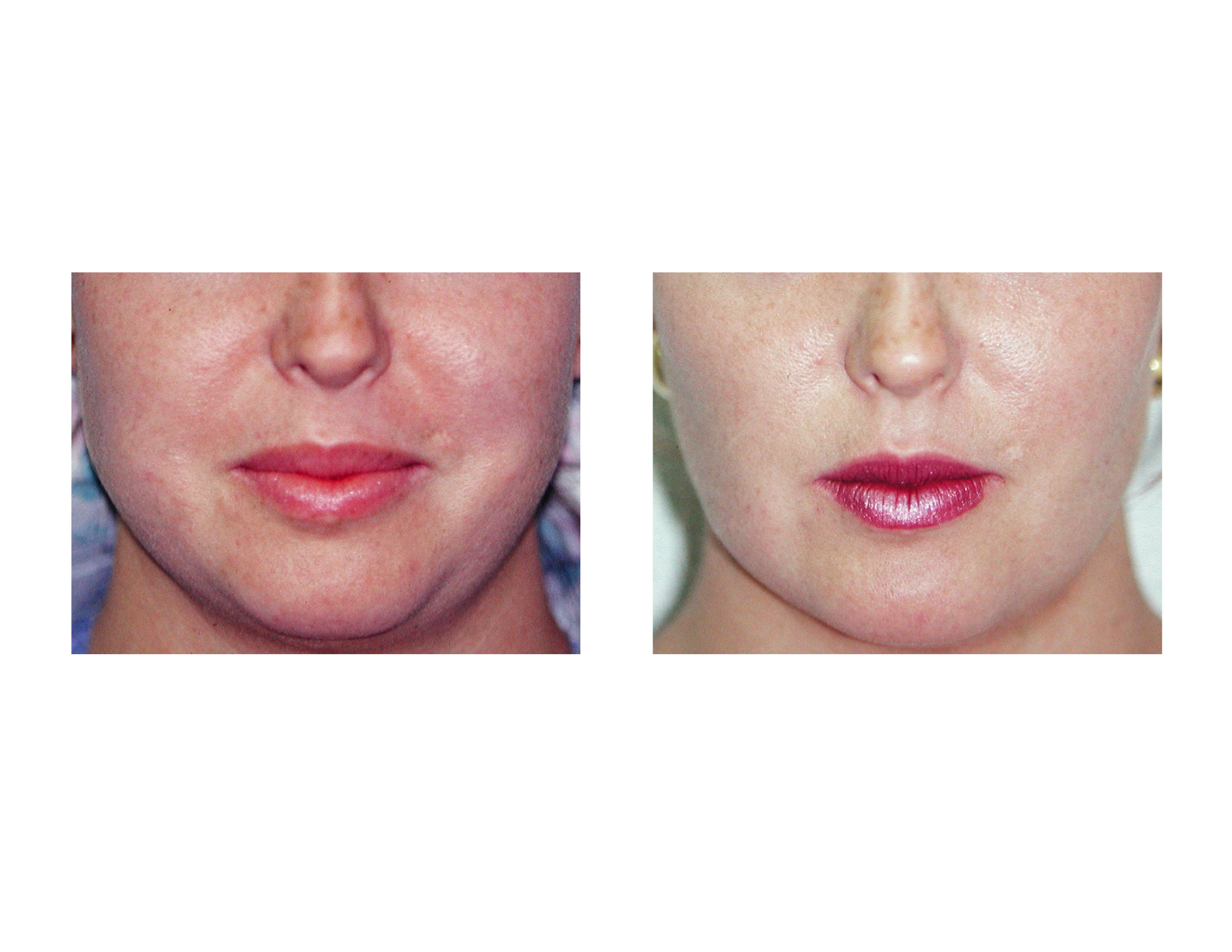 A: The perioral mounds are a well known collection of subcutaneous fat that exists at the level of the corner of the mouth that is distinctly different than that of the buccal fat pads. It can be reduced by very small cannula liposuction and even a 1cc to 2cc fat reduction can make a noticeable difference. Although some plastic surgeons make not be familiar with its treatment, that does not mean it does not exist nor is it risky to do. In answer to your questions:
- You do have a fullness in the perioral mound area with an overlying skin fold which presumably is due to aging. (descent of the midfacial tissues) It is impossible to know beforehand how much the skin excess or subcutaneous fat is contributing to that appearance. But in my experience removing the subcutaneous fat through perioral mound liposuction can make that skin fold ‘lay down’ so to speak.
- This is a very safe facial area to do liposuction in. The buccal facial nerves run above it and the marginal mandibular nerve lies below it. This is a safe facial triangle for subcutaneous fat removal.
- There is no way to absolutely predict the change but I have yet to see a patient who did not get some improvement in their perioral fullness.
- The liposuction can and should be carried down to the jawline to maximize the procedure’s effectiveness.
Dr. Barry Eppley
Indianapolis, Indiana