Your Questions
Your Questions
Q: Dr. Eppley, I am interested in knee lifts and after seeing your after surgery pictures I’m sold. I thought it would be much wider and more noticeable. The bottom after picture looks amazing. I have struggled for so long with this issue and I know it’s the only answer. I have read that the cost of the surgery is between $4700 and $5300 or something like that. Is that correct? How much time off work would I need? I’m a visiting nurse so it’s not strenuous at all. It’s exciting to think for once I’ll be able to wear shorts. How long would they be swollen? I guess that would also affect my timeline for the surgery.
A: I will have my assistant pass along the actual cost of knee lift surgery to you next week. It is most economical to have the procedure done under local anesthesia with IV sedation. The knees do not swell up that much, it is only necessary to keep them wrapped with ace wraps or Coban wraps. The biggest issue is to just be careful to not bend the kneed beyond 90 degrees for about a month after surgery to not place too much stress/stretching on the incisions. How that would affect your work would depend on that issue. I suspect it would not be more than seven to ten days.
Dr. Barry Eppley
Indianapolis, Indiana
Q: Dr. Eppley, I am interested in knee lifts and want to know if I am a good candidate. Also have you done many?
A: Technically, a knee lift is a simple excisional procedure that is done for rolls of skin above the knees. It is a near full-thickness crescent of skin and fat removed along the suprapatellar crease. Because it is done directly where the skin rolls are, it is tremendously effective. But it does at the expense of a fine line scar above the knee in the crease so a prospective patients must be fairly motivated. (sees a fine line scar as a better alternative to the skin rolls) To keep the resultant scar as narrow as possible, it is important to preoperatively mark the amount of suprapatellar knee tissue excision with the leg both fully extended and bent at 90 degrees to prevent excessive excision of tissue and extreme tension on the scar
Knee lifts have very little recovery and are not associated with much discomfort. The only caveat is that one should avoid doing activities that risk bending the knee beyond 90 degrees for the first month after surgery.
Because of the scar concerns, the request for knee lifts is very infrequent, I have performed about a half dozen knee lift procedures in the past few years.
Dr. Barry Eppley
Indianapolis, Indiana
Q: Dr. Eppley, I am interested in knee lifts. I am 50 years old and am very active but my knees look like an 80 year old women. I need a knee lift to regain my KNEE self-esteem. I am in disbelief as active as I am that my knees have aged so horribly. I have an adverse reaction to most anesthetics so hopefully this is a procedure which could be done under a local anesthetic.
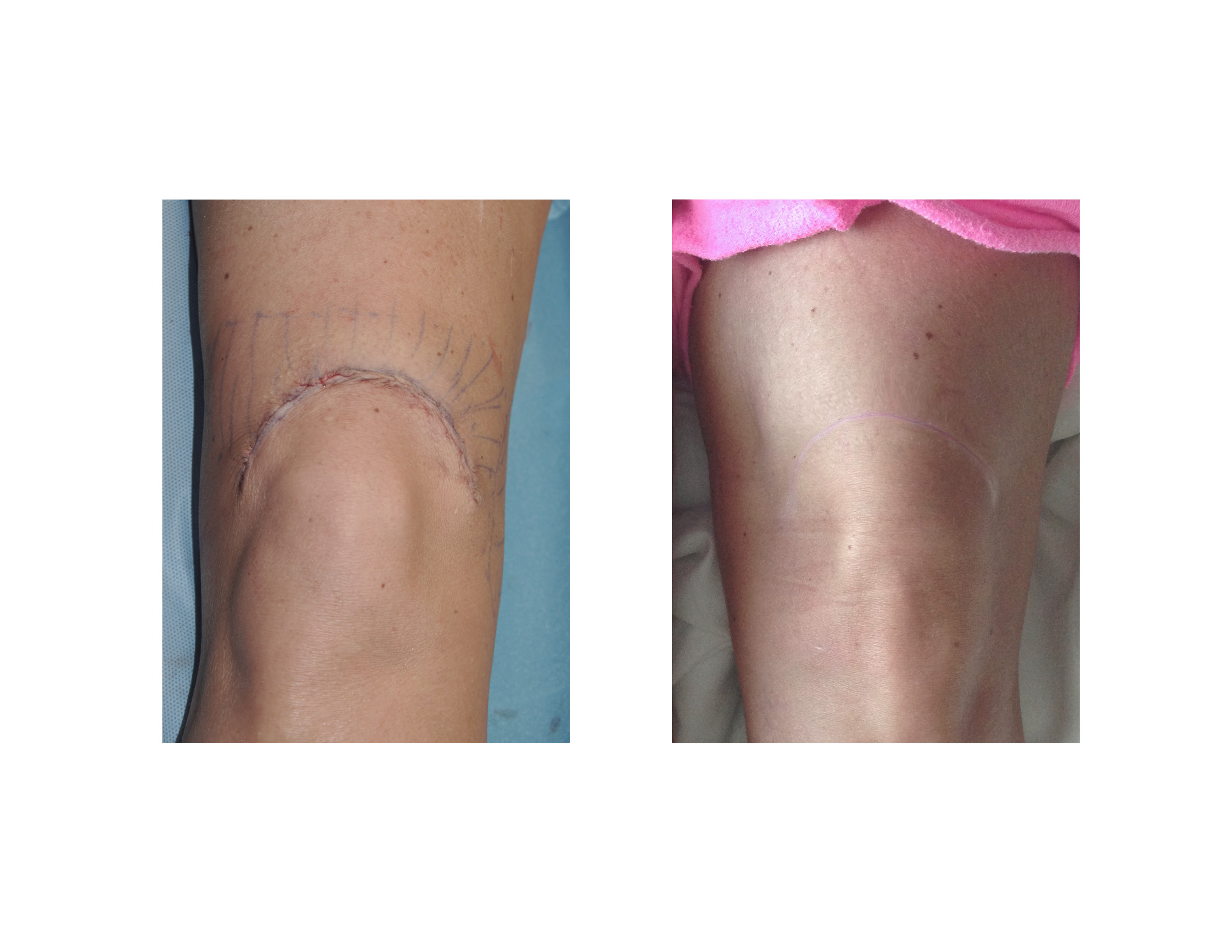 A: The knees, like any other structure on the body, are not immune to the aging process. the constant motion across the knee joint requires moveable flexible skin. But for some people (usually thinner and very active ones) that constant motion results in the development of loose skin. This loose skin appears as folds above the knees, often having two or three small skin folds that have ‘piled up’ above the knee cap.
The procedure of a knee lift can remove these skin folds by excising a crescent of skin above the patella. It must be marked and removed carefully so that enough skin is left for the knee to bend 90 degrees of greater without undue pulling on the wound closure/scar. It is a fairly simple outpatient procedure that for the very motivated could be done under local anesthesia. It does result in a fine line scar above the knee and this must be considered carefully as a worthwhile aesthetic trade-off for the removal of the suprapatellar skin folds.
Dr. Barry Eppley
Indianapolis, Indiana
Q: Dr. Eppley, I am 41 years old and weight 96 lbs. I have sagging, wrinkled loose skin at elbows and knees and was wondering if an elbow/knee lifts would be an option. I’ve never had a large weight loss but did lose 10 lbs about 2 years ago. Thanks so much for any info.
A: My guess is at your age and relatively stable weight, this is simply loose skin due to lose of elasticity of thin skin. This is very common at the elbows and knees due to the frequent flexion movements across the joints. It is not really question of whether elbow and knee lifts can be done…but should they be done. There is the aesthetic trade-off of a fine line scar which I consider more of a potential issue in the knees than the elbows due to the visibility. The good news is that thin skin usually scars the best, so this is a consideration not necessarily an impediment to doing it. I would need to see some pictures of the knees and elbows in the straight position (extended) to judge how much loose skin is present. It is that determination that makes the decision about whether elbow and knee lifts (so called ‘joint lifts’) are worthy of that scar trade-off.
Dr. Barry Eppley
Indianapolis, Indiana
Q: I have loose wrinkled skin on the inside of my arm where my elbow bends. Is there a procedure that would improve this area? It is not due to weight loss. It is due to aging. I am 50 years old and this just appeared recently.
A: Loose skin often appears across joints like the knees and elbows as a result of aging. The near constant flexion and extension of these major extremity joints over time can result in some eventual sag from the wear and tear on the skin. While not seen in flexion, this skin becomes more evident in extension of these joints.
There are plastic surgery procedures to remove this excess skin. Known as elbow and knee lifts, they are almost exclusively done in extreme weight loss patients. With a lot of weight loss, the sagging skin extends from the body outward towards the hands and feet. Rolls of skin can frequently be seen past the elbows and knees. In bariatric plastic surgery patients, removal of this excess skin is commonly considered and done. While this results in scars, it is usually considered a more favorable trade-off.
In the comparatively mild amount of loose skin that can develop from aging around knees and elbows, replacing it with scars is a more dubious trade-off. Many cosmetic procedures involve scars as a substitute for the original problem. As a result one has to be crystal clear that this trade-off is clearly better. In the weight loss patient, there is usually no doubt. In the non-weight loss patient, the amount of loose skin and how bothersome it is must be carefully considered.
Dr. Barry Eppley
Indianapolis, Indiana