Your Questions
Your Questions
Q: Dr. Eppley, I have had chin and jaw implants (both silicone, the jaw implants are fixated by screws, the chin implant is not) for roughly 10 years now. They were placed about a year apart, with different surgeons. I regret having anything in my face, and am looking to remove them entirely, and do a sliding genioplasty to make up for resorption from the chin implant, if this is possible and safe to do. I no longer can tolerate the feeling of the implants inside of me, and I do not like the look of them especially in motion and certain lighting, and just want to revert back to my normal self as closely as I can. I am a bit worried about resorption or impressions left from the jaw implants, and the overall process of removal. I think I may benefit from a CBCT scan (I believe that’s what it is called), to see what’s going on underneath.
A: Thank you for your inquiry and detailing your objectives of chin and jaw angle implant removals. It is quite normal on the lower jaw for any type of implant to have some imprinting on the bone as well as bony overgrowths. How significant implant imprinting is on the bone and the amount and locations of the bony overgrowth can be quite variable and is not related to implant size, material, or duration of implantation. These are natural biologic phenomenon from the presence of an implant which violates the congenital anatomic boundaries of the tissues. This is not a pathologic reaction and it has no functional significance.
If it is important to visualize the bony impressions and the amount of bony overgrowths this requires a 3-D CT Scan with digital removal of the implants and colorizations of the imprinted areas as well as the bony overgrowths. This can certainly be done but does not impact the implant removal process.
If the goal, in addition to implant removal, is to try and restore the bone contour as much as possible to its pre-surgical state you could fill in the bony impressions with cadaveric bone chips. While you could do a sliding genioplasty to compensate for the impression left by the chin implant that maybe overkill for the amount of oppression death that exist and bone chip placement alone may be more appropriate.
Dr. Barry Eppley
World-Renowned Plastic Surgeon
Q: Dr. Eppley, I’m trying to clarify whether this is even a real, standard option (not some crazy experiment). In the same way rhinoplasty is a well-established solution for a nose someone doesn’t like, is surgically increasing facial width (e.g., via cheek/malar and/or jaw angle implants) a recognized and commonly performed solution for patients with a proportionally narrow face?
Specifically, has this been routinely done before with the goal of increasing lateral facial width from a frontal view, and is this considered a normal indication for these procedures?
I’m not asking about extremes, only whether moving from narrow toward normal proportions through skeletal widening is a legitimate, established approach.
A: Skeletal widening of the face, whether it is the jawline or cheeks has been a standard surgical procedure with implants since the 1990s. It has become improved and more patient specific with contemporary custom implant designs. Such facial widening cannot be achieved by any bone-based procedure such as osteotomies or bone grafts.
Dr. Barry Eppley
World-Renowned Plastic Surgeon
Q: Dr. Eppley, I wanted to ask about the feasibility of achieving a small, conservative increase in intercanthal distance (approximately 2–3 mm total or 1-1.5mm per side) through a combination of limited bony and soft-tissue approaches.
Specifically, I was wondering whether a 180° orbital box osteotomy combined with soft-tissue adjustments such as medial canthoplasty / medial canthal tendon repositioning, could potentially create a modest increase in ICD while preserving the natural length and shape of the medial canthus (i.e., without visible shortening or distortion of the inner eye corner).
A:An inferior orbital box osteotomy works best for modest increases in the intercanthal distances. Technically it is not really 180° as the inner bone cuts cannot cross the bony location of the lacrimal sac.
The required soft tissue procedure in the corner of the eye to increase the distance between the two sides is not a medial canthoplasty.. This is done by V-Y lengthening procedure of the external lacrimal lake area which moves/closes down the inner eye corner out 2 to 4 mm on each side.
Dr. Barry Eppley
World-Renowned Plastic Surgeon
Q: Dr. Eppley ,I previously had a chin implant that initially created vertical elongation, but over time the contour has become rounded and anterior. I’m concerned about capsular contracture or bone remodeling and want an evaluation comparing implant revision versus sliding genioplasty. I loved how my implant looked at first, but over time I believe the shape has changed.
A:What you are experiencing is a normal phenomenon that most patients are completely unaware. First and foremost almost all standard chin implants have a round and bulbous shape to them and they are usually placed on the front edge of the bone. It takes a long time after surgery to truly see the final chin shape because of the unrecognized shrink wrap effect of the overlying soft tissues. This is why it can take a year or longer to see these details as eventually the chin assumes the shape just like of the implant that sits underneath it.. which in some patients can like a bump on the bone. This effect has nothing to do with capsular contracture which does not occur in facial implants because they are not meant to be a movable and flexible structure like an implant is in the breast. Nor is it due to bone remodeling. In short this is due to the actual shape of the implant being seen long-term over time.
The first step to do to determine what your best options are as to understand fully the shape size and location of the implant on the bone. Never guess what is going on underneath or make judgments out what one should do based on an external appearance The needed information requires a 3-D CT scan which will clearly show this information. Then you can evaluate the options of replacement with a custom chin implant or a sliding genioplasty.
Dr. Barry Eppley
World-Renowned Plastic Surgeon
Q: Dr. Eppley, I saw a surgery you did to shrink a person’s head, is it possible on me?
A: Skull reductions are best thought of as area reductions…not shrinking the whole head down. Thus the key question is what skull areas are the most promienent to you. In looking at your pictures I would assume the back of the head which is where the skull biones are the thickest and teh greatest amount of reduction can be done.
Dr. Barry Eppley
World-Renowned Plastic Surgeon
Dr. Eppley, My goal is to get rid of the sagging skin above my knee.
A: Crescentic shaped excisional knee lifts can remove suprapatellar skin rolls with the tradeoff of a crescentic scar line.
Dr. Barry Eppley
World-Renowned Plastic Surgeon
Q: Dr. Eppley, I like the chin augmentation imaging but I wish the jawline was sharper. Would this be possible with weight loss? Also, I think the chin looks a bit pointy.
A: 1) A sharper jawline s never going to come from a sliding genioplasty or any form of soft tissue reduction. Better jawlines only come from augmenting the entire jawline.
2) Your reaction to the amount of chin augmentation means it is too strong or too much. Which indicates that a bone movement of 5mms, to 6mms is the most you can aesthetically tolerate.
Dr. Barry Eppley
World-Renowned Plastic Surgeon
Q: DR. Eppley, Overall, my stomach looks good standing, but when I sit down I notice skin folding that feels more like mild skin laxity rather than excess fat. I’m looking for an honest opinion on whether this is better addressed with observation, a conservative approach, or if any surgical option would even be worthwhile in my case. Given my prior experience with Dr. Eppley and how much I trust his judgment, I would really value his opinion on the abdominal concern and whether anything should be done at all.
A: The answer to your abdominal question which is whether there is merit in doing anything comes down to two considerations. First how much of a skin roll is present when sitting down and how laxitu does the lower abdomen have when standing up. AS good way to make that determination is to take a marker when you are sitting down and outline the upper and lower margins of the skin roll from side to side. Then see what that looks like when standing and then do the pinch test, meaning grab the upper and lower margins of the marked areas centrally and see how easily it comes together. If it is hard to get together then a lower mini tummy tuck scar may not do well. If it comes together fairly easily then there’s enough skin laxity for a more favorable scar outcome.. The second consideration is how you feel about a lower abdominal scar as a trade off for that sitting skin roll.. Where that scar will be located and how long it might be will require me to have knowledge as to what that marked area looks like when standing up.
Dr. Barry Eppley
World-Renowned Plastic Surgeon
Q: Dr. Eppley, Hey there, I am interested in testicular implant surgery for cosmetic enlargement (not medically required – I have both testicles though they have atrophied a lot from being on TRT). How much is the total cost of procedure? And if custom implants were needed, how much more would that be?
A:The first question is which method of testicular enhancement do you need, displacement versus a wraparound approach. That would depend on the degree of atrophy that your testicles has. Many men on hormone supplementation d undergo significant atrophy and usually this is treated by the displacement method. Either way such testicle implants are all made custom and that is a process which could take up to 30 days to manufacture and receive the implants for surgery. The maximum size of standard testicle implants is 5.0 cm which is neither sufficient for the displacement method and obviously cannot be used as a wraparound implant.
The first place to start is to tell me by simple measurements what is the current size of your testicles.
Dr. Barry Eppley
World-Renowned Plastic Surgeon
Q: Dr. Eppley, I want to go from 700cc to 2000 cc breast implants.
A:Trying to go from 775 CC breast implants to 2000 cc breast implants is neither possible, and even if it was, it is certainly not advised. That is a complication waiting to happen. On a more practical basis going from 775 cc to approximately 1200 cc using silicone gel breast implants is more achievable in terms of tissue tolerances as well as minimizing the risk of complications. That is still a 62% increase in size. As a general rule in secondary implant enlargements a 50% increase is usually what the tissues will tolerate (stretch) inside the existing pocket.
Dr. Barry Eppley
World-Renowned Plastic Surgeon
Q: Dr. Eppley, Here are some pics of my damage occipital bone. I was involved in a roll over accident I hit my head so I have a bump on the rear right of my head, a hole fractured inwards as you can see in the image a circled. I’m trying to see if I can reshape my fracture occipital bone, to look more like a normal occipital bone more round in the back.
A:Thank you for sending your pictures. Most certainly the damage occipital bone can be adequately reconstructed for a better contour. Which technique that would be best to do that, either the application of hydroxyapatite cement or a custom skull implant, cannot be determined from your pictures alone. It really takes a 3-D skull CT scan to fully appreciate what the exact contour deficiency is compared to the opposite side. I don’t know whether the area that you have circled on your pictures represents the scope of the contour of depression or whether are you merely circled it to indicate the area. For now, until a 3-D CT skull scan shows us what is the best method.
Dr. Barry Eppley
World-Renowned Plastic Surgeon
Q: Dr. Eppley, I had a sliding genioplasty 7 months ago. Unfortunately, ever since then I have been facing lip imcompetence, open lips at rest and feel like I have to pull a muscle everytime I force my lips to close. Additionally from my observation the surgery has left me with a longer chin, longer philtrum and a different lip shape. I wondered if this would get better if the titanium plate was removed. My surgeon has dismissed my concerns and seemed clueless when I mentioned mentalis muscle resuspension. He only injected a steroid injection on my chin saying that this was scar tissue, unfortunately that didnt help with my problem at all.
A:Such lower lip incompetencies after a sliding genioplasty can be very hard to correct. But what I can say with good prediction is that removing the plate and screws alone will provide no improvement as this is a soft tissue sag issue. In the execution of an intraoral mentalis muscle resuspension procedure the hardware would be removed as a matter of convenience as well as getting it out of the way for the new suspension point. Having performed many hundreds of mentalis resuspension procedures over the years I view their success rate as about 50%. Judging the real success of such a procedure is not what it is like in the first few weeks but what it is like 3 to 4 months later.
Dr. Barry Eppley
World-Renowned Plastic Surgeon
Q: Dr. Eppley, Hello. I have read that the most amount of lengthening that could be done was about 1-2 inches. Based on this image below, how much width do you think could be added? Would it be possible to achieve a v taper?
A:I would doubt that clavicle lengthening alone due to the soft tissue limitations will create a V taper. (see attached imaging) It would likely have to be combined with a deltoid implant as well to have any chance of doing so.
Dr. Barry Eppley
World-Renowned Plastic Surgeon
Q: Dr. Eppley, I’m looking into supraorbital rim implant. Because I want to get asian blephraplasty which is asian double eyelid surgery which will give me a double eyelid and remove the monolid eye look I beielve, then I think canthoplasty is something I may need for the right eye size and width and cantal tilt. Because I want an eye area that will improve my attractiveness and looks and most importantly look natural and boost the attractiveness. I’m wondering if a more masculine attractive eye like the model Jordan Barret would suit my face because it’s striking and doesnt look very round almond eye. I feel like right now my eye is narrow and a lot wider narrow compared to a round eye look so I feel like Jordan Barrets western eye would suit me because It will suit my ethnicity face because of his eye being more narrow than round and sharp because of the down turned medial canthas and positive cantal tilt. But his eyebrows are low set and his brow ridge is also what makes his eyebrows lowest and more masculine and give him that eye look, I’m just wondering if getting supraorbital rim implant to make my eyebrows lower set so closer to my eyes visually on the outside and by having a slightly small increase projection of the brow ridge? to give that look that most attractive male model eyes have. But I’m not sure if this is something that will actually make me look better or won’t be right for me because of maybe my ethnicity etc. And I feel if I try and get the similar eye to Jordan Barrett that it won’t look ideal because my brow ridge isn’t slightly more projected and my eyebrows aren’t low set enough to give that deep set and compact, hunter eye look. The reason why I feel his eye type might suit me is because he has a town turned medial canthas which I have already because my race, and his eye is narrow and positive tilt which I have narrow eye and I think postive cantal tilt or might need canthoplasty to adjust. Most importantly I dont want to ruin my looks and look uncanny I’m not doing this for a trend I generally want to improve my face attractiveness for the better. Thank you!,
A:Thank you for your detailed inquiry and sending your pictures. Your pictures demonstrated very flat brow area but that is also consistent with the projection of your midface. I think your overall fundamental question is whether a brow bone or supraorbital rim implant help lower your eyebrows. That is a common question amongst young man and the answer is….maybe and if so slight. Because of the tightness of the brow bone tissues no matter how significant a brow bone implant is it is difficult to lower the eyebrows by any significant amount. Do I think it will give you a compact Hunter eye look… Aand that answer is no. Your brow bones are too flat and your eyebrows are too high to expect any type of brow bone augmentation to make that type of significant change.
Dr. Barry Eppley
World-Renowned Plastic Surgeon
Q: Dr. Eppley, do you do saddled infraorbital implants with PEEK? If so, what kind of incision do you use to insert them?
A:In the United States PEEK is not a material that is allowed to be used for custom facial implants for aesthetic purposes. It is not approved by the FDA for any craniofacial bone application below the level of the skull.
Dr. Barry Eppley
World-Renowned Plastic Surgeon
Q: Dr. Eppley, How long after Bimax jaw surgery can I get infraorbital-malar implants?
A:Since the infraorbital – malar area is at a superior level to that of the LeFort I osteotomy you only need to wait long enough so all of the tissues settle down and you have a clear understanding of weather augmentation in the upper mid face area is really needed. In short this would be 3 to 4 months after your double jaw surgery.
Dr. Barry Eppley
World-Renowned Plastic Surgeon
Q: Dr. Eppley, Can I get custom cheekbone implants combined with a canine fossa extension to fill in my deep canine fossa and create my dream hollow cheek look.
A:With custom implant designing you can make implant any way one wants to try and achieve a desired aesthetic effect.
Dr. Barry Eppley
World-Renowned Plastic Surgeon
Q: Dr. Eppley, I’d like you to remove the elongated crown so that my head becomes rounder.
A:Thank you for your inquiry and sending your pictures. I can definitely see your skull concern quite clearly. Crown of the skull reduction is not an uncommon skull reshaping procedure. The key question is how much of it can be safely reduced. This would be determined by 3-D CT skull scan with color mapping of the bone fitness to ensure that an adequate reduction could be done safely.
The question in any skull protrusion is whether it is a result of thicker bone or whether it is the brain pushing the bone out and the bone is actually thinner. While in the vast majority of cases it is due to figure bone it is critically important to make that distinction before undergoing surgery.
Dr. Barry Eppley
World-Renowned Plastic Surgeon
Q: Dr. Eppley, I’ve been a client of yours who is considering adding implants on my Sagittal skull look of cone shape and to ask to of muscles that move on side of head when chewing for mid year next year if possible, when you get a chance to respond, Thank You!….
A:Good to hear from you again. I believe your question is whether any type of skull implant will interfere with the temporal muscles on the side of the head that are responsible for jaw motion. And the answer is no on the basis of these two points; 1)t the temporal muscles stop at the temporal line of the skull and do not cross onto the top of the head. Thus any type of skull implant that sits between the bony temporal lines does not encroach upon the temporal muscles and 2) even if a skull implant crosses the bony temporal line it sits on top of the deep temporal fascia that covers the muscle. Thus it does not have any interference with the muscle movement.
Dr. Barry Eppley
World-Renowned Plastic Surgeon
Q: Dr. Eppley, I started noticing changes in my skull two years ago. First thing I noticed was the skate ramp that developed at the back, then a couple symmetrical lumps on the lower back, and eventually my head started looking wider, giving me a baby or alien-like appearance, which I really dislike. As bad as the back is, I’m more concerned with the sides at the moment. Does it look like a muscle thing or did my skull actually grow? Is there a way to remedy this, considering the fact that I’m bald? Thank you
A:Thank you for your inquiry in sending your pictures and x-rays. Skull bone is not really known to grow in an adult unless there is a metabolic or hormonal reason to do so which is very rare. I think what is happened over time, and this is normal, is that the scalp thins a bit an the underlying shape of the bone and muscles become more apparent. Your long term before and after pi0ctures substantiate that the size of the bone and muscles has not really changed but it has become more noticeable or ‘defined’.
Regardless of its origin I think the three head shape concerns that could be effectively addressed with minimal scarring are the flat upper back of the head, the bony lumps beneath it and the wide side of the head due to the thickness of the temporal muscles…. which appear to be all of your head shape concerns.
FYI the vast majority of aesthetic skull reshaping patients are men who are either bald, have shaved heads, or very thin overlying hair cover. So you fit right into the typical Scott reshaping patient.
Dr. Barry Eppley
World-Renowned Plastic Surgeon
Q: Dr. Eppley, I had one previous surgery along the sagittal suture about one and a half years ago by a german surgeon, but the result was not satisfactory. I am interested in additional bone burring along the sagittal line but more laterally this time. Also The scar in that area has become significantly indented and is about 10 cm long.
Additionally I am considering a slight reduction of the upper forehead by a few millimeters in a small area.
A:Thank you for your inquiry and sending your pictures. That is certainly an impressively large scar by my standards for doing sagittal crest reduction surgery and illustrates exactly why a midline scalp incision like that is not a favorable one. However that is the scar that you now have and it can certainly be used for further surgery and revised for a better scar outcome.
The important issue in any form of skull reduction is safety or how thick is the only area in which one what’s reduced. In many sagittal crest skull deformities the thickest part of the bone is the crest and it can become remarkably thin as it goes into the parasagittal area. Does it is important to know before surgery exactly what the thicknesses of bone are in your circled areas to see how much further reduction could be done. This is done by taking your 3-D CT scan and doing color mapping of the bone thicknesses. While this is important in any skull reduction patient it becomes especially relevant in someone who has had prior skull reduction surgery.
One could make the argument that since a scalp scar revision is necessary anyway one may as well remove a few millimeters of bone wherever possible by using the eyeball test in reduction to see how much could be removed. However with modern technology there is no reason not to do her preoperative bone thickness assessment.
Dr. Barry Eppley
World-Renowned Plastic Surgeon
Q: Dr. Eppley, I was wondering how much of an impact that a supraorbital implant can have on the “hooding” of the upper eyelid, and if it can be done sparingly. I was also curious if this can be done in conjunction with a fat graft?
A:I believe your fundamental question is whether a brow bone implant can create enough fullness in the upper eyelid that upper lid fat grafting would not be necessary. And if it can’t can upper lid fat grafting be done at the same time as a brow bone implant?
The answer to the first question depends on your existing upper eyelid shape or depth of your supratarsal sulcus. That would be impossible to answer without seeing some actual pictures of your eye-brow bone area. The second question is more straightforward to answer in that injection fat grafting to the upper eyelids can certainly be done at the same time as a brow bone implant.
Dr. Barry Eppley
World-Renowned Plastic Surgeon
Q: Dr. Eppley, As you can see, I have fat deposits along the sides of my mouth. I have been reading online that these are called perioral mounds. I have also read that they can be removed with micro liposuction. If this can be done to fix the problem that would be great. If not, I would like to know what needs to be done to fix this.
A:You can’t just have perioral liposuction as that will not be effective. Perioral liposuction works well in young people with taut skin. But in the older patient with age-related changes with loose skin and jowling a lower facelift is needed to properly address the problem. In short in the young patient you can spot treat the problem but the older patient the issue is more global and thus requires a far different approach.
Dr. Barry Eppley
World-Renowned Plastic Surgeon
Q: Dr. Eppley, I have a right recessed cheekbone and slightly recessed jawline. i would like to do an augmentation for both.
A:In facial skeletal asymmetries custom implants made from the patient’s 3D CT scan is the ideal method for correction. That is a scan you get where you live (we provide you with the order to get it) and then send it to me for analysis and implant planning.
Dr. Barry Eppley
World-Renowned Plastic Surgeon
Q: Dr. Eppley, I am interested in a scalp roll excision procedure on the back of my head. Can I see what the scar would look like in someone.
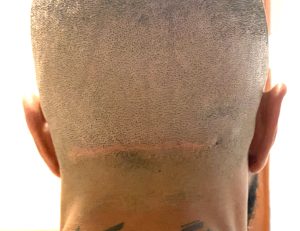 A:The scar question is a good one and is the most appropriate metric as to whether the surgery is worth it or not to a patient in my opinion. Like many aesthetic surgeries the question is whether the trade-off for the procedure would be viewed better than the initial problem being treated. In that regard I like to show this scalp scar picture of an occipitao scalp roll excisionk done by another surgeon which shows, in my experience, the worst scalp scar that I have ever seen from this procedure. The patient came to me for scalp scar revision. The relevancy of this scar picture is that one should decide on the procedure as to whether it is worth it based on the assumption that this is what their scalp roll excision scar would look like. As I consider this to be the worst case scenario. It is important to recognize that in considering any aesthetic surgery you don’t make the decision for it based on what you hope is the best result possible as that may not happen an is not completely predictable. Rather you make the assumption of the worst-case scenario and let that be the trigger point for doing this surgery or not. Therein lies the value of showing patients the worst-case scenario not the best scar result that has ever been seen.
Dr. Barry Eppley
World-Renowned Plastic Surgeon
Q: Dr. Eppley ,I’m getting asian eye surgery so I can maximize the look but I will try to keep a lot of the eye shape features the same from mine and the male models like a down turned medial canthas, and a narrow eye shape not too round like most asian patients get without thinking. Do you think it’s best to get the brow ridge implant first before the asian eye surgery?
And my mid face from the side does look flat not only because my forehead and brow ridge and eye area but because I dont have a good nose bridge because of my race, but thats the last thing I will get, because with most of those male models their brow ridge and nose look so well together like they are almost connected with perfect harmony etc so I will in the future get a nose job so it can match the brow ridge implant I get 2 to 4 mm if thats the right length needed without it being too much, visually my eyebrows might look a couple mm closer to my eyes because of the projection of the brow ridge?
But overall do you recommend no more than 2 to 4 mm projection of the brow ridge I’m aiming for the lowest my eyebrows can look visually and closer to my eyes which if thats a slight difference from going to high to medium thats a win, and with the asian eye surgery that will open my eyes slightly but not too much because a compact narrow eye shape is my goal still not like those anime or k pop looks that are the opposite to Sean oprey, Jordan barret, Chico lachowski, brad Pitts eyes, so that will add the illusion of my eyebrows being closer as well.
A: There is no question that the brow bone implant should be placed first as the swelling from that surgery could disrupt any concomitant or previous eyelid surgery.
You probably need more than 2 tio 4mms for the brow bone augmentation, 5mms forward and 3mm down would be the better implant measurements.
Dr. Barry Eppley
World-Renowned Plastic Surgeon
Q: Dr. Dr. Eppley,I am reaching out to inquire about doing a hairline raising procedure. I had facial feminization surgery about a year ago that included a hairline lowering procedure. This improved my temple recession. However, the surgeon also lowered the center of my hairline to avoid creating an extreme arch to my eyebrows. Overall, I am dissatisfied with how lowering my center hairline has impacted the proportion of harmony of my face. I am looking for options to extend my hairline up 1-2cm. Based on my research, I am under the impression this could be done by performing a two stage procedure. 1) leveraging a tissue expander to stretch the skin of the forehead 2) remove the tissue expander and remove a portion of the skin behind the hairline (behind the hairline to avoid making a weird hairline) to extend the position of the hairline up. Ive included pictures below of my current pic and a morphed ideal pic. Can you please let me know if Dr Eppley thinks he is able to achieve this?
A:Thank you for your inquiry and sending your pictures. As you have well explained what you are trying to achieve is an increase in the non-hair bearing upper forehead area of at least 1 cm or maybe even as much as 1.5 cm. The options to do so include the following:
1) Laser hair Removal. I would be remiss if I did not mention that this is always an option and it certainly the only nonsurgical one short of shaving/plucking. Its advantages are it is not surgery and it offers precise control of the location of the raised frontal hairline. You do have one advantage for laser hair removal in that you have dark hair in which it always works the best because of the darker pigment attraction. The obvious disadvantage is the need for multiple treatments to achieve the effect and whether you can get rid of 100% of the hairs..
2) Forehead Tissue Expansion. As you have previously described the surgical alternative is a four head tissue expansion followed by upper forehead flap advancement with excision of the undesired frontal hairline. Well this can be effective, as tissue expansion on a bonus surface has been around for 50 years now, there are some specific disadvantages. First and foremost the location of the tissue expander is going to be very prominent and will create its own temporary aesthetic deformity. The tissue expander really needs to stay in place for several months to allow the tissues to expand and properly relax. The relaxation phase is actually more important than how much it is expanded. The error in this approach that I see people do is they don’t believe the tissue expander and long enough for the understandable reason of its obvious presence. The second issue with forehead flap expansion is the potential for relapse. This can be largely overcome, however, by securing the advanced forehead flap to the bone. Thirdly, I don’t think you would be able to achieve a 2 cm expansion into the frontal hairline. Hey more realistic outcome it Is a 1cm advancement due to the naturally very tight tissues of the forehad
So as you can see the two stage forehead expansion and flap advancement is a straightforward concept. But wearing the expander on your forehead for the duration needed is the challenge of the procedure.
Dr. Barry Eppley
World-Renowned Plastic Surgeon
Q:Dr. Eppley, Hello, I’m interested in clavicle lengthening. I haver a 45cm bideltoid measurement. I’m tall even I’m proportional for my height, it’s a small bideltoid size. I would like to lengthen 2 cm per clavicle.
A:The most important question in clavicle lengthening is whether the procedure is worth it based on what can be achieved. Due to the limitations of the shoulder girdle soft tissue attachments the average amount of clavicle lengthening in my experience is in the 15 to 18 mm range per side, not quite 20 mms. That creates an effect that is roughly equivalent to what it looks like if you roll your shoulders backward with so-called perfect posture. That is the change that occurs as the oblique orientation of the clavicles drives the shoulders out and back. It is probably best to think of it as shoulder squaring rather than shoulder widening per se. What that means to you can be seen in the attached imaging on what I think can be accomplished with the amount of clavicle that is possible.
Dr. Barry Eppley
World-Renowned Plastic Surgeon
Q: Dr. Eppley,Hi doc  I wanted to ask how much narrowing can be done typically for shoulders ? I know it varies but just curious about the possibility – and also do you suggest getting breast implants before this procedure or after ?
A:The typical amount of clavicle shortening per side is 2.5 cm. The best way to appreciate what that means is to see some pictures of your shoulders and to do some imaging as to what that effect may be.
In regards to breast implants I don’t think it matters whether they are done before, during, or afterwards. The only thing that matters for make timing standpoint is that if it is done after shoulder narrowing surgery it should be at least 3 to 4 months before doing so.
Dr. Barry Eppley
World-Renowned Plastic Surgeon
Q: Dr. Eppley, Could you please in addition let me know the following:
– how long in advance do I need to be in the clinic (time needed for preparation of the skull implant);
– how long after the surgery do I need to stay in the USA for the post-treatment?
– what is the material that is used for skull implants?
– what is the percentage of the alopecia cases?
– does the alopecia needs treatment?
A:1) All custom implant designs are done through a virtual process, not on site.
2) 3 to 5 days
3) Soldi Silicone
4) 0.01%
5) Shock hair loss is not an issue if the implant design does not exceed the capacity of the scalp stretch. in other words let me make then design by what I know is best to avoid that potential issue.
Dr. Barry Eppley
World-Renowned Plastic Surgeon
Q: Dr. Eppley, I am strongly considering a subtle chin and paranasal augmentation procedure. I’ve been genetically gifted with a small jaw and huge cheeks, now that I’m in my mid-30s and the fat pads have decreased, all my sagging soft tissue is hanging out below my jawline. I’ve consulted several doctors, and they advised a full facelift to excise the excess SMAS. I’m looking to achieve a more balanced heart shaped face based on my natural foundation, and prefer permanent methods that will factor in facial bone loss from aging. 1. Should I do the facelift or the structural augmentation first? 2. How long should I wait in between procedures? 3. Would a chin implant or sliding genioplasty be better for my anatomy / situation? approximately how much advancement? I’m ok with my chin’s vertical length and just want to increase its projection. 4. What kind of implant material would be best for my paranasal area? I mainly want to correct how sunken in my nostrils look and soften the appearance of nasolabial grooves. 5. The left side of my face is more structurally sloped than the right, exacerbating the appearance of asymmetrical nostrils. Is it advisable to try to correct for this with paranasal augmentation? Thank you for your expertise.
A:Thank you for your inquiry and sending your pictures. As a general statement you always want to make whatever structural changes are needed first before you manipulate the overlying soft tissues. In some cases the bony procedures hey obviate the need for significant soft tissue changes such as a facelift. Whether that would happen or not cannot be predicted beforehand but I think you always want to address the foundation first onto which the soft tissue envelops.
For the chin I have done some imaging to determine the magnitude of horizontal projection you may find acceptable. As a general rule in females one has to be very cautious about too much horizontal projection and I would estimate what I have image to be about 5 to 6 mm. Whether this is done by an implant or a sliding genioplasty can be debated, and this amount of forward chin projection can be accomplished by both, but usually moving the bone is better for the submental areas and the contour of the neck to reduce its fullness. One should always do some submental liposuction on the underside of the chin anyway to optimize the result.
For the paranasal augmentation I currently prefer ePTFE paranasal implants which works quite well and the tissues integrate into the implant’s surface. The asymmetry of your nostrils is only partially contributed to by the underlying bone. You also have alar rim retraction which is not going to be solved by paranasal implants.
Dr. Barry Eppley
World-Renowned Plastic Surgeon