Your Questions
Your Questions
Q: Dr. Eppley, My main concern is that my brows sit a little high and give me a softer, more feminine look. Ideally, I’d like to lower or reshape them into a stronger, more masculine angle if that’s technically possible. If it’s not feasible, that’s okay too — I’d just like your expert perspective on whether downward repositioning or an alternative adjustment makes sense in my case.
A:Thank you for your inquiry and sending your pictures. Based on my assessment of them I believe what you have is hey differential brow shaped where the tale of the brow is higher than they medial or inner brow area. If the outer half of the brow was more even with that of the inner brow area then I think you would be more satisfied with their shape. Unfortunately there is no reverse brow lifting procedure which could differentially lower the outer half of the brow area. What I would recommend is to initially with eyeliner fill-in the lower half of the outer brow area and see what that looks like. If you find that change successful then you have the options of either micro pigmentation or, more ideally, eyebrow hair transplantation. Either approach would allow for a more controlled brow reshaping
.
Dr. Barry Eppley
World-Renowned Plastic Surgeon
Q: Dr. Eppley, I feel self conscious about my profile, specifically the maxillary area and the more downward grown midface. I want to achieve more skeletal support to have a more modelesque appearance. I don’t know what can be done . I feel specifically on profile, my jaw is more rotated down and back and goes at a bad angle. I don’t know what to do.
A:Thank you for your inquiry and sending your pictures. The pictures are not of the greatest quality to make an ideal assessment or do any imaging. But what they demonstrate as best as I could see is that you have a classic conundrum in terms of facial projection. You lack ideal forward projection of the midface and the mandible. This can either be addressed by double jaw surgery or implant augmentations. Each approach has its merits as well as its indications. The logical first approach’s to get an evaluation by a maxillofacial surgeon to determine whether double jaw surgery advancement would be beneficial and whether you want to go to that effort. You only consider implants when you have made the determination that double jaw surgery is either not indicated or it is simply not a surgical approach which you want to do.
Dr. Barry Eppley
World-Renowned Plastic Surgeon
Q: Dr. Eppley, I am a plastic surgeon from Beijing, China. I read with great interest your article published in ASJ on hip augmentation with implants (Evolving Clinical Experiences in Aesthetic Hip Implant Body Contouring) and truly admire your design of the prosthesis. I am also considering performing hip augmentation surgery with implants for my transgender patients.
I have a question and would like to seek your advice: Beyond the mid to long-term postoperative period (i.e., beyond 3 to 6 months after surgery), can patients perform movements such as deep squats, cycling, or yoga? Will they experience discomfort or even compromised stability of the implants? I suspect that when hip flexion exceeds 90 degrees, the deformation of soft tissues around the implant area may exert significant pressure on the prosthesis. I would appreciate your insights on this matter.
A:Thank you for your thoughtful inquiry. In terms of long-term outcomes from hip implants I have no concerns that the patient will experience discomfort or compromised stability of the implants in any type of physical maneuver. However what is more pertinent is that in some movements such as signifincat hip flexion it may be possible in thin patients to see some of the outline of the implant as the soft tissues change or stretch over the implant in different leg positions. This is, of course, an aesthetic concern and not a functional one. But it is important to point out preoperatively that this will likely occur and is not a rare or unexpected outcome. It is just the nature of putting an implant in an area where the soft tissue cover will change with dynamic motion while the implant form will remain the same.
Dr. Barry Eppley
World-Renowned Plastic Surgeon
Q: Dr. Eppley, Interested in a 2cm forehead reduction.
A:The amount of frontal hairline advancement that can be achieved is controlled by the natural elasticity of the scalp. as it is the entire that actually shifts forward in the procedure. There is no accurate predicting before surgery how much movement can be achieved. Whether that would be 2 cms is unknown but that amount would not be expected for most patients.
Dr. Barry Eppley
World-Renowned Plastic Surgeon
Q: Dr. Eppley, I have what I believe to be chin ptosis from a chin implant I received last year. The dr kind of refused to acknowledge the problem and instead replaced the implant with a smaller one and the issue remains. Is this something Dr Eppley could address? I had consulted a different surgeon and he’d recommended an oral maxilofacial surgeon but I hope it’s chin ptosis that can be repaired.
A:You are referring to a submental chin pad excision/tuck which is the most effective to chin pad laxity…which is not uncommon after chin implant removal or chin implant downsizing.
Dr. Barry Eppley
World-Renowned Plastic Surgeon
Q: Dr. Eppley, Are you all able to also to do 3D models how the person will look after the face implants? Thank you.
A:While the concept of creating custom facial implant designs on the patient’s 3-D skeletal model and then knowing exactly what the aesthetic outcome is would be extremely helpful. However that technology with any accuracy does not yet exist. There is yet no known precise correlation between the push of implants on the bone and exactly how anyone’s very different overlying soft tissues will respond. Currently custom facial implant designs are done based on the patients desired the preoperative changes on their pictures via prediction imaging which serves as a target for the design. This works very well for most cases provided the surgeon is a tremendous experience in doing custom facial implants And has a good feel for how to make designs have a certain aesthetic effect.
Dr. Barry Eppley
World-Renowned Plastic Surgeon
Q: Dr. Eppley, So my goal is to achieve a natural look as possible. I feel like the height of the ramus is short. The gonial angle i would like to make better. As well as a bit of width projection. As far as the jaw I like the more concave look rather than it being super square, and as far as chin I feel like i do need a bit more projection there as well. I will attach a picture I just took now trying to tuck my beard as much as I could. I’m gonna also attach a picture of my father when he was younger. Also attaching a picture of what I feel I think is that concave look. And I will also be cutting my beard fully by the end of the month and send pictures than as well. I feel like the last renderings were just very square for me. I wanna improve the height of my lower face and also that concave swoop with the jawline rather than it being super square lines.
A:The ability to have the so-called concave swoop to the face only occurs in patients who have thin overlying tissues. In other words you really have to have it initially and a jawline implant is not really going to create it in most people. Your facial soft tissues are not thin and therefore I would not expect that to be a resultant effect. You are trying to sculpt your face for more definition, which is certainly understandable, but thicker tissues largely prevent that from happening the way patients would ideally want. While it is true you can create that effect in a thicker tissue face but the implant has to become so big to make that happen that it becomes unnatural and disproportionate to the rest of the face. That is a long explanation to simply say your expectations are not achievable in terms of definition. Patients send me model face pictures all the time that look like the one you sent. However you have to recognize that those are extremely Photoshopped and altered images and are not real. I can’t create unreal outcomes. I have to do the best I can with the face and the soft tissues that are presented to me.
Dr. Barry Eppley
World-Renowned Plastic SurgeonCan I Get
Q: Dr. Eppley, I had a sliding genioplasty recently, but unfortunately the result wasn’t what I expected. My chin doesn’t look like it used to, and I’m really hoping to restore it to its original position. I’m planning a revision about two months after the first surgery.
Do you think a full reversal is possible in a case like mine? And is it generally easier to move the bone back if the revision is done this soon?
I’d really appreciate your opinion. Thank you so much for your time!
A:Thank you for your inquiry and sending your images. What would be helpful to know is:
1) what was your objective in having the sliding genioplasty?
2) What were the exact bony movements that were done?
3) Do you have any before or after x-rays?
Such information is critical in determining whether you should consider a sliding genioplasty reversal, whether it should be subtotal or complete as well as when might be appropriate to do it.
But the most important question is whether you really do ned to reverse it…and that is best unwon 3 to 4 months after the surgery when you are looking at the final result AND you have had some time to adjust to the facial change.
Dr. Barry Eppley
World-Renowned Plastic Surgeon
Q: Dr. Eppley, do I need to was it 6 months before trying to reverse my hairline advancement?
A:I don’t see the benefits of waiting six months after the original surgery to place a forehead tissue expander from a healing or biologic standpoint.
From a psychologic standpoint I could see the benefits of waiting six months as it is always possible how patients feel shortly after a facial change with more time they could come to accept the result. The psychology of this is that you have lived your whole life looking a certain way and when you make a change you may not recognize yourself and wish to return to how you did look (go back home). And for some people time can allow one to accept the change and avoid additional surgery.
Dr. Barry Eppley
World-Renowned Plastic Surgeon
Q: Dr. Eppley, Can my overdone sliding genioplasty be reversed?
A:Thank you for sending your x-rays. While there is not a side view after x-ray, which provides important information as to how much forward and downward bone movement was actually done, I can see in the Panorex that there are bone gaps which suggest there was vertical elongation.
That being said the bone movement can certainly be fully or partially reversed. As to which is the best approach to take I think one has to go back as to why you have the original surgery. It was clear in your lateral preoperative x-ray you had a short chin. Therefore there were merits as to some forward movement, not vertical elongation, but not to the extent which your surgery was done. Surgeons often overlook the difference in the magnitude of chin augmentations that are tolerated between men and women. The point being that subtotal reversal is likely the most prudent approach as you would certainly like to have some benefit for having to go through two surgeries. The only question remains as to how much reversal should be done. As a general guideline in these situations it is usually 50 to 75% of the horizontal movement done.
Dr. Barry Eppley
World-Renowned Plastic Surgeon
Q: Dr. Eppley, I also sent pictures of a model of my jaw. I just want to know if Dr. Eppley is amenable to vertically shaving off 4 mm from my chin to reduce its vertical height. I prefer the submental approach since I already have a scar there and I do not want to get a procedure where there is cutting. Thank you
A:Thank you for sending the pictures of your model which clearly shows a 4mm inferior border ostectomy of the chin which I have done many times. Besides the submental approach the keys to the procedure are the resuspension of the geniohyoid muscle back to the bone and the removal of some created excessive soft tissue chin pad from the bone removal which creates a loss of soft tissue support. If these adjunctive soft tissue procedures are not done it will create some residual soft tissue chin ptosis.
Dr. Barry Eppley
World-Renowned Plastic Surgeon
Dr. Eppley,I’ve considered for many years a genioplasty for a modest increase to the vertical length of my chin/face. Not looking for a super sharp chin, I know many Asians love the vline but I want to keep the shape but create a little more length (but also not widening). A lot to ask I know! Would a genio be the best solution or can I achieve this with an implant? Thank you!
A:Thank you for your inquiry and sending your pictures. For the modest amount of vertical lengthening you likely desire it could be done either within an implant oor a vertical bony genioplasty. But since you are not looking for a super sharp chin shape (meaning you are happy with the current shape of the front of the chin), that it would take it a custom chin implant design to do pure vertical lengthening, and to avoid the lifelong presence of an implant which is optimally placed for a vertical chin implant through a submental incision, the vertical bony genioplasty would be the preferred choice. With this approach you can select the amount of vertical lengthening you want right up to the actual surgery time based on preoperative measurements and once healed you would never have to think about your chin again given that it was done with your own natural bone. I find that surgeons, particularly those that only do chin implants, make a big deal that the recovery from a bony genioplasty is so severe. But in my extensive experience with chin surgery there is really not a whole lot of difference between an implant and a bony genioplasty when it comes to recovery.
Dr. Barry Eppley
World-Renowned Plastic SurgeonDo I Need A
Q: Dr. Eppley, I know there is too much facial fat on my face but given the progress of cosmetic surgery with you as a pioneer over the last decades, I am mailing you with interest for facial aesthetic surgery.My goal is to achieve a balanced, masculine facial structure with stronger midface and jawline proportions, while maintaining natural harmony. My bite and airway are normal, so I am looking for aesthetic contouring rather than orthognathic movement so I don’t want to go for Double jaw surgery, rotation etc .I am interested in customized facial implants (malar / paranasal / chin / jawline) and if these can be combined with rhinoplasty in one session.
Could you please give your opinion on
1. Can aesthetic cosmetic surgery be performed on me to achieve my goals.
2. Can a combination of implants be done on me to augument my upper and lower face.
Please let me know your thoughts on the above.
Thank you very much
A:The question is not whether you can have custom facial implants and a rhinoplasty at the same time. This combination of facial reshaping surgeries is done regularly. The more relevant question is how effective would they be in terms of achieving your goals. You have one major limiting factor in achieving any semblance of a more defined face and that is of the extensive soft tissue fullness particularly in the cheeks and lower third of the face and neck. While it is true that implant and bony augmentations can stretch out the facial tissues and help create improve definition and shape but the amount of augmentations you would need to do would be very extreme and would make your face too big and still without any desired definition. Even combined with extensive facial and neck defatting I would question whether the augmentations can overcome the soft tissue thicknesses. My concern would be, particularly of the lower third of the face and the jawline is that all you would do is just make your face full or and heavier.
That being said I don’t think the concept of jumping in and doing all of your indicated procedures would be the prudent thing to do for the reasons I have described. A more relevant plan in my opinion is to do the extensive facial and neck defatting with a rhinoplasty and a bony genioplasty and then see if further augmentations may be beneficial. At least with this approach you’re not going to make anything worse or heavier in appearance and you will likely make some facial improvements even if they might not me your ideal expectations. If there is a very positive response to these initial procedures then you can consider additional augmentations on a more favorable facial shape.
Dr. Barry Eppley
World-Renowned Plastic Surgeon
Q: Dr. Eppley, I had an endoscopic brow lift earlier this year and the result is over-done. I never wanted my brows lifted this high. My goal was a subtle, more youthful look at the temples because I am still young. Now the middle of my brows sits far too high, and it has completely changed my expression. My eyes look hollow and indented, and my face no longer looks like me. When I gently press my brows down to where they used to sit, they move easily and the appearance looks natural again.
A:An endoscopic brow lift works by what is known as an epicranial shift… meaning the brows are lifted because the entire scalp is mobilized and pushed backwards. No scalp or forehead tissues are removed as in numerous other traditional brow lifting techniques. It is not a procedure where there is a precise control of only portions of the brow and usually the full arch of the brows are lifted.
Reversing an endoscopic brow lift requires an epicranial shift in the opposite direction towards the brows bringing the entire scalp foreard to push the brows back down. Just like in the original brow lift procedure there’s not going to be precise control of only a limited portion of the brows, the ful larch of the brows is likely going to come down. The fact that you can manually push your brows down into the desired position is favorable in having a positive reverse epicranial shift result.
Dr. Barry Eppley
World-Renowned Plastic Surgeon
Q: Dr. Eppley, I had a sliding genioplasty several years that I am interested in revising The initial genioplasty only dealt with horizontal chin projection and now I am unhappy with the shape of my jaw. I believe a revision with some vertical chin projection would help with this.
A:Thank you for your inquiry and sending your picture. It appears that your sliding genioplasty as you have mentioned, was purely horizontal in it’s dimensional change. For a female that amount of horizontal projection looks a little bit strong. As a result of the pure horizontal projection the mandibular playing angle is also disrupted. As you have astutely surmised adding some vertical length, which would also reduce the horizontal projection by a millimeter or two, would provide an improved aesthetic outcome overall as predicted in the attached image. How much vertical lengthening you need is probably in the 5 to 6 mm range although that is up to your preference…. meaning you could have more or less depending upon your aesthetic desires.
Dr. Barry Eppley
World-Renowned Plastic Surgeon
Q: Dr. Eppley, I’m interested in pursuing full facial liposuction to achieve a more defined, chiseled facial contour. I am hoping for a face that is smaller, sleeker, and more angular.I’m specifically looking for a comprehensive procedure targeting areas such as the jowls and cheeks to enhance overall facial definition. I am interested in facial fixes and angulation. I am open to your recommendations.
Thank you for your time and expertise. I look forward to hearing from you.
A: Thank you for your inquiry and sending your pictures. The first concept to grasp is it is virtually impossible for most people to ever reduce their face into a more defined chiseled appearance and make it smaller. Surgeons try this all the time with face and neck liposuction to create improved facial definition but it never works unless one has a naturally lean face with little fat…which means they don’t need surgery anyway. The limiting factor is always going to be the thickness of the skin as well as the underlying soft tissues including muscle. In other words the two desires….improved definition and smaller…is not achievable.
This does not mean that liposuction or defatting does not have a role in improving facial contours…. but it is best thought of as an adjunctive procedure rather than having a major facial defining effect. In most patients seeking improved facial definition there has to be some form of augmentation either in the chin or cheek area. It is more achievable to augment one’s way into improve definition but one obviously has to be careful do not make the face substantially bigger in doing so. Thus the most effective approach for most patients is the combination of augmentation and reduction.
Another concept to grasp is that there is no such procedure as full face Liposuction. There are only two areas of the face in which to perform such fat reduction and that is in the cheek trampoline area (between the cheeks and the jawline) and in the neck. The the cheap defatting procedures include buccal lipectomy, perioral – lateral facial light liposuction and buccinator myectomies.
All of that being said in looking at your face I see merit in the three cheek defatting procedures possibly combined with a very small v-shaped chin augmentation (see attached imaging) there may also be a role for a very small cheek implants but I am more reserved about that in your face initially.
Dr. Barry Eppley
World-Renowned Plastic Surgeon
Q: Dr. Eppley, I need infraorbital implants that saddle. What do you think based on my pictures and x-rays?
A:By definition custom infraorbital implants always have a saddle component to them. That is one of their primary benefits as saddling the rim is the only way to try to improve lower lid position. The increased vertical dimension also allows for more horizontal projection without creating increased undereye hollowing.
Dr. Barry Eppley
World-Renowned Plastic Surgeon
Q: Dr. Eppley, Hello, I was wonder could this be corrected? I have buttock ptosis/drooping.
A:What you have is buttock ptosis but with a well defined infragluteal crease. This is solved by a lower buttock excision/tuck.
Dr. Barry Eppley
World-Renowned Plastic Surgeon
Q: Dr. Eppley, That’s an example of the procedure I’m talking about. Upon searching, I believe it’s called smile line implants.
A: Those are paranasal/labiomental fold implants…which has nothing to do with face shortening or surgery to try and accomplish that effect.
Paranasal implants augment the nasal base area and may indirectly reduce the depth of the upper nasolabial fold area by the side of the nose and increase nasal base projection.
Dr. Barry Eppley
World Renowned Plastic Surgeon
Q: Dr. Eppley, I want to remove a big chin implant but I don’t want extra skin. I’m looking for a surgeon. When I smile its not really fitting to my face. People have suggested just taking it out but I rather fix the extra skin too.
A: I believe you are referring to the concomitant procedure of chin implant removal with submental chin pad resection.
Dr. Barry Eppley
World Renowned Plastic Surgeon
Q: Dr. Eppley, I’m interested in a forehead contouring procedure that goes beyond the standard “brow bossing reduction.” My main concern is the lateral width and curvature of my forehead. I would like to achieve a narrower and more compact forehead, with a softer transition from the upper lateral forehead (above the tail of the eyebrow) toward the temporal region. I’m not referring to the central bossing or frontal sinus area — my goal is a bony reduction and reshaping of the outer table in the lateral and superior forehead zones, possibly extending to the fronto-parietal junction. From what I understand, this might be considered an “extended forehead contouring” or “fronto-temporal reduction” procedure. Could you please let me know: • Whether you perform this type of contouring (not just Type I shaving). Thank you for your time and expertise.
A: That type of forehead reshaping/reductive contouring is very common in my practice. Sucfh reductions can be done within the limits of the bone thickness. Fortunately the forehead is the thickest at the sides along the bony temporal line for the tail of the brow bone up to behind the hairline. You have correctly identified its proper name, Fronto-Temporal Reductions.
Dr. Barry Eppley
World Renowned Plastic Surgeon
Q: Dr. Eppley, I have a lot of neck sagging and lack of jaw prominence and s short chin. I would like a total jaw augmentation as well as a necklift. What do you think?
A: Thank you for your inquiry and sending your pictures. Your case poses a bit of a conundrum as the jaw augmentation and the neck lift are linked, not only by anatomic proximity but by their aesthetic effects. Normally in older men with more modest signs of jowling and neck sagging can be adequately improved by the placemcent of a custom jawline implant alone. But your degree of neck sagging is too advanced for the effects of a jawline implant alone to adequately address it. In fect the posterior 2/3s of a jawline implant would not be seen at all. Only the effects of the chin portion would be able to be seen. Thus a necklift (full lower facelift) is absolutely needed.
Point #1. You can have a necklift without jaw augmentation but you should not have a jaw augmentation without a necklift.
A custom jawline implant and a necklift can be combined but that makes for a challenging recovery particularly in terms of swelling. The normal swelling from a jawline implant could have a negative effect on the necklift results.
By its open exposure at the back of the jaw angle and ear a necklift provides the opportunity to use that exposure for aid in placing the jaw angle portion of a custom jawline implant. But due to thicker tissues in men that is more challenging to do so than in women
Point #2 A necklift and custom jawline implant can be combined but should they??
Ideally one would have a necklift first and then a custom jawline implant secondariy. And one could argue that to maximze the benefits of both this is how it should be done. An altternative strategy, and an historic one, is to combine a necklift with chin augmentation. Get the most forward part of the jaw more projected as chin augmentation has no negative effects on the results of a necklift and actially makes its results even better. The needed submental incision for the central part of the necklift provides a convenient opportunity to place an extended chin implant. If a total jaw augmentation effect is desired later the expansion of the chin soft tissues makes the placement of a custom jawline implant a bit easier.
Point #3 An amalgamated approach of a necklift and chin augmentation blends the two surgeries without making the recovery more difficult and provides some structural enhancement to the necklift as well.
In conclusion the two approachs and their advanatges and disadvantages are:
#1 Necklift + Ciustom Jawlne Implant = One stage approach, maximum recovery but with maximium result. The swelling from the jawlijne implant may have a slightly negative effect on the necklift result.
#2 Necklift + Chin Implant = Two stage approach, more traditional necklift recovery, gets some of the jaw augmentation benefits, one may or may not go for more complete jaw augmentation later.
Dr. Barry Eppley
World Renowned Plastic Surgeon
Q: Dr. Eppley, Will my labiomental fold eventually soften? I had a 5 mm sliding genioplasty 5 weeks ago, and around weeks 3.5 to 4 I noticed a really deep crease in that area. It’s worrying me that it might stay like this. My surgeon says I’m still swollen based on my photos, but my bottom lip feels tight with certain movements and my smile still isn’t back to normal. Will that crease improve after the full 3 months of recovery, or is this likely how it will look? Thank you!
A: The full effects of a sliding genioplasty, like any facial bony reshaping procedure, wil be fully seen when all swelling has resolved and the soft tissue shrink wrap effect will have occurred. This is around the 3 month postoperative time period. It is fair to say that with any chin augmentation procedure, implant or bony advancement, the labiomental fold is going to get deeper. This is an expected and unavoidable sequelae of the surgery. The question is never whether the labiomental fold will get deeper but by how much. As for lower lip tightness longer postoperative time periods are needed to determine that outcome.
Dr. Barry Eppley
World Renowned Plastic Surgeon
Q: Dr. Eppley, My concern is that my lower face appears vertically short, which makes my neck seem longer and my head proportionally smaller. When I relax my jaw slightly (keeping my lips closed), my face looks noticeably more balanced, which makes me think I might have lower facial vertical deficiency.I’m interested in understanding whether a vertical lengthening genioplasty could improve overall balance and create a more proportional facial appearance. I want my head to appear bigger because my neck seems way too long compared to my small face. I look forward to your feedback.
A: By your own description and more open jaw positioning you have demonstrated that vertical lengthening of the jawline, or even the chin, creates better craniofacial proportions. You can call this a lower facial deficiency or a normal jaw development that looks better if it had more vertical length. Either way the more relevant question is how much vertical lengthening of the chin is needed.
Dr. Barry Eppley
World Renowned Plastic Surgeon
Q: Dr. Eppley, Hi, I’m interested in a temporal skull implant, but i wanted to ask, how many centimeters can i add to my skull circumference with this implant? I want to make the temporal area more full
A:Thank you for your inquiry and sending your pictures to which I can make the following comments:
1) Head circumference is a useless aesthetic measure and is not how you determine the effects of temporal augmentation. Temporal augmentation is a function of how much linear increase in width can be created and what effects does that look like in the front and back views.
2) As a general guideline 5 to 7 mm temporal width increases work well for most patients and the maximum amount of lateral width is 9 mm.
3) Using the average amount of temporal with increase on your own pictures this is probably what would likely be close to the result.(see attached imaging)
Dr. Barry Eppley
World-Renowned Plastic Surgeon
Q: Dr. Eppley, Could a Custom Jawline be done in PEEK/Titanium?
A:Yes, it is done all the time. It costs more but it can be done. Also be aware that the dimensions of the implant will be smaller when composed of these rigid materials as they pose placement limitations.
Dr. Barry Eppley
World-Renowned Plastic Surgeon
Q: Dr. Eppley, I underwent a custom implant treatment on the occipital area (right side) at your clinic earlier this year. I’m very satisfied with the results, but I’m missing a little volume just above my ear (lower right occipital area), so I’d like to have additional surgery.(I don’t think it needs to protrude much.) I have a few questions: 1) Is it possible to undergo surgery again? 2) Is it okay to insert new implants on top of previous implants? (I’ve seen a question from a patient who underwent surgery with stacked implants. Is there any problem with that?)
A:Good to hear from you and I am pleased to hear that you had a successful surgery with the satisfied result. It is not rare that a custom skull implant patient may want a little additional volume later. In those cases what is used is an overlay implant which fits on top of the existing implant. That can be a very successful strategy as long as the amount of additional implant volume is not excessive…. which in your case does not appear to be so.
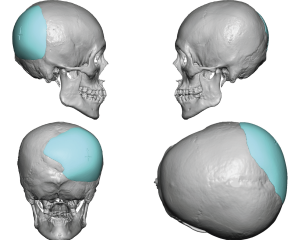 What I would do is go back to original implant design file and mark on it where you want the additional volume is needed. I have attached some pictures of your implant design for you to do so.
Dr. Barry Eppley
World-Renowned Plastic Surgeon
Q: Dr. Eppley, Interested to see what procedures are worth it for me, insecure about my side profile, especially lower jaw and chin. DJS, LJS, or sliding genioplasty?
A:Thank you for your inquiry and sending your x-rays. However, X-rays are not the means by which you determine the appropriate strategy for any facial reshaping surgery. Such strategies are determined by looking at the patient’s pictures and doing predictive imaging of various facial changes And seeing what the patient prefers. Then and only then are the x-rays potentially useful as the platform in making such as in planning DJS or making custom implants. But x-rays by themselves do not provide meaningful direction for determining optimal aesthetic changes
Dr. Barry Eppley
World-Renowned Plastic Surgeon
Q: Dr. Eppley, I am a woman interested in a minimal forehead augmentation, and I would like your advice. I have attached reference photos to show my desired result, and I would like to know if this outcome is realistic and achievable. I would also like to schedule a virtual consultation with you. In preparation, I have a few questions: Is it possible to receive a digital rendering or simulation of the expected results during consultation? What are the requirements before undergoing this procedure? What is the typical recovery process like, and how long does it take? Will there be any changes to the hairline, baby hairs, or overall hair growth? What type of scarring should I expect, and how does healing progress in the long term? Between implants (standard or custom) and fat grafting, which would you recommend in my case, and what does each option involve? Is the procedure permanent, and if so, is it reversible if needed? Are there specific instructions for aftercare, including what to avoid during recovery? I am also considering rhinoplasty. I was wondering which of the two procedures would be best to do first? Or is there no importance regarding order? Since I am an international patient, I would also like to know what arrangements are available for hospital stay, local accommodations, and overall patient support?
A: Thank you for your inquiry and sending your imaged forehead augmentation results. Indeed this would be considered a minimal forehead augmentation of but a few millimeters. In answer to your questions about this potential procedure:
1) there is no question that the only way to do it is with the custom implant design. This type of change is so specific that it had better be absolutely controlled before surgery in every dimension. Contrary to the popular perception of many the more limited the patients desired result is the more precise the whole surgical process must be. A custom forehead implant would also be completely reversible. Such a forehead implant design is done based on a 3-D CT scan that you get really live. The whole implant design process is done virtually and there is no reason for you to come here for. You’re only come once for the actual surgery.
2) this is a procedure that would take one hour to do under general anesthesia as an outpatient.
3) Because the forehead is a nonmoving bone like the rest of the skull the recovery from a physical standpoint would be very minimal. It is just about swelling and how long that takes to go down to look more normal which would be 7 to 10 days after the surgery.
4) whether one does rhinoplasty before, during, after such for head augmentation as a matter personal preference. From a technical standpoint one procedure is not influenced by the other. Aesthetically, however that may be different. Therefore you have to decide which one of the procedures is most important, if there is one, and then let that be your guide as to the order of the procedures.
5) Every patient in my practice is just like you. We have no one from here locally. Therefore every day we manage people who fly in for surgery and then leave. This is a procedure where you only come in the day before the surgery where we formally meet, have surgery the next day and there’ll be no reason for you not to return home within a day or two after the procedure. There will be no benefit to sitting here waiting for the swelling to go down before you return home. You can but ultimately what we really care about is does this look like 2 to 3 months after the surgery when you know what 100% of the result really is.
Dr. Barry Eppley
World-Renowned Plastic Surgeon
Q: Dr. Eppley, Hi, I have a pronounced sagittal crest which then transitions into a flat angled shape at the back of my skull. I was hoping to understand whether a mix of surgery and implants could correct the shape without making the skull overly-large looking? Happy to schedule a consultation if you believe this is something you could help with. Many thanks,
A: The combination of a sagittal crest reduction and augmentation to the upper back of the head is certainly a very straightforward procedure to do if that would be the appropriate resolution to a better head shape for you. In that regard I would need to see some pictures of your head to confirm that that would be the appropriate approach.
Dr. Barry Eppley
World-Renowned Plastic Surgeon